
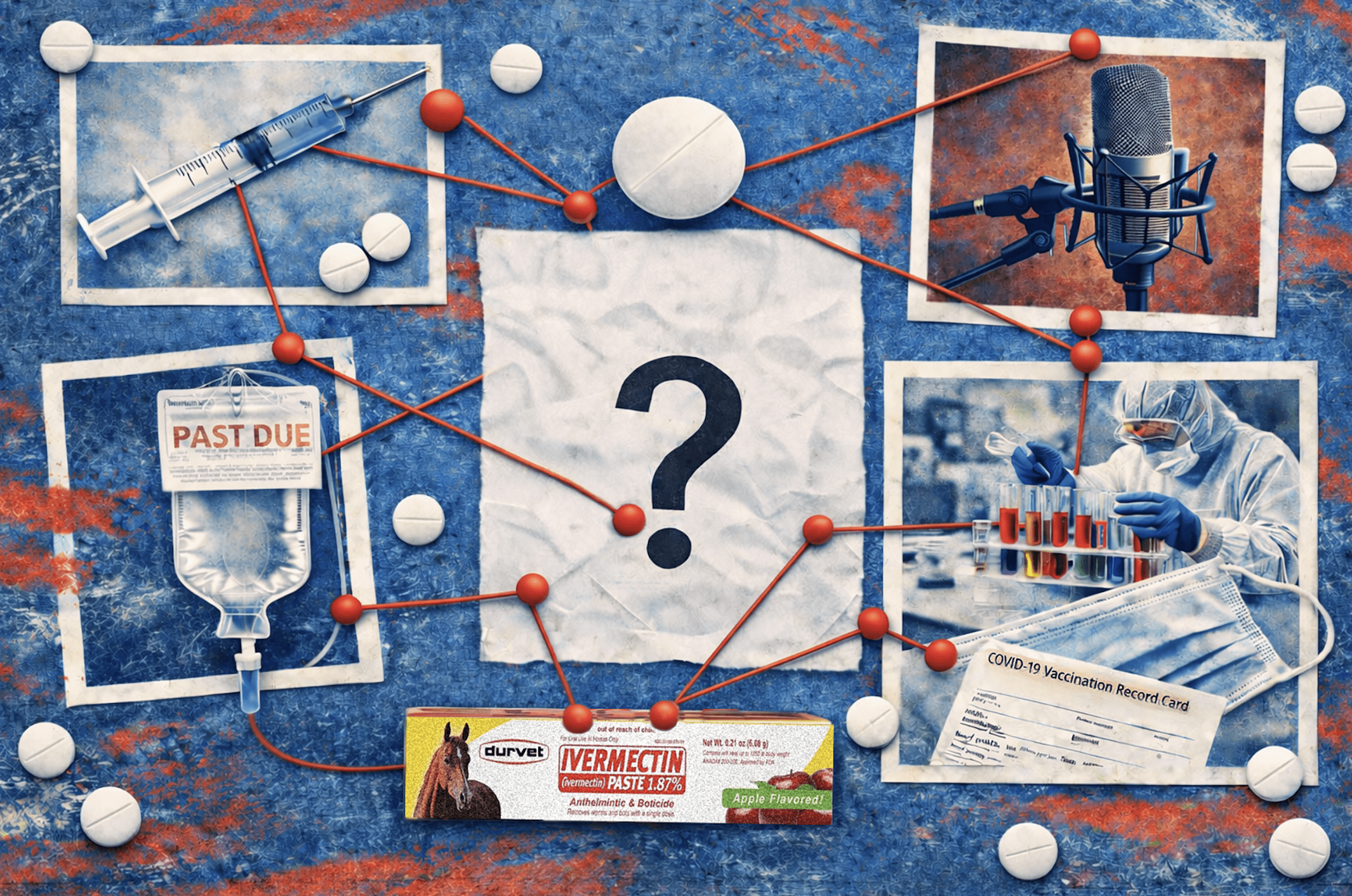
Ivermectin Isn’t a Proven Cure. So Why Do So Many People Believe It Is?

April 30, 2026
1 Comments
republish Shedding Light on the Risks
& Benefits of Medications
Shedding Light on the Risks
& Benefits of Medications Once promoted as a COVID-19 treatment, ivermectin — along with the veterinary drug fenbendazole — is now being touted online as a cancer cure, driven by viral anecdotes and early research that scientists say falls far short of proof
|
Getting your Trinity Audio player ready... |
“This has worked miracles for me,” said Kevin Town, a 55-year-old YouTube creator from Ashville, New York, as he held up two white tubes in a video posted January 4, 2026.
The tubes contained ivermectin and fenbendazole paste — products marketed as horse dewormers that Town says he bought at a local Tractor Supply store. But to Town, these were more than medications for livestock: They were an affordable and effective alternative to the conventional cancer treatments that, over the span of a year, had drained his savings and left him feeling sicker.
According to his video posts, Town was diagnosed with kidney cancer in September 2024. In November of that year, he underwent a nephrectomy, a surgery to remove his left kidney. Nine months later, Town learned his cancer had progressed and spread to his bladder and prostate. He underwent another painful procedure to remove the tumors, but his doctors told him it wasn’t enough.
“They said, ‘In order to save your life, we have to remove your bladder and your prostate at the same time’,” Town recalled in his video. He said the surgery would leave him using a urostomy bag for the rest of his life.
“I told them I didn’t want that done,” he explained.
Facing the cost of ongoing appointments and prescriptions, Town decided to try an alternative solution: He bought ivermectin and fenbendazole, treatments he said he had discovered through online posts, including from some medical professionals. He said he alternated between the two, taking each daily for a week, then switching to the other.
In his January 4th video (which has since racked up more than 21,000 views), Town says that after four months of taking the $17 veterinary drugs, he felt healthy again.
Town, who declined MedShadow’s request for a direct interview, has continued to post updates on his health on YouTube.
On April 10, Town told his viewers he had returned to his primary care doctor for the first time in seven months. He said his doctor was “absolutely amazed” at how good he looked and that he had not experienced any cancer symptoms since the previous year.
In a video uploaded on May 15, the last one Town posted before this article’s publication, he holds up the results of a CT scan, blood work, and a urinalysis, and tells viewers his doctor had found “no sign of cancer at all.”
Ivermectin and fenbendazole were approved by the U.S. Food and Drug Administration (FDA) in the early 1980s — in 1981 and 1983, respectively — to treat parasitic infections in animals, including dogs and cattle. Unlike ivermectin, which was later approved to treat onchocerciasis, or river blindness (a severe eye and skin condition caused by parasites that breed in flowing rivers) in humans, febendazole remains approved only for veterinary use.
According to Google Trends data, Interest in these antiparasitic drugs, particularly when combined with the word “cancer,” surged in 2024.
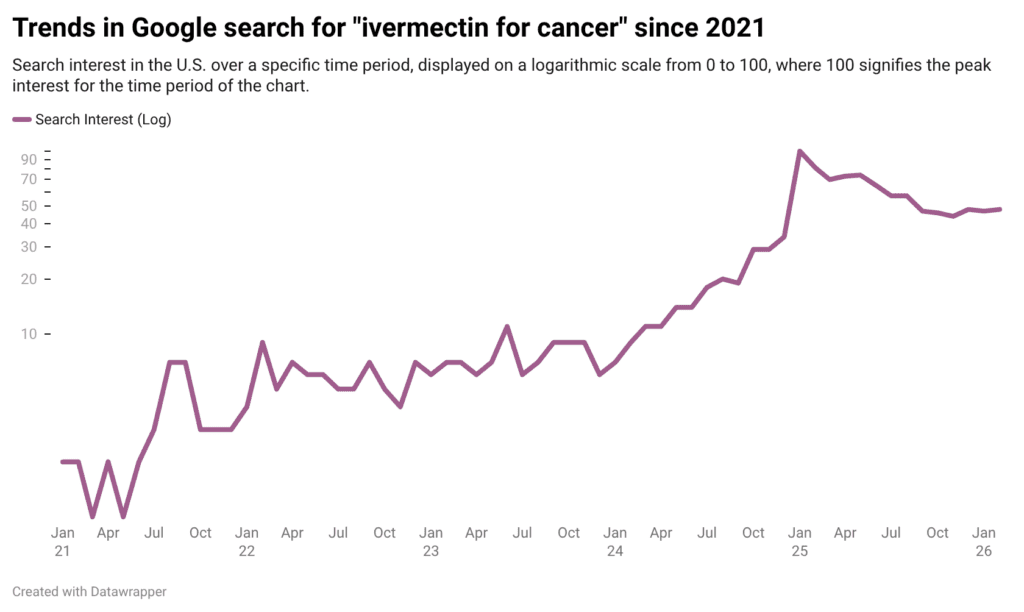
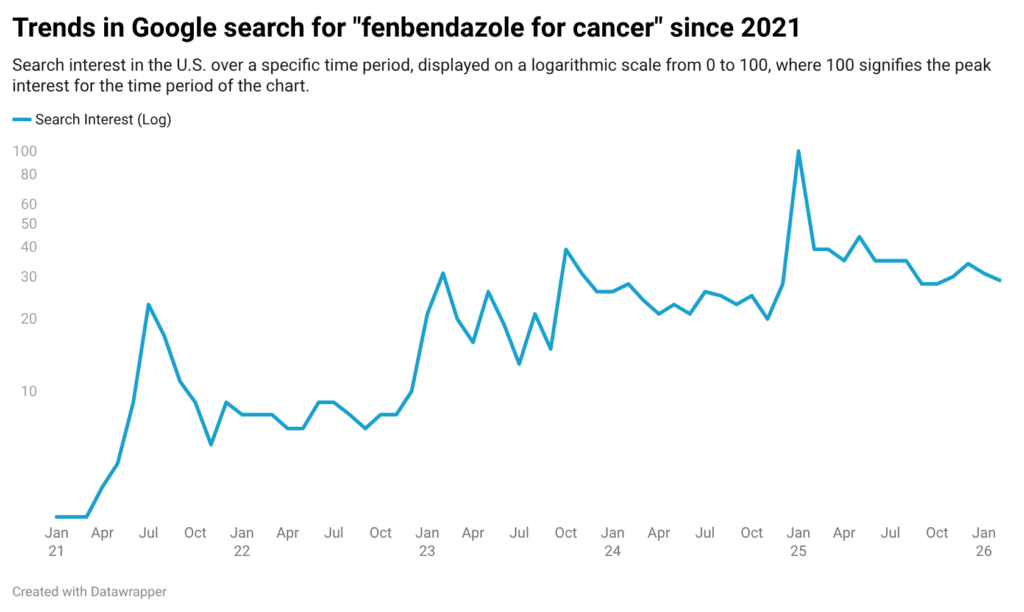
In January 2025, that attention intensified after actor Mel Gibson claimed that friends of his with stage IV cancer — the most advanced stage of the disease, where the tumor has spread to other parts of the body — were cured after taking those two drugs. Doctors and cancer organizations criticized the claims as misinformation, but their warnings did little to slow growing interest.
To date, no placebo-controlled randomized clinical trial has shown that ivermectin or fenbendazole can treat cancer in humans. Researchers have also not conducted open-label trials — studies in which participants choose which treatment to receive — for either drug as a stand-alone cancer therapy.
Febendazole, often called “fenben,” first gained attention in 2019 after Joe Tippens, a financial strategist in Oklahoma, wrote in his blog that it had cleared his cancer. Tippens says he was diagnosed with small-cell lung cancer in 2016 and began a chemotherapy and radiation regimen to treat his tumor. But a few months later, his cancer spread to other organs. With an estimated three months to live, Tippens enrolled in a Merck-run immunotherapy clinical trial at MD Anderson Cancer Center after his oncologists told him it might extend his life by about a year.
But while participating in the trial, Tippens says he heard about a scientist who cured her own cancer with fenbendazole.
“I decided — what the heck, I have nothing to lose, so I started taking it,” he said in a 2023 podcast interview.
Tippens said he secretly took fenbendazole while undergoing the trial, which he claimed included about 1,100 patients.
“I was the only survivor,” Tippens told the podcast host. “And because I admitted that I was taking something else along the way, they had to throw the entire trial out. They couldn’t use me as a success.”
“I was the only survivor. And because I admitted that I was taking something else along the way, they had to throw the entire trial out. They couldn’t use me as a success.”
His story quickly spread online, embraced by some patients searching for alternatives and criticized by others as misinformation. (MedShadow was unable to locate records of the clinical trial Tippens said he participated in.)
William Makis is a de-licensed Canadian physician who became an internet sensation in 2023 after writing a series of posts on X claiming that “turbo cancer” — a non-medical term he came up with to describe cancers in people who received the COVID-19 vaccine — was killing doctors and young people. In 2024, Makis and several collaborators — including Harvey Risch, M.D., Ph.D., a senior researcher at the Yale School of Public Health who was later appointed chair of President Trump’s Cancer Panel in 2025 — published a paper in the journal Forensic Science International claiming that COVID-19 vaccines caused deaths based on autopsy examinations of more than 200 individuals.
The journal later withdrew the article, citing concerns about “inappropriate citation of references, inappropriate design of methodology, errors, misrepresentation, and lack of factual support for the conclusions,” as well as a failure to acknowledge evidence that contradicted the authors’ claims.
In May 2025, Makis and two colleagues published another paper describing three patients with advanced cancers — breast, prostate, and melanoma — who self-medicated with fenbendazole. The authors reported that the drug appeared to help the patients achieve near-complete or complete remission, but the journal later retracted that paper after concerns were raised that Makis had failed to disclose a conflict of interest.
Makis and Dr. Risch have held leadership roles at a company called The Wellness Company that promotes and sells ivermectin and the antiparasitic drug mebendazole as potential cancer treatments. Dr. Risch serves as the company’s chief epidemiologist, while Makis was listed as chief of nuclear medicine and oncology from 2023 to 2024.
Makis also runs a Substack newsletter with more than 139,000 subscribers — some paying between $5 and $50 per month — where he continues to promote ivermectin and fenbendazole for cancer and publish testimonials from patients who say they have self-administered the drugs.
But Tippens’ story was just the beginning. In May 2025, William Makis, a physician from Edmonton, Canada (whose license has since been revoked), and his colleagues published a study involving three cancer patients that presented fenbendazole as a potential treatment. The authors reported that two patients with advanced cancers achieved complete remission and a third achieved near-complete remission, suggesting that the drug may have therapeutic effects. This result appears in the journal Case Reports in Oncology.
The findings drew attention, but in January 2026, the journal retracted the article after its editor discovered that Makis had not disclosed a conflict of interest. According to the retraction notice, “the first author [Makis] offered services related to the topic of the study.” [See Box 1 for further details]
The legitimacy of Makis’s claims has also been questioned by many in the medical community. The College of Physicians and Surgeons of Alberta (CPSA) says Makis’s medical license has been inactive since 2019 following a series of “professional complaints.” On March 11, 2026, he received a permanent injunction from the Alberta Court of King’s Bench — the superior trial court for that province — restricting him from representing or implying that he is a licensed practitioner in Alberta. Makis is also restricted from offering any health services, including medical advice or consultations. The CPSA stated that his continued use of the title “doctor” on social media platforms and offering of medical services violates provincial law.
Despite this injunction, as of April 29, Makis still posts stories of individuals he claims are surviving cancer due to ivermectin and fenbendazole. He refers to himself as a “Cancer Researcher,” “Author of 110+ peer-reviewed medical publications,” and a “Top Cancer Coach in the world,” on his Substack.
Because of its effectiveness against roundworms, ivermectin, which was discovered in the late 1970s, has become a mainstay for protecting farm animals from parasite infestations, saving the global food industry billions of dollars over the past four decades.
But its impact extends beyond livestock. In 1981, William Campbell, a zoologist at pharmaceutical giant Merck who co-discovered the drug, expanded his research to explore ivermectin’s potential in humans. That work led to a treatment for river blindness, an infectious disease that’s endemic in Africa, and broadened ivermectin’s role in treating other neglected tropical infections.
In 2015, ivermectin’s reputation as a “wonder drug” was cemented when microbiologist Satoshi Ōmura — who first isolated the active compound from Japanese soil — and Campbell shared the Nobel Prize in Physiology or Medicine for the discovery.
In March 2020, a group of scientists and physicians, including Paul Marik and Pierre Kory, formed the Front Line COVID-19 Critical Care Alliance (FLCCC). The group developed guidelines for managing COVID-19 infections, including a recommended list of drugs and supplements, that were published in late 2020 in the Journal of Intensive Care Medicine. Among the recommended treatments were methylprednisolone, a prescription corticosteroid; vitamin C; and heparin, a blood thinner. The organization later added ivermectin to its protocol, claiming the drug could lead to “large magnitude improvements in clinical outcomes” in a meta-analysis published in the American Journal of Therapeutics in April 2021.
The FLCCC’s recommendations drew criticism from the medical community, including concerns that the physicians relied on inaccurate data collection and reporting in at least one of the primary studies included in the meta-analysis that underpinned their protocol, a concern the editors acknowledged. Similar concerns were raised regarding the researchers’ 2020 protocol, which led the journal to retract the paper. Despite the withdrawal, the FLCCC continued to promote ivermectin and other substances as treatments for COVID-19.
In 2024, the American Board of Internal Medicine revoked the board certifications of Dr. Marik and Dr. Kory, citing the spread of misinformation. Physicians can still practice in the United States without board certification as long as they maintain an active medical license. Marik’s license has expired in 2022, while Kory’s remains active through 2027.
Their organization remains active. In January 2026, the FLCCC changed its name to the Independent Medical Alliance (IMA). The group has continued to promote the off-label use of ivermectin for a range of conditions, including cancer and respiratory infections.
Five years later, ivermectin returned to the spotlight for a different reason. During a U.S. Homeland Security Senate Committee hearing on December 8, 2020, pulmonologist Pierre Kory, M.D., described it as a “miracle” treatment for COVID-19. A few months later, in 2021, Kory published a meta-analysis of 18 randomized controlled trials investigating ivermectin’s effectiveness in treating the virus. The analysis claimed that the drug was associated with faster recovery and viral clearance, and reduced mortality. [See Box 2 for additional information]
Those claims were later challenged by large, independent randomized clinical trials in the U.S. and the U.K., which found that ivermectin did not improve patient outcomes. In 2024, the American Board of Internal Medicine — a nonprofit organization that certifies internal medicine doctors — revoked Kory’s board certification over the spread of misleading information, but the drug’s popularity persisted.
Under FDA regulations, doctors can prescribe ivermectin tablets to treat intestinal strongyloidiasis (roundworm infection) and onchocerciasis (river blindness), both parasitic diseases in humans. Doctors can also prescribe topical ivermectin for certain skin conditions, including rosacea.
However, the FDA has made clear that ivermectin — even products approved for human use — is not authorized to treat COVID-19. The agency also warns that any ivermectin products intended for animals (such as the type purchased by Town) are safe only when used in animals.
(According to a report by NPR, the nation’s poison control centers saw a 245% increase in ivermectin poisoning reports between July and August 2021, after rumors spread that the drug could cure COVID-19. Most of those cases involved people taking a version intended for a horse or a cow.)
Despite the FDA’s lack of support for widespread use, several states, including Texas, Idaho, Arkansas, and Tennessee, have recently passed laws allowing ivermectin to be sold over the counter for human use. Other states, like West Virginia, New Hampshire, and Iowa, are following suit.
“Like penicillin and aspirin, ivermectin is a safe, affordable medicine with minimal side effects,”
Representative Joanne Shofner, a Republican in the Texas State House who sponsored the bill allowing pharmacists to dispense ivermectin without a doctor’s prescription, told The Texas Tribune in 2025.
While ivermectin is generally considered safe for use in humans when taken as directed, people have reported serious side effects from high doses or interactions with other medications, including severe episodes of confusion, lack of muscle coordination, seizures, vomiting, and low blood pressure.
The public’s fascination with ivermectin during the COVID-19 pandemic also sparked renewed scientific curiosity about the drug. Researchers began exploring whether a medicine long used to treat parasites might also affect other diseases, including autoimmune disorders and cancer.
A current search of the U.S. National Institute of Health (NIH) archive yields more than 300 peer-reviewed papers published between 2015 and 2026 examining ivermectin’s potential anti-cancer effects. Most, however, are preclinical studies conducted in laboratory cell cultures or animal models that have not yet been tested in humans.
At the time of this article’s publication, only one active clinical trial in the U.S. is studying ivermectin as a cancer treatment in humans. The Phase I/II study — designed to evaluate safety and determine the optimal dosage of a new therapy — is being conducted by scientists at Cedars-Sinai Medical Center and City of Hope National Medical Center. In the trial, ivermectin is being tested as an adjunct treatment alongside the antibody drug balstilimab or pembrolizumab (Keytruda), which has previously shown anticancer activity in humans.
Peter P. Lee, M.D., chair of the Department of Immuno-Oncology at City of Hope, who is involved in the ivermectin/balstilimab study, said his interest in ivermectin began more than a decade ago while screening FDA-approved drugs in the National Cancer Institute database for potential anticancer activity.
“We got a couple hits, and one of those hits was ivermectin,” says Dr. Lee, emphasizing that those “hits” were observed in cancer cells in the lab, not humans.
“We got a couple hits, and one of those hits was ivermectin,” says Dr. Lee, emphasizing that those “hits” were observed in cancer cells in the lab, not humans.
While earlier studies suggested ivermectin might have anticancer effects in a range of cell types, researchers could not agree on how the drug might work. “It was all over the place, and nobody really advanced it to animal studies, let alone clinical studies,” Dr. Lee told MedShadow.
In 2015, Dr. Lee and his colleagues published research suggesting that ivermectin could trigger cancer cell death by activating the immune system. “The next natural question,” he says, “was whether it works in vivo — in a living organism.”
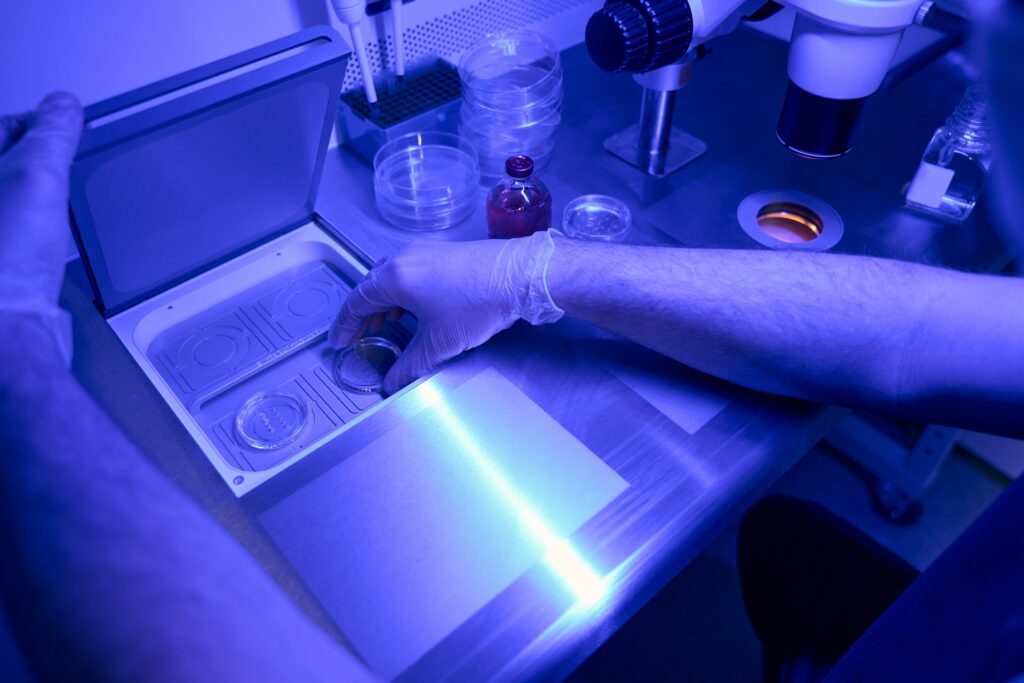
To answer that question, Dr. Lee and his team tested the activity of ivermectin on mice with triple-negative breast cancer and published the results in 2021. The mice carried what are known as “cold” tumors, meaning very few immune cells had infiltrated the tumor site. After treatment with ivermectin, the researchers found a surge of immune T cells penetrating the tumor, a sign that the animals’ immune systems were recognizing the cancer and were actively trying to destroy it.
The caveat, Dr. Lee notes, is that even though ivermectin recruited immune cells — an early step towards cell death — the tumors continued to grow.
“Eventually, the animals died, maybe a little bit slower, but they still died,” he says.
Ivermectin alone “doesn’t kill all the cancer cells,” Dr. Lee adds. “It’s not a magic bullet.”
He also notes that the drug appears to have a narrow therapeutic window, meaning small changes in dose could make it either ineffective or toxic. “It needs to be used very carefully,” he says.
What caught Dr. Lee’s attention, however, was that when ivermectin was paired with an immunotherapy drug, the combination showed potent synergy, curing more than half of the animals.
After those early preclinical findings, Dr. Lee and his colleagues advanced the research into the Phase I/II clinical trial described above, pairing ivermectin with immunotherapy drugs for breast cancer. So far, eight participants in the trial have received ivermectin along with the immunotherapy drug balstilimab. Six participants experienced disease progression, one had stable disease — meaning the cancer did not grow — and one had a partial response to the combination therapy.
One possible reason for the uneven results so far is that ivermectin, according to Dr. Lee, has low solubility, which means only a small fraction of the ingested compound reaches the systemic circulation. Drugs with poor solubility tend to require higher doses to reach the desired response.
Other research has examined whether ivermectin might strengthen the effects of chemotherapy drugs such as doxorubicin, adriamycin, and vincristine. Early experiments in cancer cells grown in laboratory dishes suggest the drug may amplify the effects of these treatments. However, there is still no evidence that such combinations work in humans.
“I think ivermectin holds great promise in combination with immune-based therapies,” says Dr. Lee. “But I certainly would not at all try to make a claim that ivermectin is a standalone cancer cure, and I certainly would not advocate patients taking it on their own.” He also stresses that the drug could be toxic at a high dose.
While some researchers share Dr. Lee’s view that ivermectin may have potential as part of combination cancer therapies, turning early laboratory findings into a safe and effective treatment still involves financial, regulatory, and biological hurdles that remain unresolved.
Historically, only a handful of drugs have been successfully repositioned to treat cancer. For example, Thalidomide, a drug that was first developed in the 1950s as a sedative and then banned for causing birth defects in unborn children, was later approved in 2006 for treating multiple myeloma. Arsenic trioxide, which was traditionally used to treat skin conditions like psoriasis and syphilis, later became a treatment option for acute promyelocytic leukemia, a specific type of blood cancer.
There is a real value in repurposing drugs for cancer treatment, but there is also little financial incentive for pharmaceutical companies, says Jonathan Sexton, Ph.D., a medicinal chemist and expert in drug repurposing at the University of Michigan Medical School.
“Drug repurposing or repositioning often gets short shrift because of the perception that there is limited return on investment due to the intellectual property situation,” he says. “If you repurpose a drug, you don’t actually own the intellectual property for that compound.”
Beyond economics, cancer drug development carries an exceptionally high failure rate. “Between 92 and 98% of drugs that show laboratory-based efficacy fail to produce human clinical efficacy,” Dr. Sexton notes.
But it’s not just red tape that keeps ivermectin from advancing as a cancer therapy. Dr. Sexton, who directs a research center focused on finding new uses for existing drugs, says his team does a “considerable” amount of work in cancer drug repurposing, and that ivermectin has long been part of the screening process. So far, he says, the laboratory findings and prospects for clinical translation are not promising. “From my perspective, there is a pretty big gap right now that makes me less optimistic that ivermectin is going to do anything substantial clinically.”
“From my perspective, there is a pretty big gap right now that makes me less optimistic that ivermectin is going to do anything substantial clinically.”
While many preclinical studies on ivermectin show the drug’s efficacy in killing cancer cells, those effects occur at low micromolar concentrations, Dr. Sexton continues. Even if ivermectin showed anticancer effects in humans, he says, the dose needed to match what’s seen in laboratory studies would likely be 50 to 100 times higher than typical levels — a range that would be toxic. “It’s very hard to distinguish an on-target, robust efficacy that would kill the cancer cell but not kill the [human] host.”
Despite the limited research (and even more tenuous efficacy) of ivermectin as a cancer therapy, Sam Brondfield, M.D., an oncologist at the University of California, San Francisco, says patients have asked him whether the drug is worth trying.
“It’s totally legitimate to ask these questions,” says Dr. Brondfield, “but as an oncologist, I put the most stock in clinical data and large clinical trials to prove that treatments are effective.” Ivermectin, he continues, “does not have that supportive data.”
In the face of a dire diagnosis, however, caution from researchers and physicians about limited evidence doesn’t always change minds.
In October 2025, a 62-year-old Reddit user known as ‘redderGlass’ posted in the r/BeatCancer subreddit: “Stage 4 and now clear for 9 months.” The post referred to what he described as a small bowel cancer diagnosis in the fall of 2023 that had spread to other organs.
“I went through several months where I was convinced I was going to die, and happy to say, none of that came true,” says redderGlass, who spoke with MedShadow on the condition of anonymity.
After receiving his diagnosis, redderGlass says he “[went] online to find cancer support groups and places where people can tell me their stories.” He began researching alternative treatment approaches, drawing on journal articles, books, and other social media posts.
By June 2024, he had compiled a list of 35 supplements and medications — including ivermectin, metformin, curcumin, the antibiotic doxycycline, and vitamin D — which he says he took daily alongside the chemotherapy prescribed by his doctor.
“I [didn’t] tell [my doctor] I was taking ivermectin,” says redderGlass. “He’s not into any of these alternative methods. He thinks they are all quackery.”
“I [didn’t] tell [my doctor] I was taking ivermectin. He’s not into any of these alternative methods. He thinks they are all quackery.”
In January 2025, redderGlass says he received his final round of chemotherapy after telling his doctor that the treatment drained his energy. At the time, he says his liver “looked like Swiss cheese. It was just covered with blotches all over it.” He continued taking most of the supplements on his list and returned to the hospital every three months for CT scans.
A year later, in January 2026, he says one of those follow-up scans showed no detectable cancer: “I walked into my doctor’s office, and he said, ‘God loves you because I’ve never seen a result like this.’”
RedderGlass continues to post about his health and self-treatment protocol on his Substack, The Metabolic Trilogy. He also directs his subscribers (792 at the time of this article’s publication) to Makis’s Substack posts and the Independent Medical Alliance website (see BOX 1 and 2).
MedShadow asked redderGlass to provide documentation supporting his account, including medical records and scan results, which he did with his name redacted. MedShadow confirmed that the records showed he had been diagnosed with metastatic cancer in 2023. A more recent record from January 2026 noted that the tumor had “predominantly calcified,” a feature that can be associated with cancer cell death.
Personal stories like those of Town and redderGlass “are important and very powerful,” says Dr. Brondfield. “And it’s important for us in medicine and science to acknowledge that and to pay attention to that, because these stories have a huge impact on how patients that we care for perceive the recommendations we have for them.”
Dr. Brondfield, who specializes in treating patients with solid tumors, says he does not dismiss individual accounts, but emphasizes that what works for one person may not work for another.
“When all you have are the individual stories, it’s tempting to say, ‘well, this is working,’ but from a scientific perspective, it’s so important to have a study to really prove it. Otherwise, you’re just kind of randomly giving out treatments to people, and you really don’t know that it’s going to help the next person, even if this one person’s story is positive.”
But not all the stories circulating online end well.
In August 2025, Mary Doran, a 74-year-old respiratory therapist in Colorado, died after taking ivermectin products intended for horses intermittently for a year. According to reporting by CBS News Colorado, Doran had been using the drug to treat chronic pain. An autopsy conducted by the Douglas County Coroner’s Office concluded that she died after a series of seizures consistent with ivermectin toxicity (although no toxicology tests were available to confirm the presence of the drug in her system).
Cases of fenbendazole-related deaths have also been reported.
In 2024, Lee Redpath, a 45-year-old man in the U.K., died from liver injury after taking fenbendazole products intended for animals. According to reporting by BBC News, Redpath purchased the drug from an online supplier after seeing videos on social media claiming it had anticancer properties.
“Tests on Lee’s liver showed that he was suffering from an acute liver injury on a background of cirrhosis due to his previous alcohol excess,” Mark Oakes, a senior coroner’s officer in Cambridgeshire, U.K., wrote in an email to MedShadow.
“Alternative causes for the liver injury — including drug use, viruses, and infection — were ruled out,” Oakes added. “Following examination and toxicology, the pathologist concluded that prolonged use of fenbendazole at high doses was the probable cause of the acute injury.”
“Following examination and toxicology, the pathologist concluded that prolonged use of fenbendazole at high doses was the probable cause of the acute injury.”
In Korea, an 80-year-old woman with advanced non–small cell lung cancer (NSCLC) also developed liver injury after taking fenbendazole for a month. According to a published case report, she was admitted to the hospital in November 2018 to begin immunotherapy. Three months later, a CT scan showed a partial response to the treatment, and doctors continued her therapy.
At a nine-month checkup, however, her liver enzyme levels were found to be abnormally high. The patient later admitted that she had been self-administering a dog-formulated version of fenbendazole for about a month. Like Redpath, she had purchased the drug after seeing social media posts claiming it had anticancer properties. After she stopped taking fenbendazole, her liver function improved.
Cases like these highlight the risks of using unproven treatments without medical guidance. Still, Dr. Brondfield says he doesn’t automatically dismiss complementary or alternative approaches.
“It’s certainly not my approach — or the approach of many oncologists — to say that these therapies have no role,” he says. “What we advocate for is understanding what treatments a patient is interested in pursuing so that we can evaluate them and see what evidence actually supports their use for that patient’s disease or symptoms.”
But there are limits.
“Where we run into trouble is when patients want to try therapies that are known to cause problems, such as interacting with standard treatments,” he adds.
Dr. Brondfield’s greatest concern when it comes to drugs like ivermectin and fenbendazole is that some patients may delay or decline proven treatments while experimenting with alternatives. Cancer, he notes, can move fast.
“It’s important to get people on effective therapy quickly,” he says. “It’s not like these folks have a lot of time.”

If you’ve experienced side effects or medication issues related to this topic, we want to hear from you.
Submit Your StoryDISCLAIMER: MedShadow provides information and resources related to medications, their effects, and potential side effects. However, it is important to note that we are not a substitute for professional medical advice, diagnosis, or treatment. The content on our site is intended for educational and informational purposes only. Individuals dealing with medical conditions or symptoms should seek guidance from a licensed healthcare professional, such as a physician or pharmacist, who can provide personalized medical advice tailored to their specific circumstances.
While we strive to ensure the accuracy and reliability of the information presented on MedShadow, we cannot guarantee its completeness or suitability for any particular individual’s medical needs. Therefore, we strongly encourage users to consult with qualified healthcare professionals regarding any health-related concerns or decisions. By accessing and using MedShadow, you acknowledge and agree that the information provided on the site is not a substitute for professional medical advice and that you should always consult with a qualified healthcare provider for any medical concerns.
MedShadow.org is dedicated to empowering people with our evidence-based journalism about the safest ways to take over-the-counter (OTC) and prescription (Rx) medications.
We also seek to stimulate public discussion about potential improvements to drug research, manufacturing and distribution processes. and also to encourage the improvement of processes to ensure that we are all better protected.
As a result, we encourage other nonprofit newsrooms, mission-aligned outlets, and advocacy organizations to republish our original content under the following conditions:
1. We Are Credited Fully and Clearly
You must include the byline and credit MedShadow.org as the original publisher. Please include a link to the original article at the top or bottom of the piece. Use the following attribution:
This article was originally published by MedShadow, a nonprofit foundation that focuses on the safest ways to take over-the-counter and prescription medications.
2. Our Content Isn’t Edited Without Permission
You may make small changes for clarity, such as adjusting headlines, subheadings, or transitions, but you may not change the core meaning, tone, or intent of the article. For substantive edits, email us at republish@medshadow.org for review and approval.
3. You Do Not Sell Or Use Our Content Commercially
Our work is free to share, but it may not be sold, monetized, or repurposed for commercial gain. You may not republish our articles behind a paywall or in publications whose primary purpose is advertising or product promotion. You may not place drug or supplement advertising adjacent to our story.
4. Photos, Graphics, and Multimedia Are Not Used Without Permission
Only the text of the article is available for republication. Images, graphics, and videos may not be reused without explicit written permission, unless they are clearly marked as Creative Commons licensed. Contact us if you’d like to request reuse of a visual asset.
If you’re unsure whether your intended use falls within these guidelines, or would like to discuss a formal syndication or licensing arrangement, please email: republish@medshadow.org
We want our journalism to reach as many people as possible, especially those making critical decisions about medications and health.
<!-- wp:paragraph -->
<p>“This has worked miracles for me,” said Kevin Town, a 55-year-old YouTube creator from Ashville, New York, as he held up two white tubes in a <a href="https://www.youtube.com/watch?v=570Yw0mcNb4">video</a> posted January 4, 2026.</p>
<!-- /wp:paragraph --><!-- wp:paragraph -->
<p>The tubes contained ivermectin and fenbendazole paste — products marketed as horse dewormers that Town says he bought at a local Tractor Supply store. But to Town, these were more than medications for livestock: They were an affordable and effective alternative to the conventional cancer treatments that, over the span of a year, had drained his savings and left him feeling sicker.</p>
<!-- /wp:paragraph --><!-- wp:paragraph -->
<p>According to his video posts, Town was <a href="https://www.youtube.com/watch?v=Md6SZnJdF6U">diagnosed with kidney cancer</a> in September 2024. In November of that year, he underwent a <a href="https://www.youtube.com/watch?v=7G9abDB3FOk">nephrectomy</a>, a surgery to remove his left kidney. Nine months later, Town learned his cancer had <a href="https://www.youtube.com/watch?v=AW4fb9GlocE">progressed and spread</a> to his bladder and prostate. He underwent <a href="https://www.youtube.com/watch?v=TKECNjhvwA4">another painful procedure</a> to remove the tumors, but his doctors told him it wasn’t enough.</p>
<!-- /wp:paragraph --><!-- wp:paragraph -->
<p>“They said, ‘In order to save your life, we have to remove your bladder and your prostate at the same time’,” Town recalled in his video. He said the surgery would leave him using a urostomy bag for the rest of his life.</p>
<!-- /wp:paragraph --><!-- wp:paragraph -->
<p>“I told them I didn’t want that done,” he explained. </p>
<!-- /wp:paragraph --><!-- wp:paragraph -->
<p>Facing the cost of ongoing appointments and prescriptions, Town decided to try an alternative solution: He bought ivermectin and fenbendazole, treatments he said he had discovered through online posts, including from some medical professionals. He said he alternated between the two, taking each daily for a week, then switching to the other.</p>
<!-- /wp:paragraph --><!-- wp:paragraph -->
<p>In his January 4th video (which has since racked up more than 21,000 views), Town says that after four months of taking the $17 veterinary drugs, he felt healthy again. </p>
<!-- /wp:paragraph --><!-- wp:paragraph -->
<p>Town, who declined MedShadow’s request for a direct interview, has continued to post updates on his health on YouTube. </p>
<!-- /wp:paragraph --><!-- wp:paragraph -->
<p>On April 10, <a href="https://youtu.be/tu-tY79-IKA">Town told his viewers</a> he had returned to his primary care doctor for the first time in seven months. He said his doctor was “absolutely amazed” at how good he looked and that he had not experienced any cancer symptoms since the previous year. </p>
<!-- /wp:paragraph --><!-- wp:paragraph -->
<p>In a <a href="https://www.youtube.com/watch?v=eLyPvyWZYbw&t=101s">video</a> uploaded on May 15, the last one Town posted before this article’s publication, he holds up the results of a CT scan, blood work, and a urinalysis, and tells viewers his doctor had found “no sign of cancer at all.”</p>
<!-- /wp:paragraph --><!-- wp:heading -->
<h2 class="wp-block-heading">From Antiparasitics to ‘Cure-Alls’: The Reinvention of Ivermectin and Fenbendazole</h2>
<!-- /wp:heading --><!-- wp:paragraph -->
<p>Ivermectin and fenbendazole were approved by the U.S. Food and Drug Administration (FDA) in the early 1980s — in 1981 and 1983, respectively — to treat parasitic infections in animals, including dogs and cattle. Unlike <a href="https://www.accessdata.fda.gov/drugsatfda_docs/label/2009/050742s024s025lbl.pdf">ivermectin</a>, which was later approved to treat onchocerciasis, or river blindness (a severe eye and skin condition caused by parasites that breed in flowing rivers) in humans, febendazole remains approved only for veterinary use.</p>
<!-- /wp:paragraph --><!-- wp:paragraph -->
<p>According to Google Trends data, Interest in these antiparasitic drugs, particularly when combined with the word “cancer,” <a href="https://trends.google.com/explore?q=ivermectin%2520cancer&date=today%205-y&geo=US">surged </a>in 2024. </p>
<!-- /wp:paragraph --><!-- wp:image {"id":30038,"sizeSlug":"large","linkDestination":"none"} -->
<figure class="wp-block-image size-large"><img src="https://medshadow.org/wp-content/uploads/2026/04/image-1024x612.png" alt="" class="wp-image-30038"/></figure>
<!-- /wp:image --><!-- wp:image {"id":30039,"sizeSlug":"large","linkDestination":"none"} -->
<figure class="wp-block-image size-large"><img src="https://medshadow.org/wp-content/uploads/2026/04/image-1-1024x612.png" alt="" class="wp-image-30039"/></figure>
<!-- /wp:image --><!-- wp:paragraph -->
<p>In January 2025, that attention intensified after actor Mel Gibson <a href="https://www.youtube.com/watch?v=1rYtrS5IbrQ">claimed </a>that friends of his with stage IV cancer — the most advanced stage of the disease, where the tumor has spread to other parts of the body — were cured after taking those two drugs. Doctors and cancer organizations <a href="https://www.publichealth.columbia.edu/news/restoring-ivermectins-good-name-poptalks-separates-junk-science">criticized</a> the claims as <a href="https://magazine.hms.harvard.edu/articles/confronting-rising-tide-cancer-misinformation">misinformation</a>, but their warnings did little to slow growing interest.</p>
<!-- /wp:paragraph --><!-- wp:paragraph -->
<p>To date, no placebo-controlled randomized clinical trial has shown that ivermectin or fenbendazole can treat cancer in humans. Researchers have also not conducted open-label trials — studies in which participants choose which treatment to receive — for either drug as a stand-alone cancer therapy.</p>
<!-- /wp:paragraph --><!-- wp:heading {"level":3} -->
<h3 class="wp-block-heading">Febendazole: A Viral Sensation With Little Proof</h3>
<!-- /wp:heading --><!-- wp:paragraph -->
<p>Febendazole, often called “fenben,” first gained attention in 2019 after Joe Tippens, a financial strategist in Oklahoma, wrote in his blog that it had <a href="https://mycancerstory.rocks/the-blog/">cleared his cancer</a>. Tippens says he was diagnosed with small-cell lung cancer in 2016 and began a chemotherapy and radiation regimen to treat his tumor. But a few months later, his cancer spread to other organs. With an estimated three months to live, Tippens enrolled in a Merck-run immunotherapy clinical trial at MD Anderson Cancer Center after his oncologists told him it might extend his life by about a year. </p>
<!-- /wp:paragraph --><!-- wp:paragraph -->
<p>But while participating in the trial, Tippens says he heard about a scientist who cured her own cancer with fenbendazole.</p>
<!-- /wp:paragraph --><!-- wp:paragraph -->
<p>“I decided — what the heck, I have nothing to lose, so I started taking it,” he said in a 2023 podcast <a href="https://podcasts.apple.com/us/podcast/vitality-made-simple/id1565963333?i=1000600785290">interview</a>.</p>
<!-- /wp:paragraph --><!-- wp:paragraph -->
<p>Tippens said he secretly took fenbendazole while undergoing the trial, which he claimed included about 1,100 patients.</p>
<!-- /wp:paragraph --><!-- wp:paragraph -->
<p>“I was the only <a href="https://www.koco.com/article/edmond-man-claims-cheap-drug-for-dogs-cured-his-cancer/27276538">survivor</a>,” Tippens <a href="https://podcasts.apple.com/us/podcast/vitality-made-simple/id1565963333?i=1000600785290">told the podcast host</a>. “And because I admitted that I was taking something else along the way, they had to throw the entire trial out. They couldn’t use me as a success.”</p>
<!-- /wp:paragraph --><!-- wp:quote -->
<blockquote class="wp-block-quote"><!-- wp:paragraph -->
<p>“I was the only survivor. And because I admitted that I was taking something else along the way, they had to throw the entire trial out. They couldn’t use me as a success.”</p>
<!-- /wp:paragraph --></blockquote>
<!-- /wp:quote --><!-- wp:paragraph -->
<p>His story quickly spread online, embraced by some patients searching for alternatives and criticized by others as <a href="https://pmc.ncbi.nlm.nih.gov/articles/PMC9650234/">misinformation</a>. (MedShadow was unable to locate records of the clinical trial Tippens said he participated in.)</p>
<!-- /wp:paragraph --><!-- wp:myplugin/custom-alignment-block {"align":"right"} -->
<div class="wp-block-myplugin-custom-alignment-block alignright"><h2>Box 1: A Controversial Figure</h2><p>William Makis is a de-licensed Canadian physician who became an internet sensation in 2023 after <a href="https://x.com/MakisMedicine/status/1705538518897107347">writing </a>a series of posts on X claiming that “turbo cancer” — a non-medical term he came up with to describe cancers in people who received the COVID-19 vaccine — was killing doctors and young people. In 2024, Makis and several collaborators — including <a href="https://ysph.yale.edu/profile/harvey-risch/">Harvey Risch, M.D., Ph.D</a>., a senior researcher at the Yale School of Public Health who was later <a href="https://www.hhs.gov/press-room/dr-harvey-risch-appointed-chairman-president-trumps-cancer-panel.html">appointed chair</a> of President Trump’s Cancer Panel in 2025 — published a paper in the journal <em>Forensic Science International</em> claiming that COVID-19 vaccines caused deaths based on autopsy examinations of more than 200 individuals.<br><br>The journal<a href="https://doi.org/10.1016/j.forsciint.2024.112115"> later withdrew the article</a>, citing concerns about “inappropriate citation of references, inappropriate design of methodology, errors, misrepresentation, and lack of factual support for the conclusions,” as well as a failure to acknowledge evidence that contradicted the authors’ claims.<br><br>In May 2025, Makis and two colleagues published another <a href="https://karger.com/cro/article/18/1/864/927630/Retracted-Paper-Fenbendazole-as-an-Anticancer">paper</a> describing three patients with advanced cancers — breast, prostate, and melanoma — who self-medicated with fenbendazole. The authors reported that the drug appeared to help the patients achieve near-complete or complete remission, but the journal later <a href="https://karger.com/cro/article/19/1/169/941881/Retraction-StatementPaper-by-William-Makis-Ilyes">retracted</a> that paper after concerns were raised that Makis had failed to disclose a conflict of interest.<br><br>Makis and Dr. Risch have held leadership roles at a company called The Wellness Company <a href="https://www.twc.health/blogs/news/from-helminth-hunters-to-cancer-combatants-repurposed-drugs-hold-promise?_pos=5&_sid=9b3ef0c13&_ss=r">that promotes</a> and sells ivermectin and the antiparasitic drug mebendazole as potential cancer treatments. Dr. Risch serves as the company’s <a href="https://www.twc.health/pages/dr-harvey-risch?srsltid=AfmBOoq7CRyChhdbw96_M8UaVi6GODgecPONJk4ud82YsL1McYyuSg-p">chief epidemiologist</a>, while Makis was listed as chief of nuclear medicine and oncology from 2023 to 2024.<br><br>Makis also runs a <a href="https://makisw.substack.com/">Substack</a> newsletter with more than 139,000 subscribers — some paying between $5 and $50 per month — where he continues to promote ivermectin and fenbendazole for cancer and publish testimonials from patients who say they have self-administered the drugs.<br></p></div>
<!-- /wp:myplugin/custom-alignment-block --><!-- wp:paragraph -->
<p>But Tippens’ story was just the beginning. In May 2025, William Makis, a physician from Edmonton, Canada (whose license has since been revoked), and his colleagues published a study involving three cancer patients that presented <a href="https://pubmed.ncbi.nlm.nih.gov/40605964/">fenbendazole as a potential treatment</a>. The authors reported that two patients with advanced cancers achieved complete remission and a third achieved near-complete remission, suggesting that the drug may have therapeutic effects. This result appears in the journal <em>Case Reports in Oncology</em>.</p>
<!-- /wp:paragraph --><!-- wp:paragraph -->
<p>The findings drew attention, but in January 2026, the journal <a href="https://karger.com/cro/article/19/1/169/941881/Retraction-StatementPaper-by-William-Makis-Ilyes">retracted</a> the article after its editor discovered that Makis had not disclosed a conflict of interest. According to the retraction notice, “the first author [Makis] offered services related to the topic of the study.” [<strong>See Box 1 for further details</strong>]</p>
<!-- /wp:paragraph --><!-- wp:paragraph -->
<p>The legitimacy of Makis’s claims has also been questioned by many in the medical community. The College of Physicians and Surgeons of Alberta (CPSA) says Makis’s medical license has been <a href="https://cpsa.ca/news/statement-william-viliam-makis-not-licensed-to-practise-medicine-in-alberta/">inactive since 2019</a> following a series of “<a href="https://jssbarristers.ca/rules/makis-v-alberta-health-services/">professional complaints</a>.” On March 11, 2026, he received a permanent injunction from the Alberta Court of King’s Bench — the superior trial court for that province — restricting him from representing or implying that he is a licensed practitioner in Alberta. Makis is also restricted from offering any health services, including medical advice or consultations. The CPSA stated that his continued use of the title “doctor” on social media platforms and offering of medical services violates provincial law. </p>
<!-- /wp:paragraph --><!-- wp:paragraph -->
<p>Despite this injunction, as of April 29, Makis still <a href="https://substack.com/home/post/p-195847593">posts </a>stories of individuals he claims are surviving cancer due to ivermectin and fenbendazole. He refers to himself as a “Cancer Researcher,” “Author of 110+ peer-reviewed medical publications,” and a “Top Cancer Coach in the world,” on his Substack.</p>
<!-- /wp:paragraph --><!-- wp:heading {"level":3} -->
<h3 class="wp-block-heading">Ivermectin: Medical Triumph, Manufactured Miracle?</h3>
<!-- /wp:heading --><!-- wp:paragraph -->
<p>Because of its effectiveness against roundworms, ivermectin, which was discovered in the late 1970s, has become a <a href="https://doi.org/10.2183/pjab.87.13">mainstay for protecting farm animals</a> from parasite infestations, saving <a href="https://www.acs.org/education/whatischemistry/landmarks/ivermectin-mectizan.html">the global food industry billions of dollars</a> over the past four decades.</p>
<!-- /wp:paragraph --><!-- wp:paragraph -->
<p>But its impact extends beyond livestock. In 1981, William Campbell, a zoologist at pharmaceutical giant Merck who co-discovered the drug, expanded his research to explore ivermectin’s potential in humans. That work led to a <a href="https://link.springer.com/article/10.1208/s12248-007-9000-9">treatment for river blindness</a>, an infectious disease that’s endemic in Africa, and broadened ivermectin’s role in treating other neglected tropical infections. </p>
<!-- /wp:paragraph --><!-- wp:paragraph -->
<p>In 2015, ivermectin’s reputation as a “wonder drug” was cemented when microbiologist Satoshi Ōmura — who first isolated the active compound from Japanese soil — and Campbell shared the Nobel Prize in Physiology or Medicine for the discovery.</p>
<!-- /wp:paragraph --><!-- wp:myplugin/custom-alignment-block {"align":"left"} -->
<div class="wp-block-myplugin-custom-alignment-block alignleft"><h2>Box 2: The <strong>Front Line COVID-19 Critical Care Alliance</strong></h2><p>In March 2020, a group of scientists and physicians, including Paul Marik and Pierre Kory, formed the Front Line COVID-19 Critical Care Alliance (FLCCC). The group developed guidelines for managing COVID-19 infections, including a <a href="https://www.newswise.com/pdf_docs/160814778997790_MATH%20protocol-%20JICM.pdf">recommended</a> list of drugs and supplements, that were published in late 2020 in the <em>Journal of Intensive Care Medicine</em>. Among the recommended treatments were methylprednisolone, a prescription corticosteroid; vitamin C; and heparin, a blood thinner. The organization later added ivermectin to its protocol, <a href="https://doi.org/10.1097/MJT.0000000000001377">claiming</a> the drug could lead to “large magnitude improvements in clinical outcomes” in a meta-analysis published in the <em>American Journal of Therapeutics</em> in April 2021.   <br><br>The FLCCC’s recommendations drew <a href="https://journals.lww.com/americantherapeutics/fulltext/2022/04000/expression_of_concern_for_kory_p,_meduri_gu,_varon.10.aspx">criticism from the medical community</a>, including concerns that the physicians relied on inaccurate data collection and reporting in at least one of the primary studies included in the meta-analysis that underpinned their protocol, a concern the editors <a href="https://pmc.ncbi.nlm.nih.gov/articles/PMC10501341/">acknowledged</a>. Similar concerns were raised regarding the researchers’ 2020 protocol, which led the journal to <a href="https://journals.sagepub.com/doi/10.1177/08850666211049062">retract</a> the paper. Despite the withdrawal, the FLCCC <a href="https://imahealth.org/protocol/math-covid-hospital-treatment/">continued to promote</a> ivermectin and other substances as treatments for COVID-19.<br><br>In 2024, the American Board of Internal Medicine <a href="https://www.unmc.edu/healthsecurity/transmission/2024/08/14/doctors-accused-of-spreading-misinformation-lose-certifications/">revoked </a>the board certifications of Dr. Marik and Dr. Kory, citing the spread of misinformation. Physicians <a href="https://www.ama-assn.org/medical-residents/transition-resident-attending/licensing-and-board-certification-what-residents">can still practice</a> in the United States without board certification as long as they maintain an active medical license. Marik’s license has <a href="https://dhp.virginiainteractive.org/Lookup/Detail/0109542065">expired</a> in 2022, while Kory’s <a href="https://licensesearch.wi.gov/IndividualLicense/SearchResultsSummary?chid=975207#:~:text=Name:%20KORY%2C%20PIERRE%20D,Other%20Names:%20NONE">remains active</a> through 2027.<br><br>Their organization remains active. In January 2026, the FLCCC changed its name to the Independent Medical Alliance (IMA). The group has continued to <a href="https://imahealth.org/ivermectin/">promote the off-label use of ivermectin</a> for a range of conditions, including <a href="https://imahealth.org/research/cancer-care/">cancer</a> and respiratory infections.</p></div>
<!-- /wp:myplugin/custom-alignment-block --><!-- wp:paragraph -->
<p>Five years later, ivermectin returned to the spotlight for a different reason. During a U.S. Homeland Security Senate Committee hearing on December 8, 2020, pulmonologist Pierre Kory, M.D., described<a href="https://www.hsgac.senate.gov/wp-content/uploads/imo/media/doc/Testimony-Kory-2020-12-08.pdf"> it as a “miracle”</a> treatment for COVID-19. A few months later, in 2021, Kory published a <a href="https://pmc.ncbi.nlm.nih.gov/articles/PMC8088823/">meta-analysis</a> of 18 randomized controlled trials investigating ivermectin’s effectiveness in treating the virus. The analysis claimed that the drug was associated with faster recovery and viral clearance, and reduced mortality.  [<strong>See Box 2 for additional information</strong>]</p>
<!-- /wp:paragraph --><!-- wp:paragraph -->
<p>Those claims were later challenged by large, independent randomized clinical trials <a href="https://jamanetwork.com/journals/jama/fullarticle/2801827">in the U.S</a>. and <a href="https://www.sciencedirect.com/science/article/pii/S0163445324000641">the U.K</a>., which found that ivermectin did not improve patient outcomes. In 2024, the American Board of Internal Medicine — a nonprofit organization that certifies internal medicine doctors — <a href="https://www.abim.org/verify-physician?type=name&ln=kory&fn=pierre">revoked</a> Kory’s board certification over the spread of misleading information, but the drug’s popularity persisted.</p>
<!-- /wp:paragraph --><!-- wp:paragraph -->
<p>Under FDA regulations, doctors can prescribe ivermectin tablets to treat intestinal strongyloidiasis (roundworm infection) and onchocerciasis (river blindness), both parasitic diseases in humans. Doctors can also prescribe topical ivermectin for certain skin conditions, including rosacea. </p>
<!-- /wp:paragraph --><!-- wp:paragraph -->
<p>However, the FDA has made clear that ivermectin — even products approved for human use — is <a href="https://www.fda.gov/consumers/consumer-updates/ivermectin-and-covid-19">not authorized to treat COVID-19</a>. The agency also warns that any ivermectin products intended for animals (such as the type purchased by Town) are <a href="https://www.fda.gov/safety/medical-product-safety-information/ivermectin-intended-animals-letter-stakeholders-do-not-use-humans-treatment-covid-19">safe only when used in animals</a>. </p>
<!-- /wp:paragraph --><!-- wp:paragraph -->
<p>(<a href="https://www.npr.org/sections/coronavirus-live-updates/2021/09/04/1034217306/ivermectin-overdose-exposure-cases-poison-control-centers">According to a report by NPR</a>, the nation’s poison control centers saw a 245% increase in ivermectin poisoning reports between July and August 2021, after rumors spread that the drug could cure COVID-19. Most of those cases involved people taking a version intended for a horse or a cow.)</p>
<!-- /wp:paragraph --><!-- wp:paragraph -->
<p>Despite the FDA’s lack of support for widespread use, several states, including <a href="https://capitol.texas.gov/tlodocs/892/billtext/html/HB00025I.htm">Texas</a>, Idaho, <a href="https://www.billtrack50.com/billdetail/1817759">Arkansas</a>, and <a href="https://wapp.capitol.tn.gov/apps/Billinfo/default.aspx?BillNumber=SB2188&ga=112">Tennessee</a>, have recently passed laws allowing ivermectin to be sold over the counter for human use. Other states, like <a href="https://www.wvlegislature.gov/Bill_Status/bills_history.cfm?INPUT=42&year=2026&sessiontype=RS">West Virginia</a>, <a href="https://gc.nh.gov/bill_status/legacy/bs2016/billText.aspx?sy=2025&id=369&txtFormat=html">New Hampshire</a>, and <a href="https://iowacapitaldispatch.com/2026/04/27/iowa-senate-sends-snap-restrictions-over-the-counter-ivermectin-to-governor/">Iowa</a>, are following suit.</p>
<!-- /wp:paragraph --><!-- wp:paragraph -->
<p>“Like penicillin and aspirin, ivermectin is a safe, affordable medicine with minimal side effects,”</p>
<!-- /wp:paragraph --><!-- wp:paragraph -->
<p>Representative Joanne Shofner, a Republican in the Texas State House who sponsored the bill allowing pharmacists to dispense ivermectin without a doctor’s prescription, <a href="https://www.texastribune.org/2025/08/27/texas-legislature-ivermectin-otc-prescription/#:~:text=Share%20this:,law%20takes%20effect%20Dec.%204.">told</a> <em>The Texas Tribune</em> in 2025. </p>
<!-- /wp:paragraph --><!-- wp:paragraph -->
<p>While ivermectin is generally considered safe for use in humans when taken as directed, people have reported <a href="https://pmc.ncbi.nlm.nih.gov/articles/PMC5929173/">serious side effects</a> from <a href="https://www.dshs.texas.gov/news-alerts/health-alert-increased-ivermectin-exposure-calls-to-texas-poison-centers-potential-toxicity-august-26-2021">high doses or interactions with other medications</a>, including severe episodes of <a href="https://www.nejm.org/doi/full/10.1056/NEJMc2114907">confusion, lack of muscle coordination, seizures, vomiting, and low blood pressure</a>. </p>
<!-- /wp:paragraph --><!-- wp:heading -->
<h2 class="wp-block-heading">Ivermectin and Cancer: Early Signals, Limited Proof</h2>
<!-- /wp:heading --><!-- wp:paragraph -->
<p>The public’s fascination with ivermectin during the COVID-19 pandemic also sparked renewed scientific curiosity about the drug. Researchers began exploring whether a medicine long used to treat parasites might also affect other diseases, including autoimmune disorders and cancer.</p>
<!-- /wp:paragraph --><!-- wp:paragraph -->
<p>A current <a href="https://pubmed.ncbi.nlm.nih.gov/?term=%22ivermectin%22+AND+%22cancer%22">search</a> of the U.S. National Institute of Health (NIH) archive yields more than 300 peer-reviewed papers published between 2015 and 2026 examining ivermectin’s potential anti-cancer effects. Most, however, are preclinical studies conducted in laboratory cell cultures or animal models that have not yet been tested in humans.</p>
<!-- /wp:paragraph --><!-- wp:paragraph -->
<p>At the time of this article’s publication, only one <a href="https://www.clinicaltrials.gov/study/NCT05318469">active clinical trial</a> in the U.S. is studying ivermectin as a cancer treatment in humans. The Phase I/II study — designed to evaluate safety and determine the optimal dosage of a new therapy — is being conducted by scientists at Cedars-Sinai Medical Center and City of Hope National Medical Center. In the trial, ivermectin is being tested as an adjunct treatment alongside the antibody drug balstilimab or pembrolizumab (<a href="https://www.keytrudahcp.com/efficacy/adjuvant-renal-cell-carcinoma/?utm_source=google&utm_medium=cpc&utm_campaign=US_JRC_KEYTRUDA+HCP+ADJUVANT+RENAL+CELL_BRND_EN_2025_HCP_SEARCH_ONCOLOGY_CPC_GOOGLE_BROD_NA_NA&utm_content=CPC_google_HCP_US-JRC-01097_ED_BROD_TXT_NA_Merck_Indication&utm_term=keytruda+kidney+cancer&gclid=Cj0KCQjw9-PNBhDfARIsABHN6-3r4tPh9LeVvzIQ11R3MZgny4jAXiHRl5C40sDlJFduF6UIcZByu3oaAhszEALw_wcB&gclsrc=aw.ds&gad_source=1&gad_campaignid=23058731402&gbraid=0AAAAAC1ONIpEEPVI_zZ6jyvwU3EfKmQXK">Keytruda</a>), which has previously <a href="https://www.sciencedirect.com/science/article/pii/S0090825821013160">shown anticancer activity in humans</a>.</p>
<!-- /wp:paragraph --><!-- wp:paragraph -->
<p><a href="https://www.cityofhope.org/research/find-a-scientist/peter-lee">Peter P. Lee, M.D.</a>, chair of the Department of Immuno-Oncology at City of Hope, who is involved in the ivermectin/balstilimab <a href="https://ascopubs.org/doi/10.1200/JCO.2025.43.16_suppl.e13146">study</a>, said his interest in ivermectin began more than a decade ago while screening FDA-approved drugs in the National Cancer Institute database for potential anticancer activity. </p>
<!-- /wp:paragraph --><!-- wp:paragraph -->
<p>“We got a couple hits, and one of those hits was ivermectin,” says Dr. Lee, emphasizing that those “hits” were observed in cancer cells in the lab, not humans.</p>
<!-- /wp:paragraph --><!-- wp:quote -->
<blockquote class="wp-block-quote"><!-- wp:paragraph -->
<p>“We got a couple hits, and one of those hits was ivermectin,” says Dr. Lee, emphasizing that those “hits” were observed in cancer cells in the lab, not humans.</p>
<!-- /wp:paragraph --></blockquote>
<!-- /wp:quote --><!-- wp:paragraph -->
<p>While earlier studies suggested ivermectin might have <a href="https://pubmed.ncbi.nlm.nih.gov/22495656/">anticancer effects</a> in a range of cell types, researchers could not agree on how the drug might work. “It was all over the place, and nobody really advanced it to animal studies, let alone clinical studies,” Dr. Lee told MedShadow.</p>
<!-- /wp:paragraph --><!-- wp:paragraph -->
<p>In 2015, Dr. Lee and his colleagues published research suggesting that ivermectin could <a href="https://pubmed.ncbi.nlm.nih.gov/26552848/">trigger cancer cell death</a> by activating the immune system. “The next natural question,” he says, “was whether it works in vivo — in a living organism.”</p>
<!-- /wp:paragraph --><!-- wp:paragraph -->
<p>To answer that question, Dr. Lee and his team tested the activity of ivermectin on mice with triple-negative breast cancer and <a href="https://www.nature.com/articles/s41523-021-00229-5">published the results in 2021</a>. The mice carried what are known as “cold” tumors, meaning very few immune cells had infiltrated the tumor site. After treatment with ivermectin, the researchers found a surge of immune T cells penetrating the tumor, a sign that the animals’ immune systems were recognizing the cancer and were actively trying to destroy it. </p>
<!-- /wp:paragraph --><!-- wp:paragraph -->
<p>The caveat, Dr. Lee notes, is that even though ivermectin recruited immune cells — an early step towards cell death — the tumors continued to grow. </p>
<!-- /wp:paragraph --><!-- wp:paragraph -->
<p>“Eventually, the animals died, maybe a little bit slower, but they still died,” he says.</p>
<!-- /wp:paragraph --><!-- wp:paragraph -->
<p>Ivermectin alone “doesn’t kill all the cancer cells,” Dr. Lee adds. “It’s not a magic bullet.”</p>
<!-- /wp:paragraph --><!-- wp:image {"id":30041,"sizeSlug":"large","linkDestination":"none"} -->
<figure class="wp-block-image size-large"><img src="https://medshadow.org/wp-content/uploads/2026/04/shutterstock_2314704841-1024x683.jpg" alt="" class="wp-image-30041"/></figure>
<!-- /wp:image --><!-- wp:paragraph -->
<p></p>
<!-- /wp:paragraph --><!-- wp:paragraph -->
<p>He also notes that the drug appears to have a narrow therapeutic window, meaning small changes in dose could make it either ineffective or toxic. “It needs to be used very carefully,” he says. </p>
<!-- /wp:paragraph --><!-- wp:paragraph -->
<p>What caught Dr. Lee’s attention, however, was that when ivermectin was paired with an immunotherapy drug, the combination showed potent synergy, curing more than half of the animals.</p>
<!-- /wp:paragraph --><!-- wp:paragraph -->
<p>After those early preclinical findings, Dr. Lee and his colleagues advanced the research into the Phase I/II clinical trial described above, pairing ivermectin with immunotherapy drugs for breast cancer. So far, eight participants in the trial have received <a href="https://ascopubs.org/doi/10.1200/JCO.2025.43.16_suppl.e13146">ivermectin along with the immunotherapy drug balstilimab</a>. Six participants experienced disease progression, one had stable disease — meaning the cancer did not grow — and one had a partial response to the combination therapy.</p>
<!-- /wp:paragraph --><!-- wp:paragraph -->
<p>One possible reason for the uneven results so far is that ivermectin, according to Dr. Lee, has low solubility, which means only a small fraction of the ingested compound reaches the systemic circulation. Drugs with poor solubility tend to require higher doses to reach the desired response.</p>
<!-- /wp:paragraph --><!-- wp:paragraph -->
<p>Other research has examined whether ivermectin might strengthen the effects of chemotherapy drugs such as <a href="https://journals.sagepub.com/doi/10.1177/09603271221143693">doxorubicin</a>, <a href="https://doi.org/10.1186/s13046-019-1251-7">adriamycin, and vincristine</a>. Early experiments in cancer cells grown in laboratory dishes suggest the drug may amplify the effects of these treatments. However, there is still no evidence that such combinations work in humans.</p>
<!-- /wp:paragraph --><!-- wp:paragraph -->
<p>“I think ivermectin holds great promise in combination with immune-based therapies,” says Dr. Lee. “But I certainly would not at all try to make a claim that ivermectin is a standalone cancer cure, and I certainly would not advocate patients taking it on their own.” He also stresses that the drug could be toxic at a high dose. </p>
<!-- /wp:paragraph --><!-- wp:heading -->
<h2 class="wp-block-heading">Profit and Toxicity: The Challenges of Repurposing Ivermectin as a Cancer Treatment</h2>
<!-- /wp:heading --><!-- wp:paragraph -->
<p>While some researchers share Dr. Lee’s view that ivermectin may have potential as part of combination cancer therapies, turning early laboratory findings into a safe and effective treatment still involves financial, regulatory, and biological hurdles that remain unresolved.</p>
<!-- /wp:paragraph --><!-- wp:paragraph -->
<p>Historically, only a handful of drugs have been <a href="https://www.nature.com/articles/s41392-024-01808-1">successfully repositioned to treat cancer</a>. For example, <a href="https://pmc.ncbi.nlm.nih.gov/articles/PMC3573415/">Thalidomide</a>, a drug that was first developed in the 1950s as a sedative and then banned for causing birth defects in unborn children, was later approved in 2006 for treating multiple myeloma. <a href="https://ashpublications.org/blood/article/89/9/3354/139279/Use-of-Arsenic-Trioxide-As2O3-in-the-Treatment-of">Arsenic trioxide</a>, which was traditionally used to treat skin conditions like psoriasis and syphilis, later became a treatment option for acute promyelocytic leukemia, a specific type of blood cancer. </p>
<!-- /wp:paragraph --><!-- wp:paragraph -->
<p>There is a real value in repurposing drugs for cancer treatment, but there is also little financial incentive for pharmaceutical companies, says <a href="https://medschool.umich.edu/profile/5574/jonathan-z-sexton">Jonathan Sexton, Ph.D</a>., a medicinal chemist and expert in drug repurposing at the University of Michigan Medical School. </p>
<!-- /wp:paragraph --><!-- wp:paragraph -->
<p>“Drug repurposing or repositioning often gets short shrift because of the perception that there is limited return on investment due to the intellectual property situation,” he says. “If you repurpose a drug, you don't actually own the intellectual property for that compound.” </p>
<!-- /wp:paragraph --><!-- wp:paragraph -->
<p>Beyond economics, cancer drug development carries an exceptionally high failure rate. “Between 92 and 98% of drugs that show laboratory-based efficacy fail to produce human clinical efficacy,” Dr. Sexton notes. </p>
<!-- /wp:paragraph --><!-- wp:paragraph -->
<p>But it’s not just red tape that keeps ivermectin from advancing as a cancer therapy. Dr. Sexton, who directs a research center focused on finding new uses for existing drugs, says his team does a “considerable” amount of work in cancer drug repurposing, and that ivermectin has long been part of the screening process. So far, he says, the laboratory findings and prospects for clinical translation are not promising. “From my perspective, there is a pretty big gap right now that makes me less optimistic that ivermectin is going to do anything substantial clinically.” </p>
<!-- /wp:paragraph --><!-- wp:quote -->
<blockquote class="wp-block-quote"><!-- wp:paragraph -->
<p>“From my perspective, there is a pretty big gap right now that makes me less optimistic that ivermectin is going to do anything substantial clinically."</p>
<!-- /wp:paragraph --></blockquote>
<!-- /wp:quote --><!-- wp:paragraph -->
<p>While many preclinical studies on ivermectin show the drug’s efficacy in killing cancer cells, those effects occur at low micromolar concentrations, Dr. Sexton continues. Even if ivermectin showed anticancer effects in humans, he says, the dose needed to match what’s seen in laboratory studies would likely be 50 to 100 times higher than typical levels — a range that would be toxic. “It's very hard to distinguish an on-target, robust efficacy that would kill the cancer cell but not kill the [human] host.”</p>
<!-- /wp:paragraph --><!-- wp:heading -->
<h2 class="wp-block-heading">The Siren Song of Personal Stories</h2>
<!-- /wp:heading --><!-- wp:paragraph -->
<p>Despite the limited research (and even more tenuous efficacy) of ivermectin as a cancer therapy, <a href="https://medicine.ucsf.edu/people/sam-brondfield">Sam Brondfield, M.D.</a>, an oncologist at the University of California, San Francisco, says patients have asked him whether the drug is worth trying.</p>
<!-- /wp:paragraph --><!-- wp:paragraph -->
<p>“It's totally legitimate to ask these questions,” says Dr. Brondfield, “but as an oncologist, I put the most stock in clinical data and large clinical trials to prove that treatments are effective.” Ivermectin, he continues, “does not have that supportive data.” </p>
<!-- /wp:paragraph --><!-- wp:paragraph -->
<p><a href="https://www.youtube.com/watch?v=jXGjoMBbZ4s">In the face of a dire diagnosis</a>, however, caution from researchers and physicians about limited evidence doesn’t always change minds.</p>
<!-- /wp:paragraph --><!-- wp:paragraph -->
<p>In October 2025, a 62-year-old Reddit user known as ‘redderGlass’ <a href="https://www.reddit.com/r/BeatCancer/comments/1o1sofm/stage_4_and_now_clear_for_9_months/">posted</a> in the r/BeatCancer subreddit: “Stage 4 and now clear for 9 months.” The post referred to what he described as a small bowel cancer diagnosis in the fall of 2023 that had spread to other organs.</p>
<!-- /wp:paragraph --><!-- wp:paragraph -->
<p>“I went through several months where I was convinced I was going to die, and happy to say, none of that came true,” says redderGlass, who spoke with MedShadow on the condition of anonymity.</p>
<!-- /wp:paragraph --><!-- wp:paragraph -->
<p>After receiving his diagnosis, redderGlass says he “[went] online to find cancer support groups and places where people can tell me their stories.” He began researching alternative treatment approaches, drawing on journal articles, books, and other social media posts. </p>
<!-- /wp:paragraph --><!-- wp:paragraph -->
<p>By June 2024, he had compiled <a href="https://www.reddit.com/r/BeatCancer/comments/1o1sofm/stage_4_and_now_clear_for_9_months/">a list of 35 supplements and medications</a> — including ivermectin, metformin, curcumin, the antibiotic doxycycline, and vitamin D — which he says he took daily alongside the chemotherapy prescribed by his doctor.</p>
<!-- /wp:paragraph --><!-- wp:paragraph -->
<p>“I [didn’t] tell [my doctor] I was taking ivermectin,” says redderGlass. “He’s not into any of these alternative methods. He thinks they are all quackery.”</p>
<!-- /wp:paragraph --><!-- wp:quote -->
<blockquote class="wp-block-quote"><!-- wp:paragraph -->
<p>“I [didn’t] tell [my doctor] I was taking ivermectin. He’s not into any of these alternative methods. He thinks they are all quackery.”</p>
<!-- /wp:paragraph --></blockquote>
<!-- /wp:quote --><!-- wp:paragraph -->
<p>In January 2025, redderGlass says he received his final round of chemotherapy after telling his doctor that the treatment drained his energy. At the time, he says his liver “looked like Swiss cheese. It was just covered with blotches all over it.” He continued taking most of the supplements on his list and returned to the hospital every three months for CT scans. </p>
<!-- /wp:paragraph --><!-- wp:paragraph -->
<p>A year later, in January 2026, he says one of those follow-up scans showed no detectable cancer: “I walked into my doctor’s office, and he said, ‘God loves you because I’ve never seen a result like this.’” </p>
<!-- /wp:paragraph --><!-- wp:paragraph -->
<p>RedderGlass continues to post about his health and self-treatment protocol on his Substack, <a href="https://themetabolictrilogy.substack.com/">The Metabolic Trilogy</a>. He also directs his subscribers (792 at the time of this article's publication) to Makis’s Substack posts and the Independent Medical Alliance website (see BOX 1 and 2). </p>
<!-- /wp:paragraph --><!-- wp:paragraph -->
<p>MedShadow asked redderGlass to provide documentation supporting his account, including medical records and scan results, which he did with his name redacted. MedShadow confirmed that the records showed he had been diagnosed with metastatic cancer in 2023. A more recent record from January 2026 noted that the tumor had “predominantly calcified,” a feature that can be <a href="https://pmc.ncbi.nlm.nih.gov/articles/PMC12754280/">associated with cancer cell death</a>.</p>
<!-- /wp:paragraph --><!-- wp:paragraph -->
<p>Personal stories like those of Town and redderGlass “are important and very powerful,” says Dr. Brondfield. “And it's important for us in medicine and science to acknowledge that and to pay attention to that, because these stories have a huge impact on how patients that we care for perceive the recommendations we have for them.”</p>
<!-- /wp:paragraph --><!-- wp:paragraph -->
<p>Dr. Brondfield, who specializes in treating patients with solid tumors, says he does not dismiss individual accounts, but emphasizes that what works for one person may not work for another. </p>
<!-- /wp:paragraph --><!-- wp:paragraph -->
<p>“When all you have are the individual stories, it's tempting to say, ‘well, this is working,’ but from a scientific perspective, it's so important to have a study to really prove it. Otherwise, you're just kind of randomly giving out treatments to people, and you really don't know that it's going to help the next person, even if this one person's story is positive.”</p>
<!-- /wp:paragraph --><!-- wp:paragraph -->
<p>But not all the stories circulating online end well.</p>
<!-- /wp:paragraph --><!-- wp:paragraph -->
<p>In August 2025, <a href="https://www.horancares.com/obituaries/mary-doran">Mary Doran</a>, a 74-year-old respiratory therapist in Colorado, died after taking ivermectin products intended for horses intermittently for a year. According to reporting by <a href="https://www.cbsnews.com/colorado/news/ivermectin-death-warnings-misuse-drug-colorado/"><em>CBS News Colorado</em></a>, Doran had been using the drug to treat chronic pain. An autopsy conducted by the Douglas County Coroner’s Office concluded that she died after a series of seizures consistent with ivermectin toxicity (although no toxicology tests were available to confirm the presence of the drug in her system).</p>
<!-- /wp:paragraph --><!-- wp:paragraph -->
<p>Cases of fenbendazole-related deaths have also been reported. </p>
<!-- /wp:paragraph --><!-- wp:paragraph -->
<p>In 2024, Lee Redpath, a 45-year-old man in the U.K., died from liver injury after taking fenbendazole products intended for animals. According to reporting by <a href="https://www.bbc.com/news/articles/ckgjn7z7v04o"><em>BBC News</em></a>, Redpath purchased the drug from an online supplier after seeing videos on social media claiming it had anticancer properties.</p>
<!-- /wp:paragraph --><!-- wp:paragraph -->
<p>“Tests on Lee’s liver showed that he was suffering from an acute liver injury on a background of cirrhosis due to his previous alcohol excess,” <a href="https://uk.linkedin.com/in/mark-oakes-741566100">Mark Oakes</a>, a senior coroner’s officer in Cambridgeshire, U.K., wrote in an email to MedShadow.</p>
<!-- /wp:paragraph --><!-- wp:paragraph -->
<p>“Alternative causes for the liver injury — including drug use, viruses, and infection — were ruled out,” Oakes added. “Following examination and toxicology, the pathologist concluded that prolonged use of fenbendazole at high doses was the probable cause of the acute injury.”</p>
<!-- /wp:paragraph --><!-- wp:quote -->
<blockquote class="wp-block-quote"><!-- wp:paragraph -->
<p>"Following examination and toxicology, the pathologist concluded that prolonged use of fenbendazole at high doses was the probable cause of the acute injury."</p>
<!-- /wp:paragraph --></blockquote>
<!-- /wp:quote --><!-- wp:paragraph -->
<p>In Korea, an 80-year-old woman with advanced non–small cell lung cancer (NSCLC) also developed liver injury after taking fenbendazole for a month. According to a <a href="https://karger.com/cro/article/14/2/886/820730/Drug-Induced-Liver-Injury-in-a-Patient-with">published case report</a>, she was admitted to the hospital in November 2018 to begin immunotherapy. Three months later, a CT scan showed a partial response to the treatment, and doctors continued her therapy.</p>
<!-- /wp:paragraph --><!-- wp:paragraph -->
<p>At a nine-month checkup, however, her liver enzyme levels were found to be abnormally high. The patient later admitted that she had been self-administering a dog-formulated version of fenbendazole for about a month. Like Redpath, she had purchased the drug after seeing social media posts claiming it had anticancer properties. After she stopped taking fenbendazole, her liver function improved.</p>
<!-- /wp:paragraph --><!-- wp:paragraph -->
<p>Cases like these highlight the risks of using unproven treatments without medical guidance. Still, Dr. Brondfield says he doesn’t automatically dismiss complementary or alternative approaches.</p>
<!-- /wp:paragraph --><!-- wp:paragraph -->
<p>“It’s certainly not my approach — or the approach of many oncologists — to say that these therapies have no role,” he says. “What we advocate for is understanding what treatments a patient is interested in pursuing so that we can evaluate them and see what evidence actually supports their use for that patient’s disease or symptoms.”</p>
<!-- /wp:paragraph --><!-- wp:paragraph -->
<p>But there are limits.</p>
<!-- /wp:paragraph --><!-- wp:paragraph -->
<p>“Where we run into trouble is when patients want to try therapies that are known to cause problems, such as interacting with standard treatments,” he adds.</p>
<!-- /wp:paragraph --><!-- wp:paragraph -->
<p>Dr. Brondfield’s greatest concern when it comes to drugs like ivermectin and fenbendazole is that some patients may delay or decline proven treatments while experimenting with alternatives. Cancer, he notes, can move fast.</p>
<!-- /wp:paragraph --><!-- wp:paragraph -->
<p>“It’s important to get people on effective therapy quickly,” he says. “It’s not like these folks have a lot of time.”</p>
<!-- /wp:paragraph -->  WarburgApril 30, 2026 3:45 PM
This has been going on for over a decade since Tippens first reported his response, so get some trials done. Can’t blame people for taking the lead when the establishment does nothing. We all know why this is ignored by the establishment, there is no money to be made in off patent molecules.