


Menu
 Shedding Light on the Risks
& Benefits of Medications
Shedding Light on the Risks
& Benefits of Medications
Shedding Light on the Risks
& Benefits of Medications Understanding Topical Medications: Types, Benefits, and Side Effects for Managing Skin Conditions
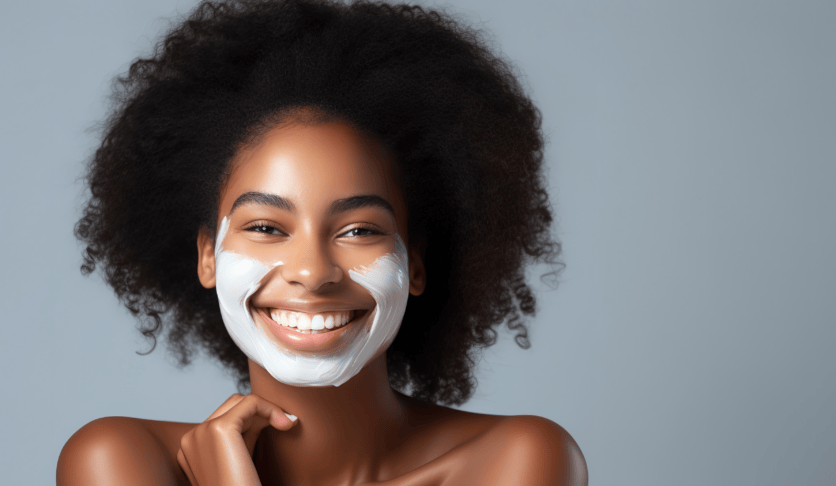
Understanding Topical Medications: Types, Benefits, and Side Effects for Managing Skin Conditions
February 5, 2024
0 Comments
republishUnderstanding Topical Medications: Types, Benefits, and Side Effects for Managing Skin Conditions
on this page:
Skin conditions can range from a mild annoyance, like an occasional blemish or patch of dry skin, to hives, rashes, and patches of scaly skin that itch or burn so intensely that you can’t focus on everyday activities. Some topical medications, like creams, require prescriptions from your healthcare provider, but many also fill the shelves of your local pharmacy or even grocery store, as well.
You may not even realize that when you’re reaching for an anti-itch cream to sooth your mosquito bite, you may be putting a drug on your skin, and possibly even into your bloodstream. Here’s what you need to know about the benefits and side effects of topical medications.
What are Topical Medications?
Topical medications are any sort of drugs that you apply to your skin, as opposed to swallowing or injecting into your body. They come in many forms such as gels, lotions, and creams. They can even be added to bathwater as a soaking element. Typically, you have an active ingredient, such as a corticosteroid, that is mixed with an inactive substance that makes it easy to apply to your skin.
Do Topical Medications Enter the Bloodstream?
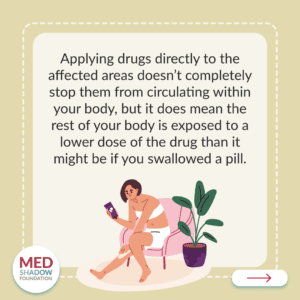
One of the main benefits of using a topical medication instead of a pill, syrup, or injection is that, if your ailment is on the skin or only on specific part of the body, (for example if you have pain, but only in your ankle), you can deliver the drug closer to that area instead of waiting for it travel through your digestive system and into your bloodstream. In many cases, this also means you’ll experience fewer side effects.
For example, while non-steroidal antiinflammatory drugs (NSAIDS) that come as gels or lotions may be more likely to irritate your skin, they are less likely to cause kidney problems, gastrointestinal, and cardiovascular side effects than pills you swallow that have to make their way from your mouth, to your kidneys or liver, all the way down to your ankle.
Still, even applying drugs directly to the affected areas doesn’t completely stop them from circulating within your body. Once absorbed, some of the drugs often do still end up in your bloodstream, meaning it’s still possible for topical medications to cause systemic side effects, such as stomach problems, in certain cases.
What is the Difference Between Medical Creams, Ointments, Gels and Lotions?
Topical medications come in many different consistencies and each preparation can deliver different concentrations of the active ingredient and offer separate benefits, such as cooling effects that can soothe itchiness. Of course, that means the consistency of the preparation may also impact the side effects it causes on your skin.
Ointments
Ointments are mostly made of oil. They can feel greasy but are also helpful for moisturizing dry skin or open wounds. They deliver more potent doses of drugs than creams or lotions.
Creams
Creams are made mostly of water with a little bit of oil mixed in. They dissolve quickly and usually deliver a little bit less of the active ingredient than ointments.
Lotions
Like creams, lotions are mostly water, but they contain even less oil than creams. They can soothe dry, itchy skin caused by dermatitis and fungal infections. They are easier to apply to most areas of your body than ointments and creams, including skin with hair on it.
Gels
Gels are made of only water, and do not contain any oil or fat. The skin absorbs less medication from gels than from ointments, creams, or lotions. They can be useful for conditions in which you want a low dose of medication that is absorbed slowly over time.
Foams
Foams are aerosolized solutions that usually use alcohol as a base. You quickly absorb medications from foams, and they can be applied to many areas of your skin including those covered in hair.
Soaks
If you add a soap, salt, crystal, or powder to your bathwater, you are creating a “soak.” You can’t easily control the exact amount of the drug you get, but you can efficiently apply it to large areas of your body. It’s mostly used for milder conditions that don’t require stronger medications.
Powders
Powders are dry and can be used on skin that’s been irritated by too much moisture or by skin-on-skin chafing.
Types of Skin Medications
Topical medications come in a variety of formulations that you rub into your skin or soak in.
Antibacterial
As you can likely predict, topical antibacterial medications are used to treat conditions caused by bacteria, such as certain types of acne, rosacea, staph infections, or wounds that could get infected.
Examples of Topical Antibacterial Medications include:
- Clindamycin
- Erythromycin
- Metronidazole
- Mupirocin
- Retapamulin
- Ozenoxacin
- Bacitracin
- Neomycin
Side Effects of Topical Antibacterial Drugs
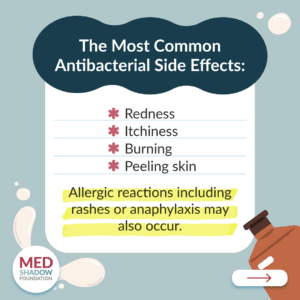
The most common side effects are
- Redness
- Itchiness
- Burning
- Peeling skin
- Allergic reactions including rashes or anaphylaxis
If your skin is slightly irritated—a little red or peeling more than usual—it’s important to keep it moisturized. In addition to your normal moisturizer, you may find that applying aloe vera is soothing, Anna Chacon, MD told MedShadow. Chacon is a dermatologist with MyPsoriasisTeam, an online support group for those with psoriasis.
Topical Steroids
One of the most common types of over-the-counter (OTC) topical medications is cortisone. It treats itchiness caused by mosquito bites, rashes, and mild burns. It’s a corticosteroid, which works by reducing inflammation. These types of drugs are common in prescription medications for eczema, psoriasis, and other inflammatory skin conditions.
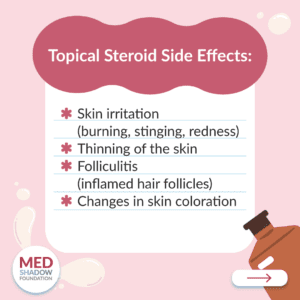
“Topical steroids, while effective, have many side effects, especially when used long term,” dermatologist Emma Guttman, MD, Ph.D., told MedShadow. Guttman is vice chair for research in the department of dermatology at the Icahn School of Medicine at Mount Sinai in New York City.
Side Effects of Topical Corticosteroids
- Skin irritation (burning, stinging, redness)
- Thinning of the skin
- Folliculitis (inflamed hair follicles)
- Changes in skin coloration
In some cases, if you use high doses of topical corticosteroids, or take them consistently for an extended period of time, (the timing and dose will likely vary from person to person) you may end up with more of the drug in your blood stream leading to systemic side effects, more like the ones you might experience when taking oral corticosteroids, such as:
- Increased appetite
- Stomach upset
- Acid reflux
- Swelling (especially in the legs and face)
- Mood changes
Topical Anti-inflammatories
In addition to corticosteroids, there are other drugs that target inflammation through your skin. They’re typically used to treat psoriasis and eczema. However, there are also topical non-steroidal anti-inflammatory drugs for pain, as well.
Topical Anti-inflammatories include:
- Eucrisa
- Diclofenac (NSAID for pain)
- Elidel
- Protopic
Side Effects of Topical Anti-inflammatories
Labels on Elidel and Protopic include a black box warning due to the potential risk of cancer (about 1% of people who used the Elidel developed lymphoma and skin cancer) with long term use. Researchers found a weak association between the drugs and a heightened risk of lymphoma, but not other cancers, in a more recent 2021 study.
As a result, these treatments are only recommended for people who can’t use other treatments, or whose eczema symptoms did not improve with other treatments.
Protopic’s black box includes a warning not to use the stronger 1% formulation in children between 2 and 15 years old. Only the .03% strength should be used by this age group. Also, neither Elidel nor Protopic is recommended for use longer than six weeks.
Common side effects of topical anti-inflammatories include:
- Burning
- Stinging
Topical Antifungals
Fungal infections are common on your skin, nails, and scalp. For these types of infections, there are a variety of topical powders, gels, and creams to treat the conditions. Antifungals work by killing fungus or stopping it from replicating and spreading.
For some types of fungal skin and nail infections, you may be able to purchase an OTC antifungal cream, ointment, or vaginal tablets. Still, it’s best to speak with your healthcare provider before taking an OTC antifungal if you can, because bacterial infections can cause similar symptoms.
If you have a bacterial infection, and you take an antifungal, you might worsen the bacterial infection. Antifungal medications only kill fungus; for bacteria, you need an antibiotic. If the infection is more severe, you may need a prescription antifungal.
Examples of antifungals include:
- Mycostatin
- Monistat (miconazole)
- Diflucan
Side Effects of Antifungals
- Increased risk of bacterial infections
- Itchy, red skin
There are many types of antifungals, and each comes with its own side effects. Read Get Rid of Fungal Infections: Antifungal Treatment Options and Side Effects.
Topical Chemotherapy
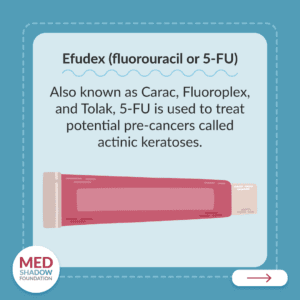
Efudex (fluorouracil or 5-FU), also known as Carac, Fluoroplex, and Tolak, is used to treat potential pre-cancers called actinic keratoses, which are crusty, scaly growths caused by damage from sun exposure. Efudex works by preventing the production of DNA in the cell being treated, resulting in the death of the cell. It is generally used twice a day for four weeks.
When April Pulliam first treated her chest with the chemotherapy cream Efudex, the itching, burning, and seeping sores were to be expected, as the cream irritated potentially precancerous spots. The nausea, nagging headaches, and fatigue, however, were not.
“I was surprised that a cream could make me feel tired and run-down,” the third-grade teacher from Bolivar, Tennessee, said.
Then she realized that it made sense.
“It’s chemotherapy in a cream,” she told MedShadow.
Several other patients shared her experience on AskAPatient.com, where they described extreme fatigue and flu-like symptoms while using the treatment.
Side Effects of Efudex Include
- Redness
- Irritation
- Sores and blisters
But other possible side effects of Efudex include:
- Trouble sleeping
- Irritability
- Temporary hair loss
- Abnormal taste in the mouth.
- Stomach or abdominal pain
- Bloody diarrhea
- Vomiting
- Signs of infection (fever, chills, persistent sore throat)
- Easy bruising or bleeding or mouth sores.
Keratolytics
Keratolytics are drugs that accelerate the exfoliation of your skin, helping older skin cells flake off. These drugs are often used to treat acne, signs of aging, psoriasis, warts, and calluses. Examples of keratolytics include:
- Salicylic acid
- Retin-A (tretinoin)
- Urea
Side Effects of Keratolytics
Since these medications work by helping your outer layers of skin flake off, peeling skin is a common side effect. They are also known to cause:
- Redness
- Itching
- Stinging and burning
- Increased risk of sunburn
Antihistamines
You may be familiar with antihistamines, which are available OTC as pills to treat seasonal allergies. However, antihistamine gels and creams can treat allergic reactions on the skin such as hives, or mosquito bites.
Examples of topical antihistamines include:
- Benadryl cream (diphenhydramine/zinc acetate)
- Prudoxin (doxepin cream)
Side Effects of Topical Antihistamines
- Allergic reactions on the skin (experts recommend taking oral diphenhydramine as opposed to creams, which are more likely to cause allergic reactions that worsen your symptoms)
- Burning or stinging
- Drowsiness (occurs in 20% of patients who use Prudoxin, especially if you apply it to more than 10% of your skin.)
- Dry mouth
- Hives
- Dizziness
- Mood changes
Natural Topical Remedies
When your skin starts to get a little red and angry or your muscles get a bit achy there are options you can try before reaching for the cortisone cream.
Cool Your Skin with Oatmeal Baths
Oatmeal mixed with water can help to cool rashes brought on by heat.
Studies have shown that such mixtures can also aid in relieving irritated skin conditions, due to oatmeal’s antiinflammatory properties. While some products (such as Aveeno) contain oatmeal, the food itself can be used to increase skin’s moisture on its own.
One 2018 review explained that the antioxidant and antiinflammatory effects of colloidal oatmeal are derived from a plant chemical called “avenanthramides.” Some say oatmeal may also soothe the skin after a sunburn.
For preparation, some recommend a cup of steel-cut, organic oatmeal mixed with warm water. Mix the oats in a bowl until a paste is created, and apply it to the skin. Allow the paste to dry before removing with warm water.
Ease Pain with Epsom Salt Soaks
Studies show that salts, like Epsom, break down in water. In this process, magnesium and sulfate are released. Studies show that magnesium has benefits treating everything from depression to body aches. However, there has been limited research if the element is absorbed through the skin during treatment such as a bath.
How Do You Fix Sensitive Skin?
Seventy percent of adults say they have sensitive skin, according to a 2019 study. Erum Ilyas, MD, a dermatologist at Schweiger Dermatology, explains that sensitive skin is not a medical condition in and of itself. The self-diagnosed condition can mean different things to different people.
“Usually when people say they have sensitive skin, they are implying that their skin gets irritated really easily,” he says.
Your skin can get irritated for a variety of reasons, from dryness to allergies, rosacea, and even because of products, such as retinol or vitamin C, designed to irritate it with the goal of creating a youthful appearance.
One way to manage sensitive skin is to look at the products you’re using and consider whether some of them contain active ingredients that you should use less often, or that you should only use at night because they make your skin more sensitive to the sun. You can also visit a dermatologist to determine if you have conditions like rosacea, or precancerous spots called actinic keratosis, that may be irritated.
Drugs that Can Affect Your Skin or Make it More Sensitive to the Sun
It’s not just topical creams and lotions that affect your skin. Many drugs can cause side effects that dry out or irritate your skin, including:
Other drugs can make your skin more sensitive to the sun. Make sure to protect your skin when you go outside if you’re using any of the following medications:
- Antiarrhythmics such as amiodarone (Cordarone, Pacerone, Nexterone)
- Antipsychotics such as chlorpromazine (Thorazine, Largactil)
- Many types of antibiotics such as doxycycline (Adoxa, Vibramycin, Doryx, Monodox, Oracea, Periostat) Nalidixic acid (NegGram), tetracycline (Sumycin), sulfonamides, ciprofloxacin, and trimethoprim.
- Diuretics such as hydrochlorothiazide (Microzide), which is used to treat high blood pressure
- Chemotherapy and immunosuppressant drugs such as methotrexate, which treats cancer and some autoimmune diseases
- Nonsteroidal anti-inflammatory drugs (NSAIDS), such as Midol and Aleve
- Statins, such as atorvastatin, lovastatin, pravastatin and simvastatin, used to lower cholesterol
- St. John’s wort, (hypericum perforatum), used to treat depression and menopause
- Antifungal medications such as voriconazole (Vfend),
- Antihistamines that treat allergies
- Oral contraceptives
- Retinoids such as tretinoin
- Sulfonylureas for type 2 diabetes (glipizide, glyburide)
What is the Healthiest Sunscreen to Use?
As you now are undoubtedly aware, creams, gels, and sprays that you rub on your skin can be readily absorbed into your bloodstream. That includes sunscreens. The best way to reduce your risk is to use clothing and hats to protect your skin when you’re in the sun, and then apply sunscreen only to the portions of your skin that you can’t otherwise cover.
Nonetheless, that advice isn’t always practical for sports, swimming, and other outdoor activities on hot, sunny days. When you do need to use sunscreen, reach for formulas that use minerals, zinc oxide, or titanium dioxide to block the sun with a physical barrier, as opposed to other products that cause a chemical reaction.
The latter are more readily absorbed into your skin, and the safety of many of these chemicals is still unknown. Some are endocrine disruptors which interfere with the functioning of the glands and organs in our bodies that release hormones responsible for guiding our growth, development, metabolism, reproduction, and more.

Want to Share Your Story?
If you’ve experienced side effects or medication issues related to this topic, we want to hear from you.
Submit Your Story- U.S. Food and Drug Administration. (n.d.). Sun and your medicine. U.S. Department of Health and Human Services
- Schwartz, B. (2024, September 26). Dermatologist Near Me | Schweiger Dermatology Group | Book Online. Schweiger Dermatology Group.
- Chen, W., Dai, R., & Li, L. (2019). The prevalence of self‐declared sensitive skin: a systematic review and meta‐analysis. Journal of the European Academy of Dermatology and Venereology, 34(8), 1779–1788
- Simon, A. (n.d.). Homemade oatmeal mask for skin rashes – Home Remedies.
- Perrelli A, Goitre L, Salzano AM, Moglia A, Scaloni A, Retta SF. Biological Activities, Health Benefits, and Therapeutic Properties of Avenanthramides: From Skin Protection to Prevention and Treatment of Cerebrovascular Diseases. Oxid Med Cell Longev. 2018 Aug 23;2018:6015351. doi: 10.1155/2018/6015351. PMID: 30245775; PMCID: PMC6126071.
- Reynertson KA, Garay M, Nebus J, Chon S, Kaur S, Mahmood K, Kizoulis M, Southall MD. Anti-inflammatory activities of colloidal oatmeal (Avena sativa) contribute to the effectiveness of oats in treatment of itch associated with dry, irritated skin. J Drugs Dermatol. 2015 Jan;14(1):43-8. PMID: 25607907.
- DailyMed – PRUDOXIN- doxepin hydrochloride cream. (n.d.-b).
- DailyMed – PRUDOXIN- doxepin hydrochloride cream. (n.d.).
- Cancer Resources from OncoLink, Treatment, Research, Coping, Clinical Trials, Prevention. (n.d.). Fluorouracil Topical (5-FU, Carac®, Efudex®, Fluoroplex®) | OncoLink. University of Pennsylvania – OncoLink
- The Skin Cancer Foundation. (2024, September 22). Actinic Keratosis – The Skin Cancer Foundation.
- Lam M, Zhu JW, Tadrous M, Drucker AM. Association Between Topical Calcineurin Inhibitor Use and Risk of Cancer, Including Lymphoma, Keratinocyte Carcinoma, and Melanoma: A Systematic Review and Meta-analysis. JAMA Dermatol. 2021;157(5):549–558. doi:10.1001/jamadermatol.2021.0345
- U.S. Food and Drug Administration. (2005, December 9). FDA approves updated labeling, boxed warning, and medication guide for two eczema drugs, Elidel and Protopic. U.S. Department of Health and Human Services
- Website, N. (2024, September 11). Topical corticosteroids. nhs.uk.
- Emma Guttman – Dermatology | Mount Sinai – New York. (2024, September 1). Mount Sinai Health System
- Anna Chacon, M.D. | Medical Reviewer | MyPsoriasisTeam. (n.d.). MyPsoriasisTeam.
- Nguyen R, Khanna NR, Safadi AO, et al. Bacitracin Topical. [Updated 2024 Jun 8]. In: StatPearls [Internet]. Treasure Island (FL): StatPearls Publishing; 2024 Jan-.
- van Zuuren EJ, Fedorowicz Z, Carter B, van der Linden MMD, Charland L. Interventions for rosacea. Cochrane Database of Systematic Reviews 2015, Issue 4. Art. No.: CD003262. DOI: 10.1002/14651858.CD003262.pub5
- Keri, J. E. (2024b, February 9). Treatment of Skin Disorders. Merck Manual Consumer Version.
- Makris UE, Kohler MJ, Fraenkel L. Adverse effects of topical nonsteroidal antiinflammatory drugs in older adults with osteoarthritis: a systematic literature review. J Rheumatol. 2010 Jun;37(6):1236-43. doi: 10.3899/jrheum.090935. Epub 2010 Apr 1. PMID: 20360183; PMCID: PMC2880214.
- Keri, J. E. (2024, February 9). Treatment of Skin Disorders. Merck Manual Consumer Version.
DISCLAIMER: MedShadow provides information and resources related to medications, their effects, and potential side effects. However, it is important to note that we are not a substitute for professional medical advice, diagnosis, or treatment. The content on our site is intended for educational and informational purposes only. Individuals dealing with medical conditions or symptoms should seek guidance from a licensed healthcare professional, such as a physician or pharmacist, who can provide personalized medical advice tailored to their specific circumstances.
While we strive to ensure the accuracy and reliability of the information presented on MedShadow, we cannot guarantee its completeness or suitability for any particular individual’s medical needs. Therefore, we strongly encourage users to consult with qualified healthcare professionals regarding any health-related concerns or decisions. By accessing and using MedShadow, you acknowledge and agree that the information provided on the site is not a substitute for professional medical advice and that you should always consult with a qualified healthcare provider for any medical concerns.
on this page:
RECOMMENDED:


DONATE:
Help fund our fight for improved medication safety and transparency by supporting our independent journalism.
Give NowWe seek to create a world where there are safer medications for all and where all people are fully informed about their medication benefits and side effects, using our explanatory and investigative journalism to both inform and stimulate public discussion to drive toward solutions.
WEBINARS
Stream our library on demand, including insights on generic drugs and pain management, straight from experts.
WATCH NOW
Republish This Story for Free
Creative Commons License (CC BY-NC-ND 4.0)MedShadow.org is dedicated to empowering people with our evidence-based journalism about the safest ways to take over-the-counter (OTC) and prescription (Rx) medications.
We also seek to stimulate public discussion about potential improvements to drug research, manufacturing and distribution processes. and also to encourage the improvement of processes to ensure that we are all better protected.
As a result, we encourage other nonprofit newsrooms, mission-aligned outlets, and advocacy organizations to republish our original content under the following conditions:
You May Republish Our Articles for Free If:
1. We Are Credited Fully and Clearly
You must include the byline and credit MedShadow.org as the original publisher. Please include a link to the original article at the top or bottom of the piece. Use the following attribution:
This article was originally published by MedShadow, a nonprofit foundation that focuses on the safest ways to take over-the-counter and prescription medications.
2. Our Content Isn’t Edited Without Permission
You may make small changes for clarity, such as adjusting headlines, subheadings, or transitions, but you may not change the core meaning, tone, or intent of the article. For substantive edits, email us at republish@medshadow.org for review and approval.
3. You Do Not Sell Or Use Our Content Commercially
Our work is free to share, but it may not be sold, monetized, or repurposed for commercial gain. You may not republish our articles behind a paywall or in publications whose primary purpose is advertising or product promotion. You may not place drug or supplement advertising adjacent to our story.
4. Photos, Graphics, and Multimedia Are Not Used Without Permission
Only the text of the article is available for republication. Images, graphics, and videos may not be reused without explicit written permission, unless they are clearly marked as Creative Commons licensed. Contact us if you’d like to request reuse of a visual asset.
You May Not:
- Use our content to promote a product, service, or political candidate
- Republish only part of an article or create derivative works without permission
- Add affiliate links, advertising overlays, or lead generators
- Translate the article without written permission
Contact Us
If you’re unsure whether your intended use falls within these guidelines, or would like to discuss a formal syndication or licensing arrangement, please email: republish@medshadow.org
We want our journalism to reach as many people as possible, especially those making critical decisions about medications and health.
Article HTML
<!-- wp:paragraph -->
<p>Skin conditions can range from a mild annoyance, like an occasional blemish or patch of dry skin, to hives, rashes, and patches of scaly skin that itch or burn so intensely that you can’t focus on everyday activities. Some topical medications, like creams, require prescriptions from your healthcare provider, but many also fill the shelves of your local pharmacy or even grocery store, as well. </p>
<!-- /wp:paragraph --><!-- wp:paragraph -->
<p>You may not even realize that when you’re reaching for an anti-itch cream to sooth your mosquito bite, you may be putting a drug on your skin, and possibly even into your bloodstream. Here’s what you need to know about the benefits and side effects of topical medications.</p>
<!-- /wp:paragraph --><!-- wp:heading -->
<h2 class="wp-block-heading">What are Topical Medications?</h2>
<!-- /wp:heading --><!-- wp:paragraph -->
<p>Topical medications are any sort of drugs that you apply to your skin, as opposed to swallowing or injecting into your body. They come in many forms such as gels, lotions, and creams. They can even be added to bathwater as a soaking element. Typically, you have<a href="https://www.merckmanuals.com/home/skin-disorders/treatment-of-skin-disorders/treatment-of-skin-disorders" target="_blank" rel="noreferrer noopener"> an active ingredient</a>, such as a corticosteroid, that is mixed with an inactive substance that makes it easy to apply to your skin.</p>
<!-- /wp:paragraph --><!-- wp:heading -->
<h2 class="wp-block-heading">Do Topical Medications Enter the Bloodstream?</h2>
<!-- /wp:heading --><!-- wp:image {"id":760,"sizeSlug":"full","linkDestination":"none","align":"right"} -->
<figure class="wp-block-image alignright size-full"><img src="https://medshadow.org/wp-content/uploads/2025/09/Do-Topical-Medications-Enter-the-Bloodstream-300x300-1.png" alt="" class="wp-image-760"/><figcaption class="wp-element-caption">Do Topical Medications Enter the Bloodstream</figcaption></figure>
<!-- /wp:image --><!-- wp:paragraph -->
<p>One of the main benefits of using a topical medication instead of a pill, syrup, or injection is that, if your ailment is on the skin or only on specific part of the body, (for example if you have pain, but only in your ankle), you can deliver the drug closer to that area instead of waiting for it travel through your digestive system and into your bloodstream. In many cases, this also means you’ll experience fewer side effects.</p>
<!-- /wp:paragraph --><!-- wp:paragraph -->
<p>For example, while non-steroidal antiinflammatory drugs (NSAIDS) that come as gels or lotions may be more likely to irritate your skin, they are less likely to cause <a href="https://www.ncbi.nlm.nih.gov/pmc/articles/PMC2880214/" target="_blank" rel="noreferrer noopener">kidney problems</a>, <a href="https://pubmed.ncbi.nlm.nih.gov/23703519/" target="_blank" rel="noreferrer noopener">gastrointestinal</a>, and <a href="https://www.ahajournals.org/doi/10.1161/JAHA.117.006874" target="_blank" rel="noreferrer noopener">cardiovascular</a> side effects than pills you swallow that have to make their way from your mouth, to your kidneys or liver, all the way down to your ankle.</p>
<!-- /wp:paragraph --><!-- wp:paragraph -->
<p>Still, even applying drugs directly to the affected areas doesn’t completely stop them from circulating within your body. Once absorbed, some of the drugs often do still end up in your bloodstream, meaning it’s still possible for topical medications to cause systemic side effects, such as stomach problems, in certain cases. </p>
<!-- /wp:paragraph --><!-- wp:heading -->
<h2 class="wp-block-heading">What is the Difference Between Medical Creams, Ointments, Gels and Lotions?</h2>
<!-- /wp:heading --><!-- wp:image {"id":759,"sizeSlug":"full","linkDestination":"none","align":"right"} -->
<figure class="wp-block-image alignright size-full"><img src="https://medshadow.org/wp-content/uploads/2025/09/What-is-the-Difference-Between-Medical-Creams-Ointments-Gels-and-Lotions-300x300-1.png" alt="" class="wp-image-759"/><figcaption class="wp-element-caption">What is the Difference Between Medical Creams, Ointments, Gels and Lotions<br></figcaption></figure>
<!-- /wp:image --><!-- wp:paragraph -->
<p>Topical medications come in<a href="https://www.merckmanuals.com/home/skin-disorders/treatment-of-skin-disorders/treatment-of-skin-disorders" target="_blank" rel="noreferrer noopener"> many different consistencies</a> and each preparation can deliver different concentrations of the active ingredient and offer separate benefits, such as cooling effects that can soothe itchiness. Of course, that means the consistency of the preparation may also impact the side effects it causes on your skin.</p>
<!-- /wp:paragraph --><!-- wp:heading {"level":3} -->
<h3 class="wp-block-heading">Ointments</h3>
<!-- /wp:heading --><!-- wp:paragraph -->
<p>Ointments are mostly made of oil. They can feel greasy but are also helpful for moisturizing dry skin or open wounds. They deliver more potent doses of drugs than creams or lotions.</p>
<!-- /wp:paragraph --><!-- wp:heading {"level":3} -->
<h3 class="wp-block-heading">Creams</h3>
<!-- /wp:heading --><!-- wp:paragraph -->
<p>Creams are made mostly of water with a little bit of oil mixed in. They dissolve quickly and usually deliver a little bit less of the active ingredient than ointments.</p>
<!-- /wp:paragraph --><!-- wp:heading {"level":3} -->
<h3 class="wp-block-heading">Lotions</h3>
<!-- /wp:heading --><!-- wp:paragraph -->
<p>Like creams, lotions are mostly water, but they contain even less oil than creams. They can soothe dry, itchy skin caused by dermatitis and fungal infections. They are easier to apply to most areas of your body than ointments and creams, including skin with hair on it.</p>
<!-- /wp:paragraph --><!-- wp:heading {"level":3} -->
<h3 class="wp-block-heading">Gels</h3>
<!-- /wp:heading --><!-- wp:paragraph -->
<p>Gels are made of only water, and do not contain any oil or fat. The skin absorbs less medication from gels than from ointments, creams, or lotions. They can be useful for conditions in which you want a low dose of medication that is absorbed slowly over time.</p>
<!-- /wp:paragraph --><!-- wp:heading {"level":3} -->
<h3 class="wp-block-heading">Foams</h3>
<!-- /wp:heading --><!-- wp:paragraph -->
<p>Foams are aerosolized solutions that usually use alcohol as a base. You quickly absorb medications from foams, and they can be applied to many areas of your skin including those covered in hair. </p>
<!-- /wp:paragraph --><!-- wp:heading {"level":3} -->
<h3 class="wp-block-heading">Soaks</h3>
<!-- /wp:heading --><!-- wp:paragraph -->
<p>If you add a soap, salt, crystal, or powder to your bathwater, you are creating a “soak.” You can’t easily control the exact amount of the drug you get, but you can efficiently apply it to large areas of your body. It’s mostly used for milder conditions that don’t require stronger medications.</p>
<!-- /wp:paragraph --><!-- wp:heading {"level":3} -->
<h3 class="wp-block-heading">Powders</h3>
<!-- /wp:heading --><!-- wp:paragraph -->
<p>Powders are dry and can be used on skin that’s been irritated by too much moisture or by skin-on-skin chafing.</p>
<!-- /wp:paragraph --><!-- wp:heading -->
<h2 class="wp-block-heading">Types of Skin Medications</h2>
<!-- /wp:heading --><!-- wp:paragraph -->
<p>Topical medications come in a variety of formulations that you rub into your skin or soak in.</p>
<!-- /wp:paragraph --><!-- wp:heading {"level":3} -->
<h3 class="wp-block-heading">Antibacterial</h3>
<!-- /wp:heading --><!-- wp:paragraph -->
<p>As you can likely predict, topical antibacterial medications are used to treat conditions caused by bacteria, such as certain types of acne, rosacea, staph infections, or wounds that could get infected.</p>
<!-- /wp:paragraph --><!-- wp:heading {"level":4} -->
<h4 class="wp-block-heading">Examples of Topical Antibacterial Medications include:</h4>
<!-- /wp:heading --><!-- wp:list -->
<ul class="wp-block-list"><!-- wp:list-item -->
<li>Clindamycin</li>
<!-- /wp:list-item --><!-- wp:list-item -->
<li>Erythromycin</li>
<!-- /wp:list-item --><!-- wp:list-item -->
<li>Metronidazole</li>
<!-- /wp:list-item --><!-- wp:list-item -->
<li>Mupirocin</li>
<!-- /wp:list-item --><!-- wp:list-item -->
<li>Retapamulin</li>
<!-- /wp:list-item --><!-- wp:list-item -->
<li>Ozenoxacin</li>
<!-- /wp:list-item --><!-- wp:list-item -->
<li><a href="https://www.ncbi.nlm.nih.gov/books/NBK536993/#:~:text=Indications-,Bacitracin%20is%20a%20topical%20antibiotic%20ointment%20widely%20used%20by%20both,American%20girl%20named%20Margaret%20Tracey." target="_blank" rel="noreferrer noopener">Bacitracin</a></li>
<!-- /wp:list-item --><!-- wp:list-item -->
<li>Neomycin</li>
<!-- /wp:list-item --></ul>
<!-- /wp:list --><!-- wp:heading {"level":4} -->
<h4 class="wp-block-heading">Side Effects of Topical Antibacterial Drugs</h4>
<!-- /wp:heading --><!-- wp:image {"id":758,"sizeSlug":"full","linkDestination":"none","align":"right"} -->
<figure class="wp-block-image alignright size-full"><img src="https://medshadow.org/wp-content/uploads/2025/09/Antibacterial-Side-Effects-300x300-1.png" alt="" class="wp-image-758"/><figcaption class="wp-element-caption">The Most Common Antibacterial Side Effects</figcaption></figure>
<!-- /wp:image --><!-- wp:paragraph -->
<p>The<a href="https://www.cochrane.org/CD003262/SKIN_treatments-rosacea" target="_blank" rel="noreferrer noopener"> most common side effects</a> are</p>
<!-- /wp:paragraph --><!-- wp:list -->
<ul class="wp-block-list"><!-- wp:list-item -->
<li>Redness</li>
<!-- /wp:list-item --><!-- wp:list-item -->
<li>Itchiness</li>
<!-- /wp:list-item --><!-- wp:list-item -->
<li>Burning</li>
<!-- /wp:list-item --><!-- wp:list-item -->
<li>Peeling skin</li>
<!-- /wp:list-item --><!-- wp:list-item -->
<li><a href="https://www.ncbi.nlm.nih.gov/books/NBK536993/#:~:text=Indications-,Bacitracin%20is%20a%20topical%20antibiotic%20ointment%20widely%20used%20by%20both,American%20girl%20named%20Margaret%20Tracey." target="_blank" rel="noreferrer noopener">Allergic reactions including rashes or anaphylaxis</a></li>
<!-- /wp:list-item --></ul>
<!-- /wp:list --><!-- wp:paragraph -->
<p>If your skin is slightly irritated—a little red or peeling more than usual—it’s important to keep it moisturized. In addition to your normal moisturizer, you may find that applying aloe vera is soothing, <a href="https://www.mypsoriasisteam.com/writers/615cad5bd9e5c87398f1d6aa" target="_blank" rel="noreferrer noopener"> Anna Chacon</a>, MD told MedShadow. Chacon is a dermatologist with MyPsoriasisTeam, an online support group for those with psoriasis.</p>
<!-- /wp:paragraph --><!-- wp:heading {"level":3} -->
<h3 class="wp-block-heading">Topical Steroids</h3>
<!-- /wp:heading --><!-- wp:paragraph -->
<p>One of the most common types of over-the-counter (OTC) topical medications is cortisone. It treats itchiness caused by mosquito bites, rashes, and mild burns. It’s a<a href="https://medshadow.org/conditions-treatments/steroids/corticosteroids/" target="_blank" rel="noreferrer noopener"> corticosteroid</a>, which works by reducing inflammation. These types of drugs are common in prescription medications for<a href="https://medshadow.org/eczema-skin-eucrisa/" target="_blank" rel="noreferrer noopener"> eczema</a>,<a href="https://medshadow.org/know-taking-psoriasis-drugs/" target="_blank" rel="noreferrer noopener"> psoriasis</a>, and other inflammatory skin conditions.</p>
<!-- /wp:paragraph --><!-- wp:image {"id":757,"sizeSlug":"full","linkDestination":"none","align":"right"} -->
<figure class="wp-block-image alignright size-full"><img src="https://medshadow.org/wp-content/uploads/2025/09/Topical-Steroid-Side-Effects-300x300-1.png" alt="" class="wp-image-757"/><figcaption class="wp-element-caption">Topical Steroid Side Effects<br></figcaption></figure>
<!-- /wp:image --><!-- wp:paragraph -->
<p>“Topical steroids, while effective, have many side effects, especially when used long term,” dermatologist <a href="https://www.mountsinai.org/profiles/emma-guttman" target="_blank" rel="noreferrer noopener">Emma Guttman, MD, Ph.D.</a>, told MedShadow. Guttman is vice chair for research in the department of dermatology at the Icahn School of Medicine at Mount Sinai in New York City.</p>
<!-- /wp:paragraph --><!-- wp:heading {"level":4} -->
<h4 class="wp-block-heading"><a href="https://www.nhs.uk/conditions/topical-steroids/" target="_blank" rel="noreferrer noopener">Side Effects of Topical Corticosteroids</a></h4>
<!-- /wp:heading --><!-- wp:list -->
<ul class="wp-block-list"><!-- wp:list-item -->
<li>Skin irritation (burning, stinging, redness)</li>
<!-- /wp:list-item --><!-- wp:list-item -->
<li>Thinning of the skin</li>
<!-- /wp:list-item --><!-- wp:list-item -->
<li>Folliculitis (inflamed hair follicles)</li>
<!-- /wp:list-item --><!-- wp:list-item -->
<li>Changes in skin coloration</li>
<!-- /wp:list-item --></ul>
<!-- /wp:list --><!-- wp:paragraph -->
<p>In some cases, if you use high doses of topical corticosteroids, or take them consistently for an extended period of time, (the timing and dose will likely vary from person to person) you may end up with more of the drug in your blood stream leading to systemic side effects, more like the ones you might experience when taking oral corticosteroids, such as:</p>
<!-- /wp:paragraph --><!-- wp:list -->
<ul class="wp-block-list"><!-- wp:list-item -->
<li>Increased appetite</li>
<!-- /wp:list-item --><!-- wp:list-item -->
<li>Stomach upset</li>
<!-- /wp:list-item --><!-- wp:list-item -->
<li>Acid reflux</li>
<!-- /wp:list-item --><!-- wp:list-item -->
<li>Swelling (especially in the legs and face)</li>
<!-- /wp:list-item --><!-- wp:list-item -->
<li>Mood changes</li>
<!-- /wp:list-item --></ul>
<!-- /wp:list --><!-- wp:heading {"level":3} -->
<h3 class="wp-block-heading">Topical Anti-inflammatories</h3>
<!-- /wp:heading --><!-- wp:paragraph -->
<p>In addition to corticosteroids, there are other drugs that target inflammation through your skin. They’re typically used to treat psoriasis and eczema. However, there are also topical non-steroidal anti-inflammatory drugs for pain, as well.</p>
<!-- /wp:paragraph --><!-- wp:heading {"level":4} -->
<h4 class="wp-block-heading">Topical Anti-inflammatories include:</h4>
<!-- /wp:heading --><!-- wp:list -->
<ul class="wp-block-list"><!-- wp:list-item -->
<li>Eucrisa</li>
<!-- /wp:list-item --><!-- wp:list-item -->
<li>Diclofenac (NSAID for pain)</li>
<!-- /wp:list-item --><!-- wp:list-item -->
<li>Elidel</li>
<!-- /wp:list-item --><!-- wp:list-item -->
<li>Protopic</li>
<!-- /wp:list-item --></ul>
<!-- /wp:list --><!-- wp:heading {"level":4} -->
<h4 class="wp-block-heading">Side Effects of Topical Anti-inflammatories</h4>
<!-- /wp:heading --><!-- wp:paragraph -->
<p>Labels on Elidel and Protopic include a black box warning due to the potential risk of cancer (about 1% of people who used the Elidel developed lymphoma and skin cancer) with long term use. Researchers found a weak association between the drugs and a heightened risk of lymphoma, but not other cancers, in a<a href="https://jamanetwork.com/journals/jamadermatology/fullarticle/2778024" target="_blank" rel="noreferrer noopener"> more recent 2021 study</a>.</p>
<!-- /wp:paragraph --><!-- wp:image {"id":756,"sizeSlug":"full","linkDestination":"none","align":"right"} -->
<figure class="wp-block-image alignright size-full"><img src="https://medshadow.org/wp-content/uploads/2025/09/Common-Side-Effects-of-Topical-Anti-Inflammatory-300x300-1.png" alt="" class="wp-image-756"/><figcaption class="wp-element-caption">Common Side Effects of Topical Anti-Inflammatory</figcaption></figure>
<!-- /wp:image --><!-- wp:paragraph -->
<p>As a result, these treatments are only recommended for people who can’t use other treatments, or whose eczema symptoms did not improve with other treatments. </p>
<!-- /wp:paragraph --><!-- wp:paragraph -->
<p>Protopic’s black box includes a warning not to use the stronger 1% formulation in children between 2 and 15 years old. Only the .03% strength should be used by this age group. Also, neither Elidel nor Protopic is recommended for use longer than six weeks.</p>
<!-- /wp:paragraph --><!-- wp:paragraph -->
<p>Common side effects of topical anti-inflammatories include:</p>
<!-- /wp:paragraph --><!-- wp:list -->
<ul class="wp-block-list"><!-- wp:list-item -->
<li>Burning</li>
<!-- /wp:list-item --><!-- wp:list-item -->
<li>Stinging</li>
<!-- /wp:list-item --></ul>
<!-- /wp:list --><!-- wp:heading {"level":3} -->
<h3 class="wp-block-heading">Topical Antifungals</h3>
<!-- /wp:heading --><!-- wp:paragraph -->
<p><a href="https://medshadow.org/get-rid-of-fungal-infections-antifungal-treatment-options-and-side-effects/" target="_blank" rel="noreferrer noopener">Fungal infections</a> are common on your skin, nails, and scalp. For these types of infections, there are a variety of topical powders, gels, and creams to treat the conditions. Antifungals work by killing fungus or stopping it from replicating and spreading. </p>
<!-- /wp:paragraph --><!-- wp:paragraph -->
<p>For some types of fungal skin and nail infections, you may be able to purchase an OTC antifungal cream, ointment, or vaginal tablets. Still, it’s best to speak with your healthcare provider before taking an OTC antifungal if you can, because bacterial infections can cause similar symptoms.</p>
<!-- /wp:paragraph --><!-- wp:image {"id":755,"sizeSlug":"full","linkDestination":"none","align":"right"} -->
<figure class="wp-block-image alignright size-full"><img src="https://medshadow.org/wp-content/uploads/2025/09/Topical-Antifungals-300x300-1.png" alt="" class="wp-image-755"/><figcaption class="wp-element-caption">Topical Antifungals<br></figcaption></figure>
<!-- /wp:image --><!-- wp:paragraph -->
<p>If you have a bacterial infection, and you take an antifungal, you might worsen the bacterial infection. Antifungal medications only kill fungus; for bacteria, you need an antibiotic. If the infection is more severe, you may need a prescription antifungal. </p>
<!-- /wp:paragraph --><!-- wp:paragraph -->
<p>Examples of antifungals include:</p>
<!-- /wp:paragraph --><!-- wp:list -->
<ul class="wp-block-list"><!-- wp:list-item -->
<li>Mycostatin </li>
<!-- /wp:list-item --><!-- wp:list-item -->
<li>Monistat (miconazole) </li>
<!-- /wp:list-item --><!-- wp:list-item -->
<li>Diflucan </li>
<!-- /wp:list-item --></ul>
<!-- /wp:list --><!-- wp:heading {"level":4} -->
<h4 class="wp-block-heading">Side Effects of Antifungals</h4>
<!-- /wp:heading --><!-- wp:list -->
<ul class="wp-block-list"><!-- wp:list-item -->
<li>Increased risk of bacterial infections</li>
<!-- /wp:list-item --><!-- wp:list-item -->
<li>Itchy, red skin</li>
<!-- /wp:list-item --></ul>
<!-- /wp:list --><!-- wp:paragraph -->
<p>There are many types of antifungals, and each comes with its own side effects. Read <a href="https://medshadow.org/get-rid-of-fungal-infections-antifungal-treatment-options-and-side-effects/" target="_blank" rel="noreferrer noopener">Get Rid of Fungal Infections: Antifungal Treatment Options and Side Effects</a>.</p>
<!-- /wp:paragraph --><!-- wp:heading {"level":3} -->
<h3 class="wp-block-heading"><a href="https://medshadow.org/skin-cancer-efusex-cream/" target="_blank" rel="noreferrer noopener">Topical Chemotherapy</a></h3>
<!-- /wp:heading --><!-- wp:image {"id":761,"sizeSlug":"full","linkDestination":"none","align":"right"} -->
<figure class="wp-block-image alignright size-full"><img src="https://medshadow.org/wp-content/uploads/2025/09/Efudex-300x300-1.png" alt="" class="wp-image-761"/><figcaption class="wp-element-caption"><em>Efudex</em></figcaption></figure>
<!-- /wp:image --><!-- wp:paragraph -->
<p>Efudex (fluorouracil or 5-FU), also known as Carac, Fluoroplex, and Tolak, is used to treat potential pre-cancers called <a href="https://www.skincancer.org/skin-cancer-information/actinic-keratosis" target="_blank" rel="noreferrer noopener">actinic keratoses</a>, which are crusty, scaly growths caused by damage from sun exposure. Efudex works by <a href="https://www.oncolink.org/cancer-treatment/oncolink-rx/fluorouracil-topical-5-fu-carac-r-efudex-r-fluoroplex" target="_blank" rel="noreferrer noopener">preventing the production of DNA in the cell being treated</a>, resulting in the death of the cell. It is generally used twice a day for four weeks.</p>
<!-- /wp:paragraph --><!-- wp:paragraph -->
<p>When April Pulliam first treated her chest with the chemotherapy cream Efudex, the itching, burning, and seeping sores were to be expected, as the cream irritated potentially precancerous spots. The nausea, nagging headaches, and fatigue, however, were not.</p>
<!-- /wp:paragraph --><!-- wp:paragraph -->
<p>“I was surprised that a cream could make me feel tired and run-down,” the third-grade teacher from Bolivar, Tennessee, said.</p>
<!-- /wp:paragraph --><!-- wp:paragraph -->
<p>Then she realized that it made sense.</p>
<!-- /wp:paragraph --><!-- wp:paragraph -->
<p>“It’s chemotherapy in a cream,” she told<a href="https://www.medshadow.org/skin-cancer-efusex-cream/" target="_blank" rel="noreferrer noopener"> MedShadow</a>.</p>
<!-- /wp:paragraph --><!-- wp:paragraph -->
<p>Several other patients shared her experience on<a href="https://www.askapatient.com/viewrating.asp?drug=16831&name=EFUDEX" target="_blank" rel="noreferrer noopener"> AskAPatient.com</a>, where they described extreme fatigue and flu-like symptoms while using the treatment.</p>
<!-- /wp:paragraph --><!-- wp:heading {"level":4} -->
<h4 class="wp-block-heading">Side Effects of Efudex Include</h4>
<!-- /wp:heading --><!-- wp:list -->
<ul class="wp-block-list"><!-- wp:list-item -->
<li>Redness</li>
<!-- /wp:list-item --><!-- wp:list-item -->
<li>Irritation</li>
<!-- /wp:list-item --><!-- wp:list-item -->
<li>Sores and blisters</li>
<!-- /wp:list-item --></ul>
<!-- /wp:list --><!-- wp:paragraph -->
<p>But other possible side effects of Efudex include:</p>
<!-- /wp:paragraph --><!-- wp:list -->
<ul class="wp-block-list"><!-- wp:list-item -->
<li>Trouble sleeping</li>
<!-- /wp:list-item --><!-- wp:list-item -->
<li>Irritability</li>
<!-- /wp:list-item --><!-- wp:list-item -->
<li>Temporary hair loss</li>
<!-- /wp:list-item --><!-- wp:list-item -->
<li>Abnormal taste in the mouth.</li>
<!-- /wp:list-item --><!-- wp:list-item -->
<li>Stomach or abdominal pain</li>
<!-- /wp:list-item --><!-- wp:list-item -->
<li>Bloody diarrhea</li>
<!-- /wp:list-item --><!-- wp:list-item -->
<li>Vomiting</li>
<!-- /wp:list-item --><!-- wp:list-item -->
<li>Signs of infection (fever, chills, persistent sore throat)</li>
<!-- /wp:list-item --><!-- wp:list-item -->
<li>Easy bruising or bleeding or mouth sores.</li>
<!-- /wp:list-item --></ul>
<!-- /wp:list --><!-- wp:heading {"level":3} -->
<h3 class="wp-block-heading">Keratolytics</h3>
<!-- /wp:heading --><!-- wp:paragraph -->
<p>Keratolytics are drugs that accelerate the exfoliation of your skin, helping older skin cells flake off. These drugs are often used to treat acne, signs of aging, psoriasis, warts, and calluses. Examples of keratolytics include:</p>
<!-- /wp:paragraph --><!-- wp:list -->
<ul class="wp-block-list"><!-- wp:list-item -->
<li>Salicylic acid</li>
<!-- /wp:list-item --><!-- wp:list-item -->
<li><a href="https://medshadow.org/retin-a-safety/" target="_blank" rel="noreferrer noopener">Retin-A (tretinoin)</a></li>
<!-- /wp:list-item --><!-- wp:list-item -->
<li>Urea</li>
<!-- /wp:list-item --></ul>
<!-- /wp:list --><!-- wp:heading {"level":4} -->
<h4 class="wp-block-heading">Side Effects of Keratolytics</h4>
<!-- /wp:heading --><!-- wp:paragraph -->
<p>Since these medications work by helping your outer layers of skin flake off, peeling skin is a common side effect. They are also known to cause:</p>
<!-- /wp:paragraph --><!-- wp:list -->
<ul class="wp-block-list"><!-- wp:list-item -->
<li>Redness</li>
<!-- /wp:list-item --><!-- wp:list-item -->
<li>Itching</li>
<!-- /wp:list-item --><!-- wp:list-item -->
<li>Stinging and burning</li>
<!-- /wp:list-item --><!-- wp:list-item -->
<li><a href="https://medshadow.org/drug-updates-recalls/drug-safety/drugs-can-make-skin-sun-sensitive/" target="_blank" rel="noreferrer noopener">Increased risk of sunburn</a></li>
<!-- /wp:list-item --></ul>
<!-- /wp:list --><!-- wp:heading {"level":3} -->
<h3 class="wp-block-heading">Antihistamines</h3>
<!-- /wp:heading --><!-- wp:paragraph -->
<p>You may be familiar with antihistamines, which are available OTC as pills to treat seasonal allergies. However, antihistamine gels and creams can treat allergic reactions on the skin such as hives, or mosquito bites.</p>
<!-- /wp:paragraph --><!-- wp:paragraph -->
<p>Examples of topical antihistamines include:</p>
<!-- /wp:paragraph --><!-- wp:list -->
<ul class="wp-block-list"><!-- wp:list-item -->
<li>Benadryl cream (diphenhydramine/zinc acetate)</li>
<!-- /wp:list-item --><!-- wp:list-item -->
<li>Prudoxin (doxepin cream)</li>
<!-- /wp:list-item --></ul>
<!-- /wp:list --><!-- wp:heading {"level":4} -->
<h4 class="wp-block-heading"><a href="https://dailymed.nlm.nih.gov/dailymed/drugInfo.cfm?setid=ca53346b-8ab3-4722-98f6-cf272706d3fa" target="_blank" rel="noreferrer noopener">Side Effects of Topical Antihistamines</a></h4>
<!-- /wp:heading --><!-- wp:list -->
<ul class="wp-block-list"><!-- wp:list-item -->
<li>Allergic reactions on the skin (experts recommend taking oral diphenhydramine as opposed to creams, which are more likely to cause allergic reactions that worsen your symptoms)</li>
<!-- /wp:list-item --><!-- wp:list-item -->
<li>Burning or stinging</li>
<!-- /wp:list-item --><!-- wp:list-item -->
<li><a href="https://dailymed.nlm.nih.gov/dailymed/drugInfo.cfm?setid=ca53346b-8ab3-4722-98f6-cf272706d3fa" target="_blank" rel="noreferrer noopener">Drowsiness</a> (occurs in 20% of patients who use Prudoxin, especially if you apply it to more than 10% of your skin.)</li>
<!-- /wp:list-item --><!-- wp:list-item -->
<li>Dry mouth</li>
<!-- /wp:list-item --><!-- wp:list-item -->
<li>Hives</li>
<!-- /wp:list-item --><!-- wp:list-item -->
<li>Dizziness</li>
<!-- /wp:list-item --><!-- wp:list-item -->
<li>Mood changes</li>
<!-- /wp:list-item --></ul>
<!-- /wp:list --><!-- wp:heading -->
<h2 class="wp-block-heading"><a href="https://medshadow.org/foods-as-medicine-for-skin/" target="_blank" rel="noreferrer noopener">Natural Topical Remedies</a></h2>
<!-- /wp:heading --><!-- wp:paragraph -->
<p>When your skin starts to get a little red and angry or your muscles get a bit achy there are <a href="https://medshadow.org/homemade-salves-for-eczema/" target="_blank" rel="noreferrer noopener">options you can try</a> before reaching for the cortisone cream. </p>
<!-- /wp:paragraph --><!-- wp:heading {"level":3} -->
<h3 class="wp-block-heading">Cool Your Skin with Oatmeal Baths</h3>
<!-- /wp:heading --><!-- wp:paragraph -->
<p>Oatmeal mixed with water can help to cool rashes brought on by heat.</p>
<!-- /wp:paragraph --><!-- wp:paragraph -->
<p><a href="https://pubmed.ncbi.nlm.nih.gov/25607907/" target="_blank" rel="noreferrer noopener">Studies have shown</a> that such mixtures can also aid in relieving irritated skin conditions, due to oatmeal’s antiinflammatory properties. While some products (such as Aveeno) contain oatmeal, the food itself can be used to increase skin’s moisture on its own.</p>
<!-- /wp:paragraph --><!-- wp:paragraph -->
<p><a href="https://pubmed.ncbi.nlm.nih.gov/30245775/" target="_blank" rel="noreferrer noopener">One 2018 review</a> explained that the antioxidant and antiinflammatory effects of colloidal oatmeal are derived from a plant chemical called “avenanthramides.” Some say oatmeal may also soothe the skin after a sunburn.</p>
<!-- /wp:paragraph --><!-- wp:paragraph -->
<p>For preparation, <a href="https://www.pushdoctor.co.uk/what-we-treat/skin-conditions/articles/homemade-oatmeal-mask-for-skin-rashes-home-remedies" target="_blank" rel="noreferrer noopener">some recommend</a> a cup of steel-cut, organic oatmeal mixed with warm water. Mix the oats in a bowl until a paste is created, and apply it to the skin. Allow the paste to dry before removing with warm water.</p>
<!-- /wp:paragraph --><!-- wp:heading {"level":3} -->
<h3 class="wp-block-heading">Ease Pain with Epsom Salt Soaks</h3>
<!-- /wp:heading --><!-- wp:paragraph -->
<p><a href="https://health.clevelandclinic.org/7-things-you-probably-didnt-know-about-epsom-salt/" target="_blank" rel="noreferrer noopener">Studies show that salts</a>, like Epsom, break down in water. In this process, magnesium and sulfate are released. <a href="https://pubmed.ncbi.nlm.nih.gov/19944540/" target="_blank" rel="noreferrer noopener">Studies show that magnesium</a> has benefits treating everything from depression to body aches. However, there has been limited research if the element is absorbed through the skin during treatment such as a bath.</p>
<!-- /wp:paragraph --><!-- wp:heading -->
<h2 class="wp-block-heading">How Do You Fix <a href="https://medshadow.org/how-to-manage-sensitive-skin/" target="_blank" rel="noreferrer noopener">Sensitive Skin</a>? </h2>
<!-- /wp:heading --><!-- wp:paragraph -->
<p>Seventy percent of adults say they have sensitive skin, according to a<a href="https://onlinelibrary.wiley.com/doi/abs/10.1111/jdv.16166" target="_blank" rel="noreferrer noopener"> 2019 study</a>. Erum Ilyas, MD, a dermatologist at <a href="https://www.schweigerderm.com/" target="_blank" rel="noreferrer noopener">Schweiger Dermatology</a>, explains that sensitive skin is not a medical condition in and of itself. The self-diagnosed condition can mean different things to different people. </p>
<!-- /wp:paragraph --><!-- wp:paragraph -->
<p>“Usually when people say they have sensitive skin, they are implying that their skin gets irritated really easily,” he says.</p>
<!-- /wp:paragraph --><!-- wp:paragraph -->
<p>Your skin can get irritated for a variety of reasons, from dryness to allergies, rosacea, and even because of products, such as retinol or vitamin C, designed to irritate it with the goal of creating a youthful appearance.</p>
<!-- /wp:paragraph --><!-- wp:paragraph -->
<p>One way to manage sensitive skin is to look at the products you’re using and consider whether some of them contain active ingredients that you should use less often, or that you should only use at night because they make your skin more sensitive to the sun. You can also visit a dermatologist to determine if you have conditions like rosacea, or precancerous spots called actinic keratosis, that may be irritated. </p>
<!-- /wp:paragraph --><!-- wp:heading -->
<h2 class="wp-block-heading">Drugs that Can Affect Your Skin or Make it More Sensitive to the Sun</h2>
<!-- /wp:heading --><!-- wp:paragraph -->
<p>It’s not just topical creams and lotions that affect your skin. Many drugs can cause side effects that dry out or irritate your skin, including:</p>
<!-- /wp:paragraph --><!-- wp:paragraph -->
<p>Other drugs can make your skin more sensitive to the sun. Make sure to protect your skin when you go outside if you’re using <a href="https://www.fda.gov/drugs/special-features/sun-and-your-medicine" target="_blank" rel="noreferrer noopener">any of the following medications</a>:</p>
<!-- /wp:paragraph --><!-- wp:list -->
<ul class="wp-block-list"><!-- wp:list-item -->
<li><a href="https://medshadow.org/heart-disease-prevention-treatments-and-side-effects/#Heart_Rhythm_Disorders_arrhythmias" target="_blank" rel="noreferrer noopener">Antiarrhythmics</a> such as amiodarone (Cordarone, Pacerone, Nexterone)</li>
<!-- /wp:list-item --><!-- wp:list-item -->
<li><a href="https://medshadow.org/antipsychotic-side-effects/" target="_blank" rel="noreferrer noopener">Antipsychotics</a> such as chlorpromazine (Thorazine, Largactil)</li>
<!-- /wp:list-item --><!-- wp:list-item -->
<li>Many types of antibiotics such as doxycycline (Adoxa, Vibramycin, Doryx, Monodox, Oracea, Periostat) Nalidixic acid (NegGram), tetracycline (Sumycin), sulfonamides, ciprofloxacin, and trimethoprim. </li>
<!-- /wp:list-item --><!-- wp:list-item -->
<li>Diuretics such as hydrochlorothiazide (Microzide), which is used to treat high blood pressure</li>
<!-- /wp:list-item --><!-- wp:list-item -->
<li><a href="https://medshadow.org/long-term-side-effects-of-chemo/" target="_blank" rel="noreferrer noopener">Chemotherapy</a> and immunosuppressant drugs such as methotrexate, which treats cancer and some <a href="https://medshadow.org/autoimmune-disease/" target="_blank" rel="noreferrer noopener">autoimmune diseases</a></li>
<!-- /wp:list-item --><!-- wp:list-item -->
<li>Nonsteroidal anti-inflammatory drugs (NSAIDS), such as Midol and Aleve</li>
<!-- /wp:list-item --><!-- wp:list-item -->
<li>Statins, such as <a href="https://www.webmd.com/drugs/2/drug-841/atorvastatin+oral/details" target="_blank" rel="noreferrer noopener">atorvastatin</a>, <a href="https://www.webmd.com/drugs/mono-92-LOVASTATIN+-+ORAL.aspx?drugid=11594&drugname=Lovastatin+Oral" target="_blank" rel="noreferrer noopener">lovastatin</a>, <a href="https://www.webmd.com/drugs/2/drug-6989/pravastatin-oral/details" target="_blank" rel="noreferrer noopener">pravastatin</a> and <a href="https://www.webmd.com/drugs/2/drug-6105/simvastatin+oral/details" target="_blank" rel="noreferrer noopener">simvastatin</a>, used to lower cholesterol</li>
<!-- /wp:list-item --><!-- wp:list-item -->
<li><a href="https://www.mountsinai.org/health-library/herb/st-johns-wort#:~:text=or%20mental%20confusion.-,St.,least%20SPF%2015%20or%20higher" target="_blank" rel="noreferrer noopener">St. John’s wort</a>, (hypericum perforatum), used to treat depression and menopause</li>
<!-- /wp:list-item --><!-- wp:list-item -->
<li><a href="https://medshadow.org/get-rid-of-fungal-infections-antifungal-treatment-options-and-side-effects/" target="_blank" rel="noreferrer noopener">Antifungal medications</a> such as voriconazole (Vfend), </li>
<!-- /wp:list-item --><!-- wp:list-item -->
<li><a href="https://medshadow.org/spring-is-here-and-so-are-your-allergies/" target="_blank" rel="noreferrer noopener">Antihistamines</a> that treat allergies</li>
<!-- /wp:list-item --><!-- wp:list-item -->
<li><a href="https://medshadow.org/a-guide-to-contraception-and-side-effects/" target="_blank" rel="noreferrer noopener">Oral contraceptives </a></li>
<!-- /wp:list-item --><!-- wp:list-item -->
<li><a href="https://medshadow.org/side-effects-of-acne-medicine/" target="_blank" rel="noreferrer noopener">Retinoids</a> such as tretinoin</li>
<!-- /wp:list-item --><!-- wp:list-item -->
<li><a href="https://medshadow.org/diabetes-drug-best/" target="_blank" rel="noreferrer noopener">Sulfonylureas</a> for type 2 diabetes (glipizide, glyburide)</li>
<!-- /wp:list-item --></ul>
<!-- /wp:list --><!-- wp:heading -->
<h2 class="wp-block-heading">What is the <a href="https://www.medshadow.org/safe-sunscreen-2021/" target="_blank" rel="noreferrer noopener">Healthiest Sunscreen</a> to Use? </h2>
<!-- /wp:heading --><!-- wp:paragraph -->
<p>As you now are undoubtedly aware, creams, gels, and sprays that you rub on your skin can be readily absorbed into your bloodstream. That includes <a href="https://medshadow.org/how-to-avoid-toxic-sunscreens/" target="_blank" rel="noreferrer noopener">sunscreens</a>. The best way to reduce your risk is to use clothing and hats to protect your skin when you’re in the sun, and then apply sunscreen only to the portions of your skin that you can’t otherwise cover. </p>
<!-- /wp:paragraph --><!-- wp:paragraph -->
<p>Nonetheless, that advice isn’t always practical for sports, swimming, and other outdoor activities on hot, sunny days. When you do need to use sunscreen, reach for formulas that use minerals, zinc oxide, or titanium dioxide to block the sun with a physical barrier, as opposed to other products that cause a chemical reaction. </p>
<!-- /wp:paragraph --><!-- wp:paragraph -->
<p>The latter are more readily absorbed into your skin, and the safety of many of these chemicals is still unknown. Some are <a href="https://www.medshadow.org/endocrine-disruptors/" target="_blank" rel="noreferrer noopener">endocrine disruptors</a> which interfere with the functioning of the glands and organs in our bodies that release hormones responsible for guiding our growth, development, metabolism, reproduction, and more.</p>
<!-- /wp:paragraph --><!-- wp:embed {"url":"https://youtu.be/zLHCU3XZkvc","type":"video","providerNameSlug":"youtube","responsive":true,"className":"wp-embed-aspect-16-9 wp-has-aspect-ratio"} -->
<figure class="wp-block-embed is-type-video is-provider-youtube wp-block-embed-youtube wp-embed-aspect-16-9 wp-has-aspect-ratio"><div class="wp-block-embed__wrapper">
https://youtu.be/zLHCU3XZkvc
</div></figure>
<!-- /wp:embed -->