


November 23, 2024
 Shedding Light on the Risks
& Benefits of Medications
Shedding Light on the Risks
& Benefits of Medications 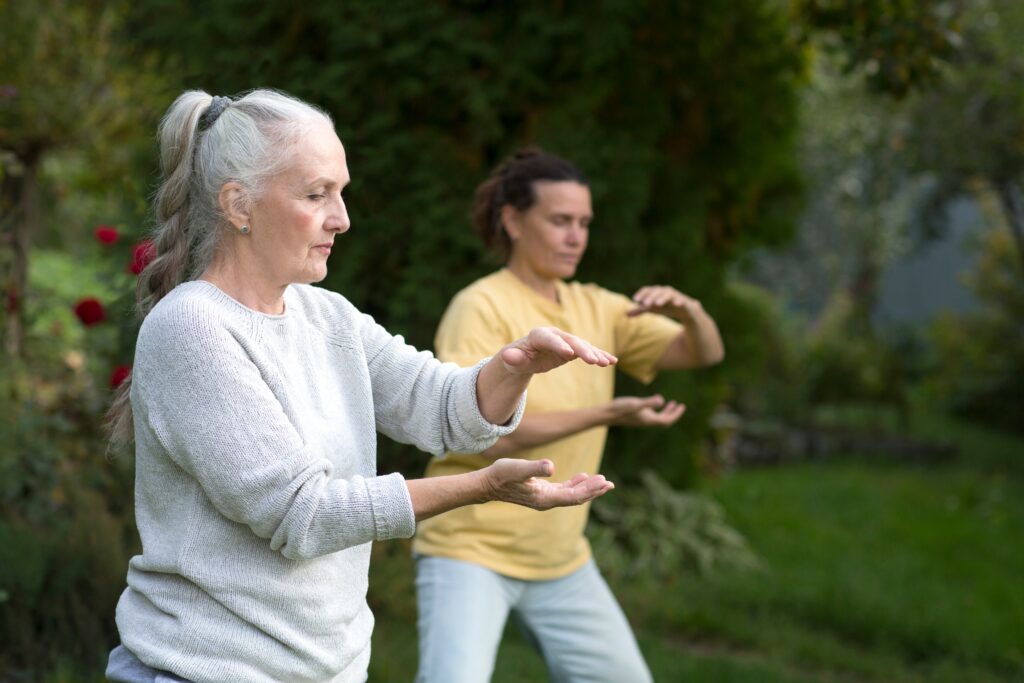
Photo: Shutterstock
Studies link tai chi to fewer falls, better balance, lower blood pressure, and relief from chronic pain — though the evidence is stronger for some benefits than others
Photo: Shutterstock
|
Getting your Trinity Audio player ready... |
It’s no secret that physical activity is central to aging well. According to the Centers for Disease Control and Prevention (CDC), four of the five most expensive chronic conditions affecting adults over 50 can be prevented or managed with regular exercise. What’s more, a large systematic review published in the British Journal of Sports Medicine analyzed 196 studies involving more than 30 million people and found that physical activity outside of work was linked to a lower risk of death from any cause.
Despite this research, fewer than 1 in 3 people aged 65 and older regularly meet the recommended guidelines of 150 minutes of moderate-intensity activity or 75 minutes of vigorous aerobic activity, and 2 days of muscle strengthening per week.
One increasingly popular way to close that gap is tai chi. This ancient Chinese martial art, now widely practiced as a modern wellness ritual, offers a gentle, low-impact approach to movement that’s accessible to most individuals, including older adults and those with chronic conditions. With its slow, controlled movements and low risk of injury, tai chi has gained traction worldwide, backed by a growing body of research demonstrating benefits such as improved balance, better sleep quality, and relief of chronic pain. Interest also appears to be rising online, with Google searches for “tai chi” spiking in 2026.
Often described as “meditation in motion,” tai chi draws from a rich blend of spiritual tradition, breathwork, and martial arts. The practice originated in China, with roots dating back to the late Ming and early Qing dynasties (around 1644). Chen Wangting, a retired military officer in the mid-17th century, is credited by many historians with developing one of the earliest formal systems of tai chi, drawing on his military experience and existing martial traditions, and incorporating both fast and slow, controlled movements.
In the 20th century, tai chi evolved beyond its martial origins. The Chinese government began promoting it as an accessible form of exercise focused on wellness and disease prevention, helping to standardize and popularize the practice. This shift fueled its global expansion. Today, tai chi is practiced by more than 300 million people worldwide, including more than 1.5 million individuals in the United States.
“Tai chi is considered a mind-body-spirit practice,” says Ruth Taylor-Piliae, Ph.D., a professor in the Nursing and Health Sciences Division at the University of Arizona College of Nursing. “It combines physical movement with breathwork, staying present, being mindful in the moment, and focusing on what you’re doing in real time.”
Tai chi rests on two principles from traditional Chinese philosophy and medicine: qi (the body’s vital energy) and yin and yang (opposing yet complementary forces that work together to create balance). Tai chi is thought to support the smooth, unobstructed flow of qi throughout the body, while fostering harmony between yin and yang.
There are several forms of tai chi, including Yang — which Dr. Taylor-Piliae notes is the most widely practiced in the United States — as well as Chen, Wu, Hao, and Sun. “In my opinion, all of them are good and can lead to health benefits,” she says.
While each style differs slightly in pacing, posture, and structure, they are all rooted in low-impact, slow, continuous movement, with sequences that flow seamlessly from one to the next.
For example, in a movement like “Dancing with Rainbows,” participants gently sweep their arms overhead from side to side, while “Playing With Waves” involves shifting the arms and body forward and backward through space. Throughout a sequence, participants are guided to focus their attention on the movement itself, tune in to bodily sensations, and coordinate their breath with each motion.
Tai chi doesn’t require a set session length, but sessions typically last 20 to 90 minutes and can be performed standing, walking, or adapted for individuals in wheelchairs or with other physical limitations. Christina Le-Short, M.D., Medical Director and Vice President of Clinical Delivery at Override, a virtual pain management clinic, says the adaptability and gentleness of tai chi can be especially beneficial for older adults and those with chronic pain.
“Tai chi can be a great entry point [to physical activity] because it is slow, low-impact, and adaptable,” notes Dr. Le-Short. “It gives people a way to work on mobility, balance, and confidence without the all-or-nothing mindset that often makes pain flares worse.”
Tai chi can offer a range of benefits that extend across physical, mental, and emotional health. A growing body of research highlights its potential to improve balance, support healthy blood pressure levels, and reduce chronic pain — particularly in older adults.
Still, the evidence has limitations. Many studies are relatively small, include varied participant populations, and differ widely in the style of tai chi practiced and in the frequency and duration of sessions.
Experts say those gaps in the research are tied, in part, to longstanding funding and perception challenges surrounding alternative therapies.
“Funding is an issue for research on all medical interventions,” explains Beau J. Anderson, Ph.D., Associate Dean and a Professor at Pace University in the College of Health Professions, Associate Clinical Professor at Albert Einstein College of Medicine, and member of MedShadow’s Health and Advisory Panel. Additionally, “many scientists and medical professionals don’t keep up with the latest research and continue to think that these therapies have no supportive evidence (even at a basic level like case studies and consumer usage), and therefore argue against funding research on them,” continues Dr. Anderson. This tends to be less of a challenge in the countries where these practices originated, she notes, which may explain why much of the tai chi research comes out of China rather than the United States.
In terms of the studied benefits of tai chi, Dr. Le-Short says, “the strongest evidence is for balance and fall prevention.”
As we age, our risk of falling increases; about 28–35% of people aged 65 and older experience at least one fall a year, rising to 32–42% among those 70 and older. Falls can have serious consequences, including bone fractures, head injuries, and increased mortality risk.
A 2023 meta-analysis examined the effects of tai chi on fall prevention and balance in older adults, analyzing 24 randomized controlled trials. The studies varied in size from a dozen participants to 200-plus per group, and included populations ranging from generally healthy older adults to those at a higher risk of falling due to conditions like stroke and Parkinson’s disease.
Overall, the findings were consistent: tai chi significantly improved balance and reduced fall risk. Specifically, people practicing tai chi had a 28% lower fall rate than those in the control group. Tai chi also improved performance on several standard balance tests.
“When you are doing tai chi, it’s a matter of being aware of where your body is in space and time, called proprioception,” says Dr. Taylor-Piliae. “Knowing where you’re going to step and being aware of that can develop neural pathways [that decrease fall risk], and while you are stepping carefully, you also strengthen the muscles, ligaments, and tendons in the legs to support your body weight.”
Nearly half of adults in the United States live with high blood pressure, and this risk only increases with age. “High blood pressure can lead to other chronic cardiovascular diseases that create a downward spiral,” says Dr. Taylor-Piliae, who notes that there is strong evidence supporting tai chi’s ability to improve blood pressure.
For example, a small 2019 longitudinal study followed 120 adults aged 50 and older for six years, comparing those who practiced tai chi regularly to a control group. Researchers found that the tai chi group saw significant improvements in multiple cardiovascular risk factors, including blood pressure, weight, body mass index, and heart and lung function. The rate of cardiovascular and cerebrovascular disease was significantly lower in the tai chi group (16.7%) compared to the control group (38.3%).
In a separate 2025 systematic review, researchers found that tai chi can reliably improve blood pressure in people with hypertension. The strongest results were seen in programs lasting 12 weeks or longer, while shorter programs did not show consistent or statistically significant benefits. The analysis also suggests that frequency matters: practicing five or more times per week was linked to greater improvements in both blood pressure and lipid levels. Sessions lasting under 60 minutes per day appeared to be just as effective as longer ones.
Interestingly, one study of 342 adults with elevated blood pressure found that tai chi outperformed aerobic exercise — climbing stairs, jogging, brisk walking, and cycling — when both were performed four times per week. After one year, systolic blood pressure dropped by an average of 7 points in the tai chi group, compared to about 4 points in the aerobic group. Researchers suggest tai chi’s added benefit may come from activating the body’s relaxation response, though aerobic exercise remains essential for overall health.
“For people with chronic pain, tai chi is especially appealing because it is low-impact and often feels less intimidating than more strenuous exercise,” says Dr. Le-Short, who notes that this population can struggle with staying active due to worry that movement will increase pain.
“The American College of Rheumatology and Arthritis Foundation strongly recommend tai chi for knee and hip osteoarthritis, and the National Center for Complementary and Integrative Health (NCCIH) notes benefit for pain in knee osteoarthritis, as well as possible benefit for low back pain and fibromyalgia-related symptoms,” she says.
Studies that support these claims include:
As a form of gentle movement, tai chi is generally considered safe. A 2019 review found that rates of adverse events with tai chi were comparable to those seen in control groups and other active interventions.
“Still, adults with major balance impairment, severe osteoporosis, uncontrolled cardiopulmonary disease, recent surgery, or significant neurologic issues should start with guidance and choose an instructor who can modify movements,” says Dr. Le-Short. “The practical goal is not perfect form; it is safe, sustainable movement that matches the person’s capacity.”

If you’ve experienced side effects or medication issues related to this topic, we want to hear from you.
Submit Your StoryDISCLAIMER: MedShadow provides information and resources related to medications, their effects, and potential side effects. However, it is important to note that we are not a substitute for professional medical advice, diagnosis, or treatment. The content on our site is intended for educational and informational purposes only. Individuals dealing with medical conditions or symptoms should seek guidance from a licensed healthcare professional, such as a physician or pharmacist, who can provide personalized medical advice tailored to their specific circumstances.
While we strive to ensure the accuracy and reliability of the information presented on MedShadow, we cannot guarantee its completeness or suitability for any particular individual’s medical needs. Therefore, we strongly encourage users to consult with qualified healthcare professionals regarding any health-related concerns or decisions. By accessing and using MedShadow, you acknowledge and agree that the information provided on the site is not a substitute for professional medical advice and that you should always consult with a qualified healthcare provider for any medical concerns.


Help fund our fight for improved medication safety and transparency by supporting our independent journalism.
Give NowWe seek to create a world where there are safer medications for all and where all people are fully informed about their medication benefits and side effects, using our explanatory and investigative journalism to both inform and stimulate public discussion to drive toward solutions.
No comments yet. Be the first to comment!
