
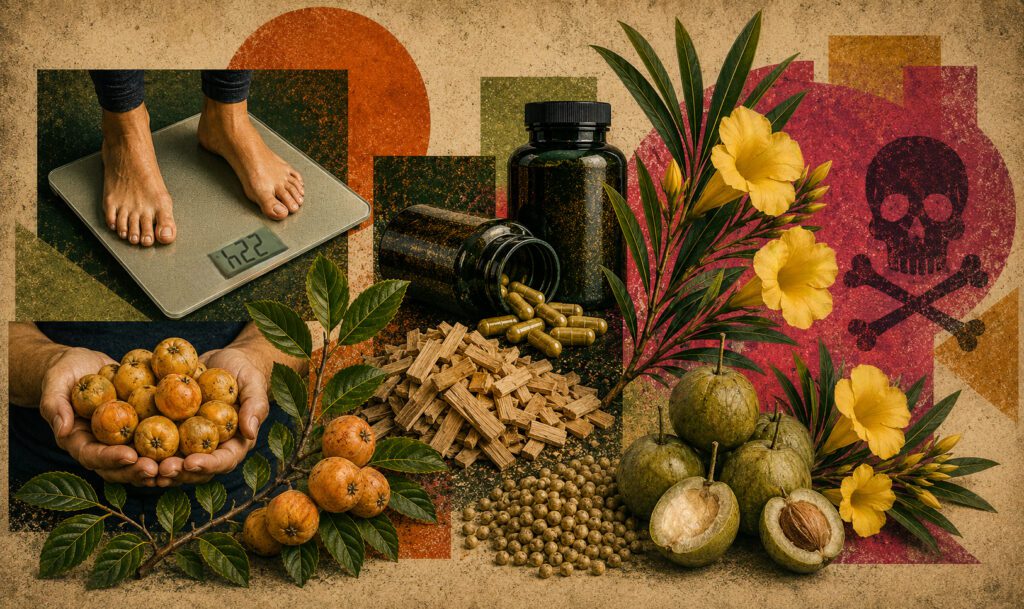
Tejocote Root and the Tainted Supplement Problem the FDA Can’t Contain

May 28, 2026
2 Comments
republish Shedding Light on the Risks
& Benefits of Medications
Shedding Light on the Risks
& Benefits of Medications An investigation into unregulated weight-loss products found widespread contamination with a toxic plant and a regulatory system struggling to keep them off the market
|
Getting your Trinity Audio player ready... |
One September day in 2022, a New Jersey mother rushed her toddler to the emergency room after the little girl began vomiting. The ER team discovered that the child’s blood pressure had dropped, and her heart rate had slowed to a dangerous level.
After learning the child had ingested some of her mother’s weight loss supplement, a bottle labeled Eva Nutrition Mexican Tejocote Root, emergency physicians contacted the New Jersey Poison Control Center.
One of the doctors assigned to the case was Noah Berland, M.D., then a toxicology fellow. The poison team suspected the supplement had been contaminated with yellow oleander, a toxic plant that can cause digestive issues and heart problems, as well as mimic the effects of the heart medication digoxin.
Their theory proved correct: Two doses of a digoxin antidote, given 12 hours apart, reversed the child’s symptoms.
After learning the child’s mother had purchased the supplement on Amazon, Dr. Berland focused his investigation on the platform. To determine how widespread the problem might be, he ordered 10 tejocote root supplements, including two samples of Eva Nutrition Mexican tejocote root, from Amazon, and sent them to Flora Research Laboratories, a company in Oregon that specializes in testing botanical ingredients.
The lab’s analysis found that none of the 10 products tested positive for tejocote root — the ingredient advertised on their labels that promised to detoxify the body, control appetite, and induce weight loss — but 9 of the 10 products did test positive for yellow oleander.
“That so many [samples] were adulterated did surprise me,” says James Kababick, founder and director of Flora Research Laboratories.
Dr. Berland, Kababick, and their team published their findings in the CDC’s Morbidity and Mortality Weekly Report in September 2023, and soon after, the FDA launched an investigation into tejocote root supplements, which remains ongoing as of April 2026. The agency has identified more than two dozen adulterated supplements, many of which are sold by independent retailers on third-party platforms like Amazon and eBay.
When the FDA attempted to contact sellers and notify them of the contamination, some agreed to recall the supplements. Others refused. In several cases, the FDA stated in an online consumer notice — complete with photos of the affected products and the companies’ responses — that it was unable to contact the seller at all.
But concerns about adulterated tejocote root supplements had surfaced before.
A 2020 case study describes a 63-year-old woman who went to the emergency room with a low heart rate and vomiting, later suffering fatal cardiac arrest. It was only after she died that investigators discovered the weight loss supplement she had been taking was adulterated with yellow oleander. While the case study may have alerted emergency room physicians to the possibility of adulteration, there was no recall at the time.
As the FDA’s list of yellow oleander-affected supplements has expanded (with the most recent batch published on March 11, 2026), many of the recalled products remain available online, sometimes under the same name, other times with slightly altered names. Experts say the agency has failed to meaningfully police the safety of the supplement market, leaving regulators to chase dangerous products after they appear rather than preventing them from reaching consumers in the first place.
“It’s a systematic problem that’s been going on for 20 plus years, and it’s not getting better,” says Pieter Cohen, M.D., an internist at Cambridge Health Alliance whose research focuses on supplement safety.
Yellow oleander, native to Mexico and Central America, is most commonly used as an ornamental plant, but has also been used in traditional medicine.
All parts of the yellow oleander plant are poisonous, though the seeds are particularly potent — experts say ingesting as few as 2 seeds can be fatal.
Tejocote root comes from the Mexican hawthorn tree, which grows in Mexico and Guatemala. Supplement labels often claim it can detoxify the body, reduce appetite, and boost metabolism, though MedShadow could not identify definitive research supporting those claims.
Because none of the 10 supplements tested by Dr. Berland and Kababick contained identifiable tejocote root, the contamination likely stemmed from economically motivated adulteration — the deliberate substitution of ingredients, often to reduce costs. In other words, companies may be selling yellow oleander labeled as tejoocote root because it’s cheaper, allowing them to cut costs and turn a profit.
“I don’t think this is an accidental contamination at all,” says Dr. Berland. “It would be illegal to market things as containing yellow oleander. You can get diarrhea from yellow oleander, and from there, get weight loss.”
“I don’t think this is an accidental contamination at all. It would be illegal to market things as containing yellow oleander. You can get diarrhea from yellow oleander, and from there, get weight loss.”
Who, exactly, is responsible for the adulteration remains difficult to determine. Because the substitution appears to be so widespread, Kababick believes many companies may be sourcing tejocote root from the same upstream supplier. If that’s the case, the adulteration could occur before the ingredients ever reach the brands that sell the supplements. Those suppliers are not typically disclosed publicly, though manufacturers are expected to maintain records identifying them in the event of an FDA inspection.
Still, that does not absolve supplement manufacturers or sellers of responsibility. Under the Dietary Supplement Health and Education Act of 1994 (DSHEA), manufacturers are required to develop testing requirements to ensure the potency and purity of the ingredients they purchase before using them to make supplements, according to Michael Levin, a consultant to pharmaceutical, integrative medicine, and natural product companies.
Dietary supplement manufacturers are required to comply with the FDA Current Good Manufacturing Practice in Manufacturing, Packaging, Labeling, or Holding Operations for Dietary Supplements (21 CFR Part 111), which was established under DSHEA in 2007.
When inspectors visit supplement manufacturers, they can give citations for failures to adhere to specific subsections of this code. From 2016 to 2025, the most frequently cited violation was a failure to comply with CFR 111.70(e), which requires manufacturers to establish specifications for the identity, purity, strength, and composition of each finished supplement, as well as limits on contaminants that could adulterate the product.
In other words, this violation means a company hasn’t established which tests it actually needs to run and what the results of those tests must be to confirm that the supplement has been properly manufactured and is safe to sell. The FDA leaves this responsibility up to the manufacturers.
Since recalls for yellow oleander adulteration began in 2023, Kababick says his company, which tests botanical ingredients for many supplement manufacturers, has worked with certain sellers of tejocote root supplements. In several cases, Kababick says, once the companies learned from the FDA that the tejocote root they’d purchased was adulterated, they began sourcing the ingredient from a new supplier that passed Kababick’s analysis. (He declined to name the companies, citing confidentiality agreements with clients.)
MedShadow reached out to most companies on the FDA’s recall list, using available contact information on their websites, to ask what steps they had taken to ensure product quality. None responded.
If a company wants to market a supplement containing a completely new ingredient — one that has not previously been used in supplements or food — it must notify the FDA at least 75 days before selling the product and provide evidence supporting the ingredient’s safety, along with the proposed label.
If a company wants to open a new manufacturing facility, it must register the facility with the FDA by completing forms that include the facility’s address, contact name, and a promise that, if the agency requests an inspection, it will permit one.
But companies that combine existing ingredients into new formulations and have them manufactured at previously registered facilities typically do not need to have those products reviewed by regulators before they are sold in the U.S. For example, a company can combine existing supplement ingredients, such as vitamin D and calcium, into a single tablet without premarket review, but it cannot synthesize an entirely new chemical and market it as a supplement without notifying the FDA.
A single manufacturing facility can be contracted to make thousands of different products for many different companies.
“If you and I wanted to create a dietary supplement, technically, [all] we need [is] to find an FDA-approved facility, and then we have to get them to make our supplement,” says Jensen Jose, regulatory counsel at the Center for Science in the Public Interest. “You don’t have to ever tell the FDA. You make it, you put it on Amazon, and you’re done.”
“If you and I wanted to create a dietary supplement, technically, [all] we need [is] to find an FDA-approved facility, and then we have to get them to make our supplement. You don’t have to ever tell the FDA. You make it, you put it on Amazon, and you’re done.”
That leaves the FDA overseeing the safety of a market it can’t fully map, as the agency does not maintain a complete list of all supplements being sold in the U.S. at any given time.
To monitor the safety of supplements, the agency relies on inspections of manufacturing facilities to ensure compliance with current good manufacturing practices (cGMPs), which are intended to prevent contamination and maintain quality. According to the Government Accountability Office, these inspections may be routine or triggered by reports of adverse effects linked to specific products.
But the agency has struggled to keep pace with inspections. Dietary supplements are regulated as foods, and the FDA aims to inspect each food facility at least once every five years — a target it has not met since 2018, according to the U.S. Government Accounting Office, largely due to a shortage of qualified inspectors.
The FDA can also chemically test supplements it suspects may be tainted, often in response to reports of adverse events. But in 2022, the agency inspected just 517 supplement firms and analyzed 686 samples out of more than 100,000 products on the U.S. market.
Moreover, Levin points out that while manufacturers are required to register with the FDA, not all do, making it difficult to know how many may be operating with limited or no oversight.
“Every legally operating dietary supplement company is registered with the FDA,” he says. “But there are criminals that are operating in a shopping mall or out of a garage.”
“Every legally operating dietary supplement company is registered with the FDA. But there are criminals that are operating in a shopping mall or out of a garage.”
Jose explains that his organization, Center for Science in the Public Interest, often submits enforcement request letters, formally asking the FDA to take action against companies that violate existing rules. At one point, he said, he asked the agency directly what his group could include in these letters to make them more likely to prompt action.
The answer: Provide the physical address of the supplement manufacturers.
Unlike prescription drugs, which can be purchased only from licensed pharmacies, supplements are sold through a sprawling and difficult-to-track marketplace. While consumers can buy them from health and wellness chain stores like the Vitamin Shoppe and GNC, they can also purchase supplements from grocery stores, smaller independent stores, pharmacies, gas stations, individual sellers operating through social media or direct sales, and from large online platforms like Amazon, eBay, and Etsy.
In 2024, Amazon began requiring sellers to provide third-party testing — or verification of prior testing — for certain dietary supplements, including those marketed for weight management, sold in the U.S. By 2026, the company expanded the requirement to all supplements sold on its platform. Most FDA recalls involving Amazon products occurred in 2024 or earlier, though more recent recalls specify that orders were fulfilled by third-party sellers (meaning Amazon did not store or handle the products, though they remain subject to the same rules).
Many of the contaminated tejocote supplements analyzed by Dr. Berland and Kababick were sold by independent distributors through online platforms such as Amazon. Among the 34 sellers and brands named on the FDA’s recall list, only two appear in FDA inspection records. It’s unclear where the others were manufactured. The company names in the recall announcement list the entities selling the products, but not necessarily the companies that may be contracted to manufacture them.
Even among brands that have undergone FDA inspection, adulterated products can still make it to market.
World Green Nutrition, a San Antonio-based manufacturer, was inspected by the FDA in May 2023, May 2024, and April 2025. Following the first two inspections, the company announced recalls in February and June 2024 of separate tejocote root products that FDA testing found contained yellow oleander.
During the 2025 inspection — after both recalls — the firm was cited for failing to investigate product complaints, which may come to the company from consumers, healthcare providers, or retailers. Inspectors also found deficiencies in quality control procedures, including inadequate standards for testing the identity, purity, strength, and composition of finished supplements.
Manufacturers are required to establish procedures for testing their products, maintaining quality, and responding to irregularities during and after production. When these tests aren’t conducted or fall short, it becomes easier for adulterated or contaminated supplements to reach the market.
Green ELV Nutrition Elv Control Herbal Supplement, distributed by World Green Nutrition, was among the products recalled in April 2024. At least one independent distributor now advertises another Green ELV Nutrition product — W8 — as a replacement for the Elv Control Herbal Supplement. An eBay listing reviewed by MedShadow shows a label identifying the supplement as a blend of herbal ingredients, including tejocote root.
The product does not appear to be sold on Green Elv Nutrition’s website. Instead, the site says its products are available through authorized distributors in 10 countries, including the U.S. and Mexico. As of May 15, 2026, a “find your distributor” link directed users to a second website that was under maintenance and listed no sellers.
Aside from the two recalls and despite the quality-control issues cited in its 2025 inspection, the FDA does not appear to have taken any further public action against World Green Nutrition.
Another manufacturer visited by the FDA, VidaSlim, was also based in San Antonio. The agency inspected its plant in December 2024 and cited a variety of quality control problems.
In February 2025, after the citation, the firm recalled three types of capsules and two flavors of drink mixes containing yellow oleander. Despite the recalls, the FDA issued a Warning Letter that July stating that VidaSlim’s responses to problems identified during the inspection were insufficient. For example, investigators found that company management could not provide documentation showing it had conducted quality control before distributing supplements. According to the letter, VidaSlim drafted quality-control protocols in response to the inspection findings but had not yet implemented them. Many product labels — including some for products that did not contain tejocote — also lacked required information, such as the distributor’s address and complete ingredient lists or quantities.
VidaSlim no longer appears to be operating, but on March 2, 2025, the company’s old Instagram account published a post urging people to follow a new company, TRUslim, which, according to its website, operates from the same address as the previously inspected VidaSlim. The old Vidaslim URL also redirects to TRUslim’s site, which lists a variety of weight-loss supplements, though it is unclear whether any contain tejocote root, as the ingredient lists for some supplements are not on the website.
TRUslim’s owners advertise that their facility is FDA-registered, but as of March 18, 2026, the FDA hasn’t published any inspection records for the facility. (The FDA’s database of registered supplement facilities is not publicly available or subject to FOIA requests. Federal law prohibits the agency from sharing this information.)
A third seller on the FDA’s recall list was ShopNewMeRoot.com. That website has since expired, but an Instagram account with the handle @new_me_root currently directs followers to a separate site, newmeshop.store, which appears to sell a tejocote root supplement using the same branding and packaging shown in the FDA’s recall notice for ShopNewMeRoot.com. The Instagram account, which was verified by Meta in April of 2025, was created in 2012 and has nearly 50,000 followers, though most posts receive fewer than 20 likes.
Suerte y Salud, a fourth seller named on the FDA’s recall list, currently appears in a Google Business listing that links to suerteysalud.com. That domain redirects to LaMilagrosaLab.com, a website selling supplements and beauty products, which included tejocote root tea and a tejocote root supplement, as of March 19, 2026.
“Those companies appear and disappear and change names, and we call the battle of trying to keep up with that, ‘Whack a Mole,’” says Kababick.
“Those companies appear and disappear and change names, and we call the battle of trying to keep up with that, ‘Whack a Mole.’”
Making matters even more confusing, several companies have disputed ownership of the trademark of the brand name Alipotec, which appears repeatedly throughout the recall list.
MedShadow shared these findings with the FDA and asked the agency for comment by email. In response, an unnamed FDA spokesperson wrote back, “The FDA takes action against products that have been found to contain hidden, potentially dangerous ingredients capable of causing serious harm. We remain deeply committed to protecting all American consumers, and we will continue to issue warnings, pursue regulatory action, and work to remove dangerous products from the marketplace.”
So far, none of the companies has responded to a request for comment.
While the FDA has the authority to mandate recalls, it has done so only once for a food product. (Under federal regulatory standards, supplements are treated as a category of food.) In that 2018 case, the agency ordered a recall of kratom powders contaminated with Salmonella after the company, Triangle Pharmanaturals, LLC, repeatedly refused to initiate a voluntary recall.
Although the FDA has separately raised concerns about the safety of kratom products, which can have opioid-like effects even when uncontaminated, the agency emphasized that this recall was specifically due to the Salmonella contamination, not the broader safety profile of kratom.
Typically, the agency asks manufacturers to initiate a recall, and they often comply. Another option for reducing the harm caused by dangerous products is bad publicity. Under the Food, Drug and Cosmetic Act, the FDA can publicize the agency’s opinion and findings on the safety of a product to quickly inform consumers of the potential risk, and inspire sellers to act.
In an email, an unnamed FDA spokesperson told MedShadow:
“FDA may use public warnings, safety alerts, or amplification of firm messaging to inform consumers and stakeholders of hazards associated with products, especially in instances where the firm does not take action. The Agency may consider additional regulatory steps, where appropriate, including warning letters, administrative orders like mandatory recall or facility registration suspension, or judicial actions such as a court-ordered seizure or injunction.
FDA actively works with third-party platforms where products such as these are sold in an effort to reduce consumer exposure. We will continue to monitor the marketplace and, when needed, take action as appropriate to protect the public health.”
However, even when a company does recall a product, “in many cases, it recalls a specific lot, but leaves the rest on the market,” notes Dr. Cohen.
He and his colleagues have conducted several studies showing that after the FDA identifies banned ingredients in supplements and issues recall requests or Warning Letters, many of the supplements remain on the shelves and continue to be adulterated even years later.
The FDA “sends out these letters requesting a recall. . . and as far as we can tell, there’s no systematic way they’re going back and confirming that the recalls were conducted or are retesting the products that continue to be sold,” adds Dr. Cohen.
On January 27, 2026, MedShadow filed a Freedom of Information Act request for the FDA’s communications with the companies to determine whether any further action was taken after the companies declined recalls. So far, the agency has provided internal risk assessment forms for three recalls. Many related documents have been requested but have not yet been provided.
One of the risk assessment forms referred back to the case study of the woman’s death in 2020 to demonstrate the longevity of the problem.
The FDA’s CAERS database — a public database that includes records of reports from patients, doctors, and families of adverse events they suspect were caused by certain foods or supplements — contains 30 reports of adverse events tied to tejocote root supplements, 13 of which resulted in hospitalization, according to the reports. The earliest dates to 2018, and the records run through September 2025.
Even so, the total may be an undercount: some people may stop taking the supplement without ever reporting an adverse event.
Albert Richer, 41, says he learned about tejocote root supplements and their purported appetite-suppressing effects on social media before purchasing a bottle online in the summer of 2021. Within a week of taking the supplement, he says he developed “dizziness, nausea, and a racing heartbeat” severe enough that he stopped using it. He did not visit a hospital or report his experience to CAERS.
Reporting to CAERS is voluntary. Even doctors aren’t required to report adverse events through the system. In the case of the toddler, Kababick and the poison control team reached out to experts at the FDA and CDC without filing a CAERS report. There does not appear to be a report matching the woman who died in 2020 in the CAERS database, either, only the published case study.
Consumers can also report their experiences directly to the manufacturer, who is then required to share them with the FDA, though it’s not clear how often this occurs.
The FDA spokesperson’s email comment to MedShadow said: “The FDA is continuing to identify and test products suspected to be contaminated with yellow oleander as part of our surveillance efforts and will continue to communicate, or otherwise act, to protect consumers from these unsafe products.”

If you’ve experienced side effects or medication issues related to this topic, we want to hear from you.
Submit Your StoryDISCLAIMER: MedShadow provides information and resources related to medications, their effects, and potential side effects. However, it is important to note that we are not a substitute for professional medical advice, diagnosis, or treatment. The content on our site is intended for educational and informational purposes only. Individuals dealing with medical conditions or symptoms should seek guidance from a licensed healthcare professional, such as a physician or pharmacist, who can provide personalized medical advice tailored to their specific circumstances.
While we strive to ensure the accuracy and reliability of the information presented on MedShadow, we cannot guarantee its completeness or suitability for any particular individual’s medical needs. Therefore, we strongly encourage users to consult with qualified healthcare professionals regarding any health-related concerns or decisions. By accessing and using MedShadow, you acknowledge and agree that the information provided on the site is not a substitute for professional medical advice and that you should always consult with a qualified healthcare provider for any medical concerns.
 Emma YasinskiMay 29, 2026 8:55 AM
It has been used in traditional medicine, but it’s not clear that any benefits would outweigh the risks. It hasn’t been thoroughly studied for medical applications to my knowledge!
 ChristineMay 28, 2026 2:31 PM
Does yellow oleander have any medical uses other than as a component of weight loss supplements?