 Shedding Light on the Risks
& Benefits of Medications
Shedding Light on the Risks
& Benefits of Medications 
MedShadow Poll: Americans Want Prescription Drug Advertising Reform

on this page:
Half of Americans support banning prescription drug advertising, one in five view its overall effect as harmful, and two-thirds say there are too many ads
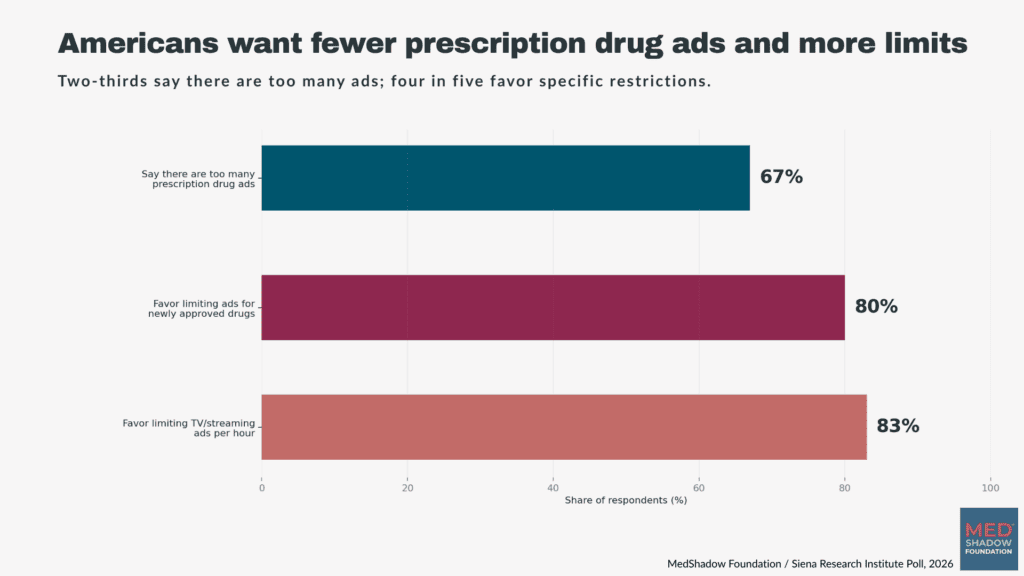
According to a new national MedShadow Foundation poll conducted by the Siena Research Institute, half of Americans (50%) support banning prescription drug advertisements. The poll also reveals a generational divide: 60% of younger adults (ages 18-34) support a ban, while only 40% of those 55+ support a ban. Two-thirds of Americans say there are somewhat or far too many prescription drug advertisements, and 83% favor limiting the number of these ads specifically on television and streaming services. Four out of five people additionally support restricting advertising for newly approved drugs during an initial period after approval.
While about half say drug ads do an excellent or very good job explaining the illness or condition treated (52%) and the drug’s benefits (52%), fewer give top ratings for explaining who should take the prescription (42%) and what the side effects are (41%). Nearly all Americans (93%) support requiring an information-first advertising format that clearly explains the condition being treated and the purpose of the drug.
Drug ads affect Americans’ healthcare decisions in various ways: 60% have asked a health professional about an advertised drug, and 53% say a drug ad made them ask about a side effect of a drug they were already taking. Nearly nine in 10 (88%) say prescription drug advertising can encourage people to seek medical care, and more than eight in 10 (84%) say it can introduce treatment options people may not otherwise know about.
“Since Americans see drug ads as an information source and use them to help guide their decisions, it’s incumbent upon the pharmaceutical industry to ensure the information provided is clear, complete, in context, and always strongly encourages consumers to talk to their doctors,” said Diane Salvatore, Executive Director of MedShadow Foundation. “At the same time, more doctors need to engage with patients who come to them with questions about treatment options and drug side effects, and government regulators need to pass and enforce meaningful guidelines for ads.”
Roughly half of Americans (52%) view the overall effect of drug advertising as helpful; however, one in five (21%) describe it as harmful. Age differences emerge here as well: 58% of adults ages 35-54 describe advertising as helpful, while younger adults are the most likely to view it as harmful (27%). A majority of people (55%) also said they worry or wonder whether they might have a medical condition they had not previously considered after seeing a drug ad. They also express concerns about the volume and impact of these ads. Four out of five (81%) believe advertising may encourage reliance on medication instead of lifestyle changes.
While health professionals are the dominant source of drug information cited in the poll (80%), substantial shares of adults also report using internet searches (49%), family (35%), social media (33%), and friends (30%) for drug information. Sources of health information vary substantially by age. Older adults (55+) are most likely to rely on healthcare professionals (84% vs. 74% among ages 18–34) and less likely to use digital and social sources. Younger and middle-aged adults are significantly more likely to use internet searches and AI tools (55–57% vs. 38%), social media (45–47% vs. 12%), influencers (24–27% vs. 1%), podcasts (22–23% vs. 4%), and streaming services (29–31% vs. 7%) for health information.
“One of the clearest findings in the poll is the significant generational divide in how Americans respond to prescription drug advertising,” Colleen Kromrey, Director of Project Management at Siena Research Institute at ReconMR. “Younger adults (ages 18 to 34) are the most influenced by these ads, yet they are also the strongest critics when it comes to describing ads as harmful. Younger adults are also more likely to encounter advertising, engage with the information, and act on it, while expressing greater concern about its impact on their healthcare decisions.”
The overall findings in this poll suggest Americans are grappling with both the benefits and drawbacks of prescription drug advertising and want greater confidence that its influence serves patients’ interests. For the full poll, crosstabs, and methodology, visit sri.siena.edu/2026/09/15/new-medshadow-poll or medshadow.org.
###
About MedShadow Foundation:
MedShadow Foundation, founded in 2013, is a nonprofit that focuses on the safest ways to take over-the-counter and prescription medications, as well as lifestyle and nutrition options. Medications have many benefits, but knowing how to balance these against their potential side effects is essential. Side effects can sometimes be difficult to recognize, so MedShadow works to illuminate and explain medication reactions that may be otherwise minimized or obscured. MedShadow does not accept or receive any financial support from the pharmaceutical or supplement industries. medshadow.org
About Siena Research Institute:
Founded in 1980 at Siena University in New York, and now a division of ReconMR, the Siena Research Institute (SRI) conducts regional, statewide and national surveys on business, economic, political, voter, social, academic, and historical issues. The surveys include both expert and public opinion polls, and the results of SRI surveys have been published in major regional and national newspapers, scholarly journals, books and encyclopedias. sri.siena.edu
DISCLAIMER: MedShadow provides information and resources related to medications, their effects, and potential side effects. However, it is important to note that we are not a substitute for professional medical advice, diagnosis, or treatment. The content on our site is intended for educational and informational purposes only. Individuals dealing with medical conditions or symptoms should seek guidance from a licensed healthcare professional, such as a physician or pharmacist, who can provide personalized medical advice tailored to their specific circumstances.
While we strive to ensure the accuracy and reliability of the information presented on MedShadow, we cannot guarantee its completeness or suitability for any particular individual’s medical needs. Therefore, we strongly encourage users to consult with qualified healthcare professionals regarding any health-related concerns or decisions. By accessing and using MedShadow, you acknowledge and agree that the information provided on the site is not a substitute for professional medical advice and that you should always consult with a qualified healthcare provider for any medical concerns.
on this page:
We seek to create a world where there are safer medications for all and where all people are fully informed about their medication benefits and side effects, using our explanatory and investigative journalism to both inform and stimulate public discussion to drive toward solutions.
WEBINARS
Stream our library on demand, including insights on generic drugs and pain management, straight from experts.
WATCH NOW