

Results from a new national poll show broad support for fewer prescription drug ads, and tighter rules governing how they’re regulated

You’ve seen the commercials: smiling families strolling on beaches with their coiffed golden retrievers and a cinematic sunset in the distance, while a soothing voice urges the viewer to consider whether the latest pharmaceutical drug “could be right for you,” followed immediately by a rapid-fire recitation of sometimes hair-raising side effects. Then, in the blink of an eye: back to your regularly scheduled programming.
According to a new, nationally representative MedShadow Foundation/Sienna poll, Americans have had enough.
In fact, half of Americans support banning direct-to-consumer (DTC) prescription drug advertisements altogether (50%), including 60% of adults aged 18 to 34. And nearly everyone surveyed (93%) said the ads should lead with clear information about the condition treated and the drug’s purpose.
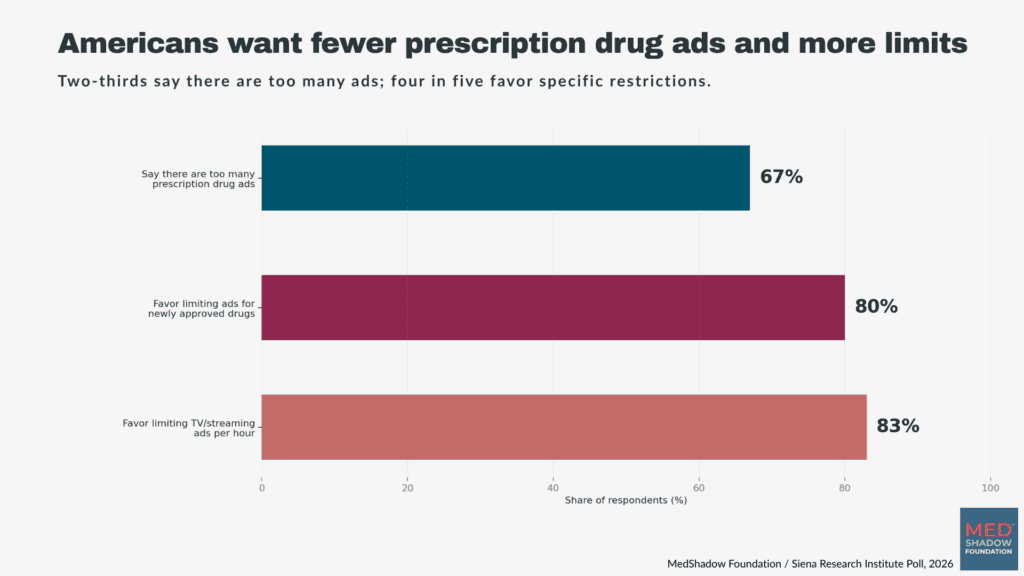
The poll results indicate that Americans strongly support regulatory changes: 83% support limiting drug ads on TV and streaming services, and 80% support restricting ads for newly approved drugs during an initial time period.
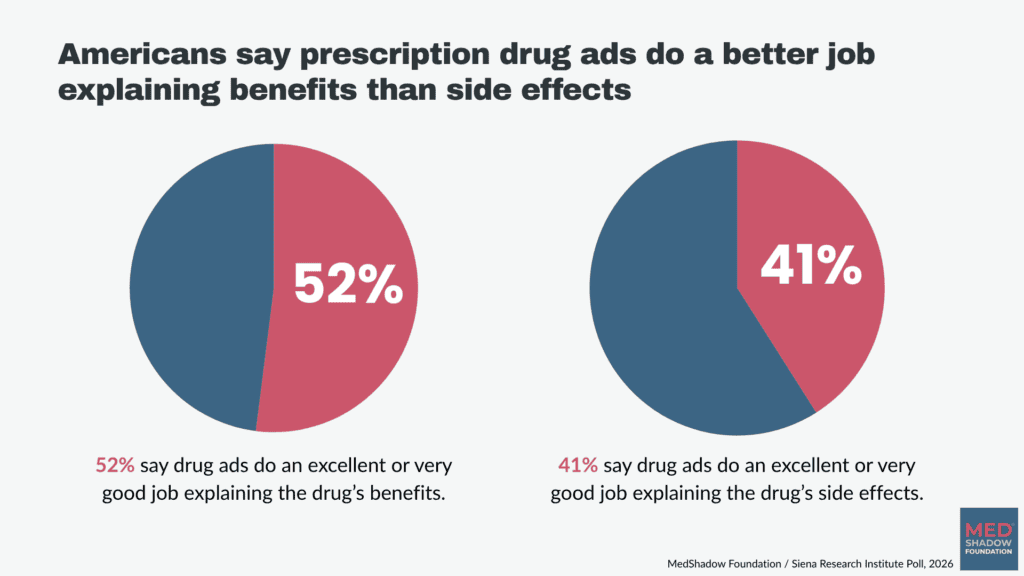
About half say ads do an excellent or very good job explaining the illness or condition treated (52%) and the drug’s benefits (52%), but fewer give top ratings for explaining who should take the prescription (42%) and the side effects (41%).
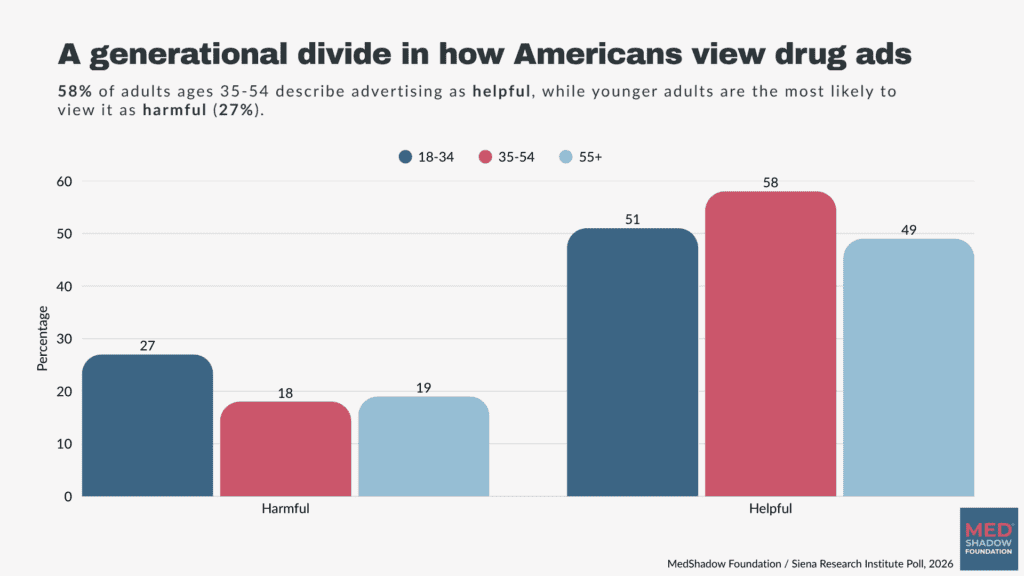
People also have concerns about the long-term impact of drug ads. One in five (21%) describes drug ads as harmful, while eight in 10 (81%) believe drug advertisements encourage reliance on medication instead of lifestyle changes.
While 88% of those polled say drug ads can encourage people to seek medical care, which could be helpful, it’s also clear that Americans on average feel that drug advertising is not as clear about side effects as it is about benefits.
U.S. lawmakers are struggling to turn that sentiment into policy. A number of legislative solutions have been proposed over the past two years, including a ban on DTC drug ads, delays for advertising newly approved drugs, or other regulations.
MedShadow is working on ways to turn these findings into action. Watch this space for more on how you can make your voice heard.
A year ago, in September 2025, Secretary Robert F. Kennedy, Jr. announced that the US Department of Health and Human Services (HHS) would require drug companies to disclose “all critical safety facts” in their advertising. The Food and Drug Administration (FDA) subsequently said it would propose a rule, titled Transparency in Direct-to-Consumer Advertising, in December 2026 to eliminate the option for broadcast ads to direct customers to another source, such as a website, for full safety information. Multiple queries by MedShadow to the office of Secretary Kennedy about the proposed rule and other actions related to drug advertising taken by the FDA went unanswered by the time of publication.
Independent reporting on drug recalls, medication safety and integrative health, including supplements. No pharma funding.
Additionally, a September 2024 bipartisan effort by Senators Dick Durbin (D-IL) and Mike Braun (R-IN) outlined specific guidance on deceptive drug promotions, social media influencers, and telehealth providers. Senators Durbin and Roger Marshall (R-KS) have also recently pushed for the FDA to review certain DTC drug ads before they air. Senators Bernie Sanders (I-VT) and Angus King (I-ME) have proposed a bill that would ban prescription drug ads outright. And Senator King, along with Senators Tim Kaine (D-VA) and Senator Peter Welsh (D-VT), have proposed a three-year restriction on newly approved drugs while additional real-world safety data are collected.
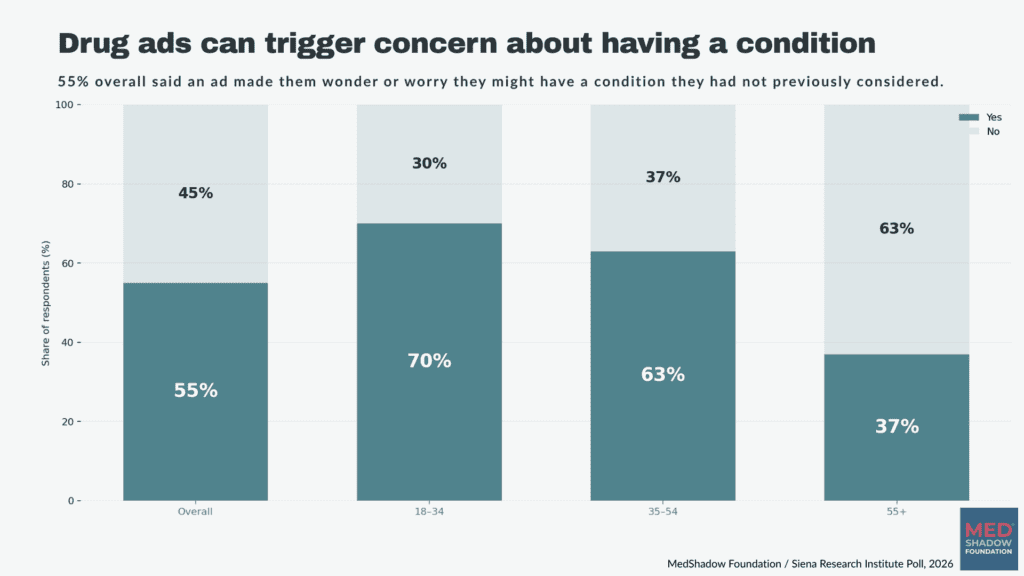
However, none of these approaches has yet become law, leaving meaningful reform in legislative limbo.
To read the full report, crosstabs, questionnaire, and methodology, visit www.Siena.edu/SRI/SNY.
DISCLAIMER: MedShadow provides information and resources related to medications, their effects, and potential side effects. However, it is important to note that we are not a substitute for professional medical advice, diagnosis, or treatment. The content on our site is intended for educational and informational purposes only. Individuals dealing with medical conditions or symptoms should seek guidance from a licensed healthcare professional, such as a physician or pharmacist, who can provide personalized medical advice tailored to their specific circumstances.
While we strive to ensure the accuracy and reliability of the information presented on MedShadow, we cannot guarantee its completeness or suitability for any particular individual’s medical needs. Therefore, we strongly encourage users to consult with qualified healthcare professionals regarding any health-related concerns or decisions. By accessing and using MedShadow, you acknowledge and agree that the information provided on the site is not a substitute for professional medical advice and that you should always consult with a qualified healthcare provider for any medical concerns.
Help fund our fight for improved medication safety and transparency by supporting our independent journalism.
Give NowWe seek to create a world where there are safer medications for all and where all people are fully informed about their medication benefits and side effects, using our explanatory and investigative journalism to both inform and stimulate public discussion to drive toward solutions.
Stream our library on demand, including insights on generic drugs and pain management, straight from experts.
WATCH NOWMedShadow.org is dedicated to empowering people with our evidence-based journalism about the safest ways to take over-the-counter (OTC) and prescription (Rx) medications.
We also seek to stimulate public discussion about potential improvements to drug research, manufacturing and distribution processes. and also to encourage the improvement of processes to ensure that we are all better protected.
As a result, we encourage other nonprofit newsrooms, mission-aligned outlets, and advocacy organizations to republish our original content under the following conditions:
1. We Are Credited Fully and Clearly
You must include the byline and credit MedShadow.org as the original publisher. Please include a link to the original article at the top or bottom of the piece. Use the following attribution:
This article was originally published by MedShadow, a nonprofit foundation that focuses on the safest ways to take over-the-counter and prescription medications.
2. Our Content Isn’t Edited Without Permission
You may make small changes for clarity, such as adjusting headlines, subheadings, or transitions, but you may not change the core meaning, tone, or intent of the article. For substantive edits, email us at republish@medshadow.org for review and approval.
3. You Do Not Sell Or Use Our Content Commercially
Our work is free to share, but it may not be sold, monetized, or repurposed for commercial gain. You may not republish our articles behind a paywall or in publications whose primary purpose is advertising or product promotion. You may not place drug or supplement advertising adjacent to our story.
4. Photos, Graphics, and Multimedia Are Not Used Without Permission
Only the text of the article is available for republication. Images, graphics, and videos may not be reused without explicit written permission, unless they are clearly marked as Creative Commons licensed. Contact us if you’d like to request reuse of a visual asset.
If you’re unsure whether your intended use falls within these guidelines, or would like to discuss a formal syndication or licensing arrangement, please email: republish@medshadow.org
We want our journalism to reach as many people as possible, especially those making critical decisions about medications and health.
For website editors
Copy the article body, including its formatting and links, then paste it into your publishing system. Add the byline and required credit described in these guidelines.
<!-- wp:paragraph -->
<p>You've seen the commercials: smiling families strolling on beaches with their coiffed golden retrievers and a cinematic sunset in the distance, while a soothing voice urges the viewer to consider whether the latest pharmaceutical drug “could be right for you,” followed immediately by a rapid-fire recitation of sometimes hair-raising side effects. Then, in the blink of an eye: back to your regularly scheduled programming.</p>
<!-- /wp:paragraph -->
<!-- wp:paragraph -->
<p>According to a new, nationally representative MedShadow Foundation/Sienna poll, Americans have had enough.</p>
<!-- /wp:paragraph -->
<!-- wp:paragraph -->
<p>In fact, half of Americans support banning <a href="https://medshadow.org/drug-updates-recalls/drug-safety/should-drug-companies-be-advertising-to-consumers/">direct-to-consumer (DTC) prescription drug advertisements</a> altogether (50%), including 60% of adults aged 18 to 34. And nearly everyone surveyed (93%) said the ads should lead with clear information about the condition treated and the drug’s purpose.</p>
<!-- /wp:paragraph -->
<!-- wp:image {"id":34903,"sizeSlug":"large","linkDestination":"none"} -->
<figure class="wp-block-image size-large"><img src="https://medshadow.org/wp-content/uploads/2026/09/Too-Many-Ads-Landscape-Size-1024x576.png" alt="" class="wp-image-34903"/></figure>
<!-- /wp:image -->
<!-- wp:paragraph -->
<p>The poll results indicate that Americans strongly support regulatory changes: 83% support limiting drug ads on TV and streaming services, and 80% support restricting ads for newly approved drugs during an initial time period.</p>
<!-- /wp:paragraph -->
<!-- wp:paragraph -->
<p>About half say ads do an excellent or very good job explaining the illness or condition treated (52%) and the drug’s benefits (52%), but fewer give top ratings for explaining who should take the prescription (42%) and the side effects (41%).</p>
<!-- /wp:paragraph -->
<!-- wp:image {"id":34904,"sizeSlug":"large","linkDestination":"none"} -->
<figure class="wp-block-image size-large"><img src="https://medshadow.org/wp-content/uploads/2026/09/Drug-Ads-Explain-Benefits-More-than-Side-Effects-Landscape-Size-1024x576.png" alt="" class="wp-image-34904"/></figure>
<!-- /wp:image -->
<!-- wp:paragraph -->
<p>People also have concerns about the long-term impact of drug ads. One in five (21%) describes drug ads as harmful, while eight in 10 (81%) believe drug advertisements encourage reliance on medication instead of lifestyle changes.</p>
<!-- /wp:paragraph -->
<!-- wp:paragraph -->
<p>While 88% of those polled say drug ads can encourage people to seek medical care, which could be helpful, it’s also clear that Americans on average feel that drug advertising is not as clear about side effects as it is about benefits. </p>
<!-- /wp:paragraph -->
<!-- wp:image {"id":34906,"sizeSlug":"large","linkDestination":"none"} -->
<figure class="wp-block-image size-large"><img src="https://medshadow.org/wp-content/uploads/2026/09/Americans-View-Prescription-Drug-Ads-as-Helpful-vs.-Harmful-Landscape-Size-1024x576.png" alt="" class="wp-image-34906"/></figure>
<!-- /wp:image -->
<!-- wp:paragraph -->
<p>U.S. lawmakers are struggling to turn that sentiment into policy. <a href="https://medshadow.org/drug-updates-recalls/drug-safety/the-fdas-new-drug-ad-rules-are-here-will-they-actually-change-anything/">A number of legislative solutions</a> have been proposed over the past two years, including a ban on DTC drug ads, delays for advertising newly approved drugs, or other regulations. </p>
<!-- /wp:paragraph -->
<!-- wp:myplugin/custom-alignment-block {"align":"right"} -->
<div class="wp-block-myplugin-custom-alignment-block alignright"><h2>What You Can Do</h2><p>MedShadow is working on ways to turn these findings into action. Watch this space for more on how you can make your voice heard.</p></div>
<!-- /wp:myplugin/custom-alignment-block -->
<!-- wp:paragraph -->
<p>A year ago, in September 2025, Secretary Robert F. Kennedy, Jr. announced that the US Department of Health and Human Services (HHS) would require drug companies to disclose "all critical safety facts" in their advertising. The Food and Drug Administration (FDA) subsequently said it would propose a rule, titled <em>Transparency in Direct-to-Consumer Advertising</em>, in December 2026 to eliminate the option for broadcast ads to direct customers to another source, such as a website, for full safety information. Multiple queries by MedShadow to the office of Secretary Kennedy about the proposed rule and other actions related to drug advertising taken by the FDA went unanswered by the time of publication.</p>
<!-- /wp:paragraph -->
<!-- wp:paragraph -->
<p>Additionally, <a href="https://www.congress.gov/bill/118th-congress/senate-bill/5040/text">a September 2024 bipartisan effort</a> by Senators Dick Durbin (D-IL) and Mike Braun (R-IN) outlined specific guidance on deceptive drug promotions, social media influencers, and telehealth providers. Senators Durbin and Roger Marshall (R-KS) have also recently pushed for the FDA to review certain DTC drug ads before they air. Senators Bernie Sanders (I-VT) and Angus King (I-ME) have proposed a bill that would ban prescription drug ads outright. And Senator King, along with Senators Tim Kaine (D-VA) and Senator Peter Welsh (D-VT), have proposed a three-year restriction on newly approved drugs while additional real-world safety data are collected.</p>
<!-- /wp:paragraph -->
<!-- wp:image {"id":34909,"sizeSlug":"large","linkDestination":"none"} -->
<figure class="wp-block-image size-large"><img src="https://medshadow.org/wp-content/uploads/2026/09/Drug-Ads-Prompt-Concerns-Landscape-1024x576.png" alt="" class="wp-image-34909"/></figure>
<!-- /wp:image -->
<!-- wp:paragraph -->
<p>However, none of these approaches has yet become law, leaving meaningful reform in legislative limbo. </p>
<!-- /wp:paragraph -->
<!-- wp:paragraph -->
<p>To read the full report, crosstabs, questionnaire, and methodology, visit <a href="http://www.siena.edu/SRI/SNY">www.Siena.edu/SRI/SNY</a>. </p>
<!-- /wp:paragraph -->We think it’s invaluable — and hope you agree. Our work is made possible by donations from readers like you.
We think it’s invaluable — and hope you agree. Our journalism is made possible by donations from readers like you.
As a nonprofit, we don’t take a dime from pharmaceutical or supplement companies. That means we can report on the benefits, risks, and alternatives to prescription and over-the-counter drugs free from corporate pressure or influence.
No comments yet. Be the first to comment!

We've noticed that you're interested in this topic. Would you read a dedicated newsletter about it?