

Photo: Created with AI
From prompting confusion about side effects to raising concerns about health conditions, a new MedShadow national poll shows why many Americans want more regulation on prescription drug advertising

Photo: Created with AI
A new, nationally representative MedShadow Foundation/Siena Institute poll has uncovered a complicated relationship between Americans and drug ads: Some say these ads provide insights and promote doctor visits, but others say they stoke anxiety and prioritize benefits over risks. And almost all Americans think there are simply too many.
The following eight charts highlight key findings from our national poll. For a deeper look at the results and what Americans want regulators to do about prescription drug advertising, read our full story, What Americans Really Want From Drug Ads.
Independent reporting on drug recalls, medication safety and integrative health, including supplements. No pharma funding.
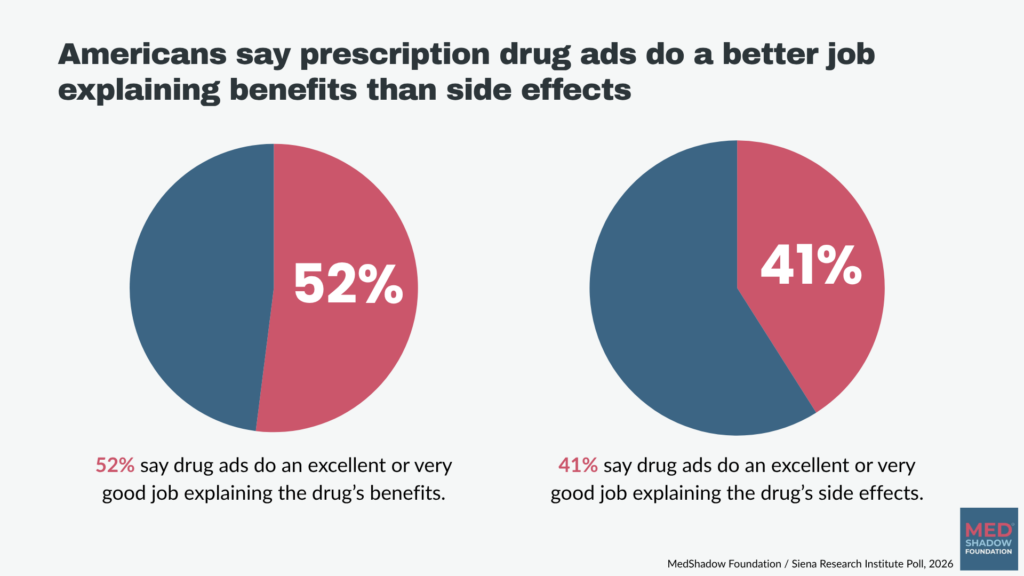
Fifty-two percent of Americans say drug ads do an excellent or very good job explaining a medication’s benefits, compared with 41% who say the same about side effects.
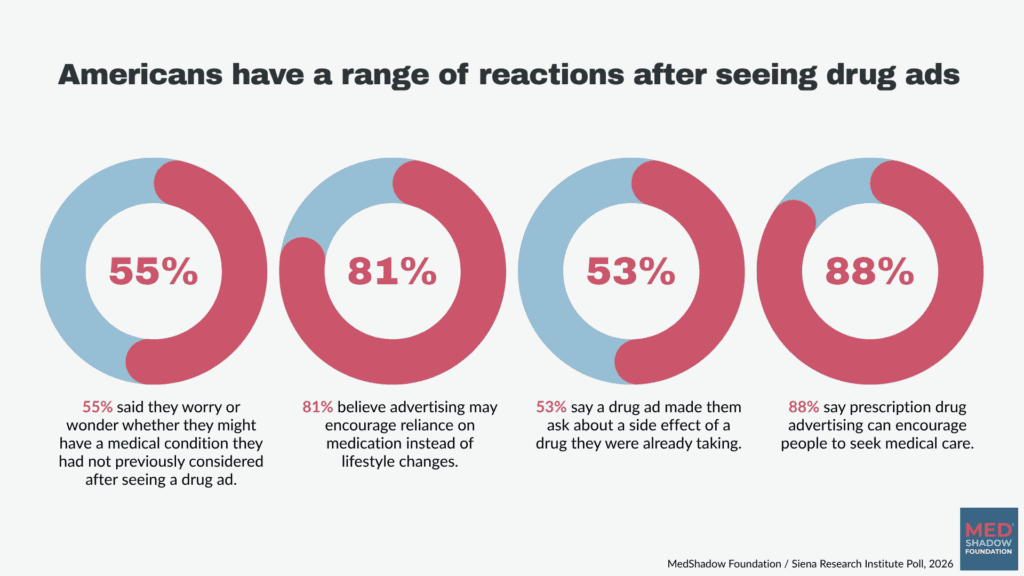
While some Americans credit drug ads with helping them learn about treatment options, others say the ads can cause unnecessary worry or encourage people to rely on medication instead of lifestyle changes.
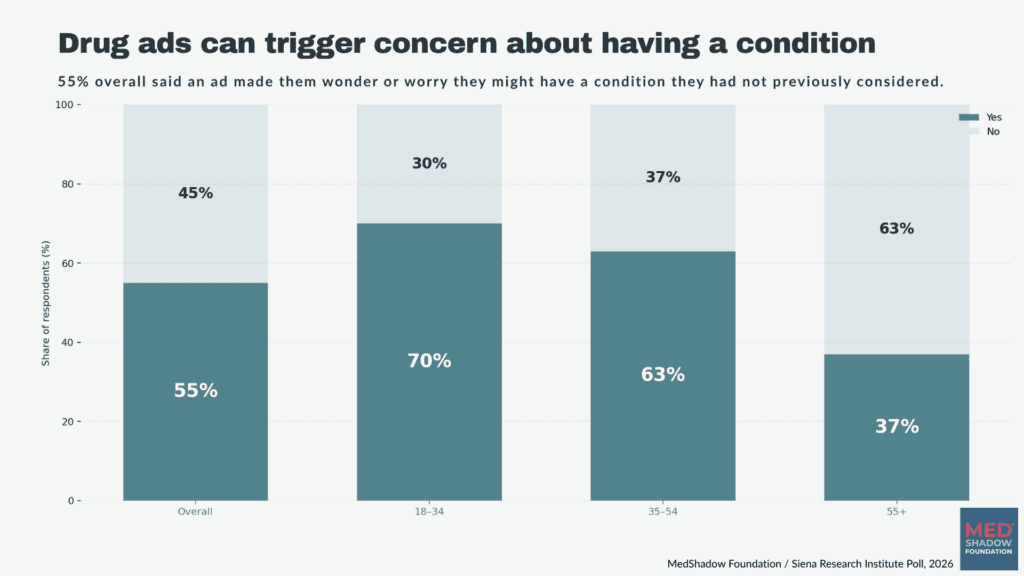
More than half of Americans say a drug ad has made them worry or wonder whether they have a medical condition they hadn’t previously considered. That rises to 70% among adults ages 18 to 34.
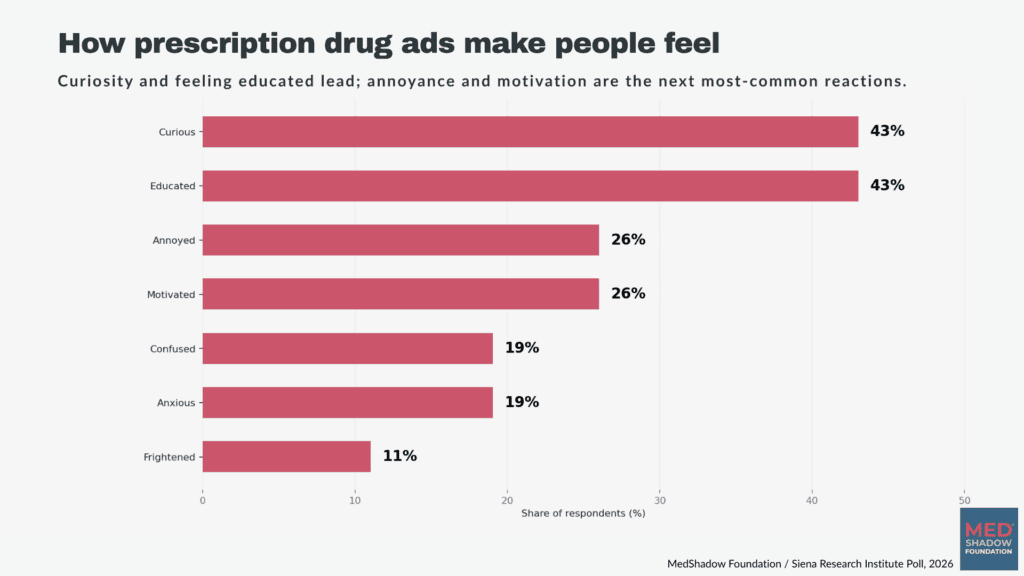
Curiosity and feeling educated are the most commonly reported reactions to drug ads, but Americans also report feeling annoyed, anxious, confused, and frightened.
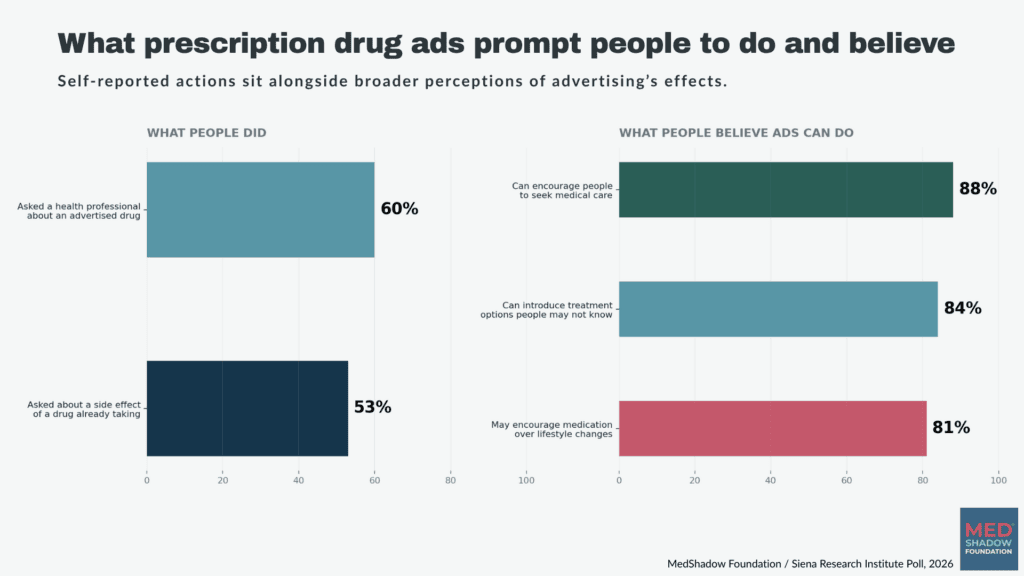
Sixty percent of Americans say they’ve asked a healthcare professional about a drug after seeing it advertised, while 53% have asked about a side effect of a medication they were already taking.
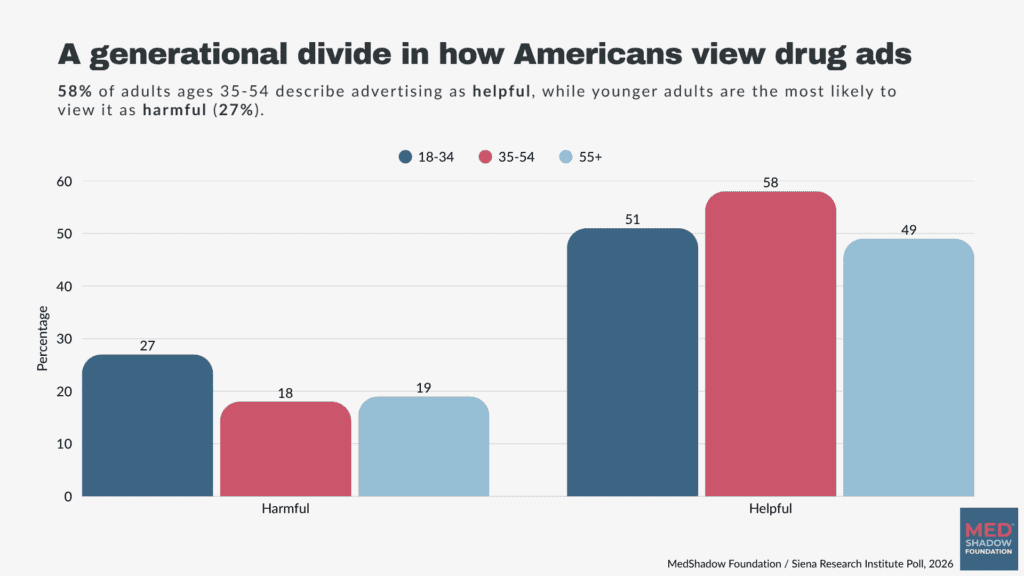
Twenty-seven percent of adults ages 18 to 34 describe prescription drug advertising as harmful, compared with 18% of adults ages 35 to 54 and 19% of those 55 and older.
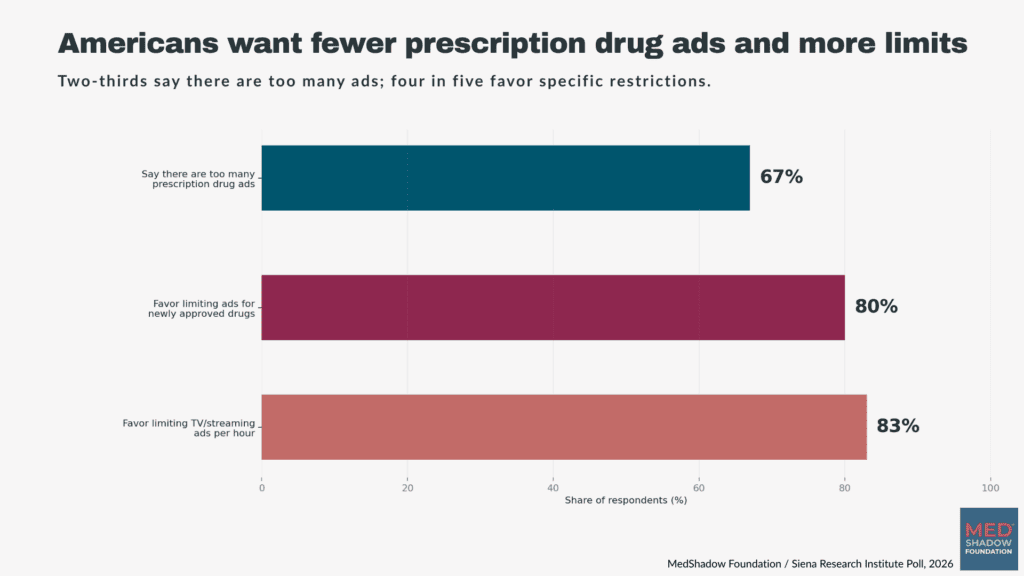
Two-thirds of Americans say there are too many prescription drug ads, and large majorities support limits on advertising — including restrictions on ads for newly approved drugs and the number shown on television and streaming services.
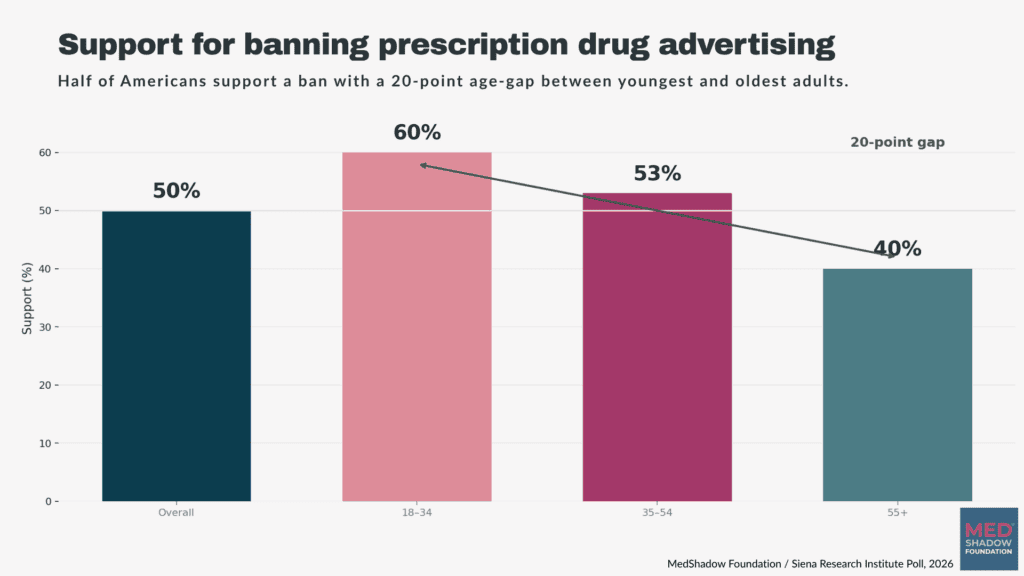
Overall, Americans are evenly divided on banning prescription drug advertising. But support varies sharply by age, from 60% among adults ages 18 to 34 to 40% among those 55 and older.
Prescription drug ads can shape how Americans think about their health and the questions they bring to healthcare providers. That influence is also fueling a growing debate over how these ads should be regulated, and, as our poll shows, Americans have strong opinions about what should change.
DISCLAIMER: MedShadow provides information and resources related to medications, their effects, and potential side effects. However, it is important to note that we are not a substitute for professional medical advice, diagnosis, or treatment. The content on our site is intended for educational and informational purposes only. Individuals dealing with medical conditions or symptoms should seek guidance from a licensed healthcare professional, such as a physician or pharmacist, who can provide personalized medical advice tailored to their specific circumstances.
While we strive to ensure the accuracy and reliability of the information presented on MedShadow, we cannot guarantee its completeness or suitability for any particular individual’s medical needs. Therefore, we strongly encourage users to consult with qualified healthcare professionals regarding any health-related concerns or decisions. By accessing and using MedShadow, you acknowledge and agree that the information provided on the site is not a substitute for professional medical advice and that you should always consult with a qualified healthcare provider for any medical concerns.
Help fund our fight for improved medication safety and transparency by supporting our independent journalism.
Give NowWe seek to create a world where there are safer medications for all and where all people are fully informed about their medication benefits and side effects, using our explanatory and investigative journalism to both inform and stimulate public discussion to drive toward solutions.
Stream our library on demand, including insights on generic drugs and pain management, straight from experts.
WATCH NOWMedShadow.org is dedicated to empowering people with our evidence-based journalism about the safest ways to take over-the-counter (OTC) and prescription (Rx) medications.
We also seek to stimulate public discussion about potential improvements to drug research, manufacturing and distribution processes. and also to encourage the improvement of processes to ensure that we are all better protected.
As a result, we encourage other nonprofit newsrooms, mission-aligned outlets, and advocacy organizations to republish our original content under the following conditions:
1. We Are Credited Fully and Clearly
You must include the byline and credit MedShadow.org as the original publisher. Please include a link to the original article at the top or bottom of the piece. Use the following attribution:
This article was originally published by MedShadow, a nonprofit foundation that focuses on the safest ways to take over-the-counter and prescription medications.
2. Our Content Isn’t Edited Without Permission
You may make small changes for clarity, such as adjusting headlines, subheadings, or transitions, but you may not change the core meaning, tone, or intent of the article. For substantive edits, email us at republish@medshadow.org for review and approval.
3. You Do Not Sell Or Use Our Content Commercially
Our work is free to share, but it may not be sold, monetized, or repurposed for commercial gain. You may not republish our articles behind a paywall or in publications whose primary purpose is advertising or product promotion. You may not place drug or supplement advertising adjacent to our story.
4. Photos, Graphics, and Multimedia Are Not Used Without Permission
Only the text of the article is available for republication. Images, graphics, and videos may not be reused without explicit written permission, unless they are clearly marked as Creative Commons licensed. Contact us if you’d like to request reuse of a visual asset.
If you’re unsure whether your intended use falls within these guidelines, or would like to discuss a formal syndication or licensing arrangement, please email: republish@medshadow.org
We want our journalism to reach as many people as possible, especially those making critical decisions about medications and health.
For website editors
Copy the article body, including its formatting and links, then paste it into your publishing system. Add the byline and required credit described in these guidelines.
<!-- wp:paragraph -->
<p>A new, nationally representative MedShadow Foundation/Siena Institute poll has uncovered a complicated relationship between Americans and drug ads: Some say these ads provide insights and promote doctor visits, but others say they stoke anxiety and prioritize benefits over risks. And almost all Americans think there are simply too many.</p>
<!-- /wp:paragraph -->
<!-- wp:paragraph -->
<p>The following eight charts highlight key findings from our national poll. For a deeper look at the results and what Americans want regulators to do about prescription drug advertising, read our full story, <a href="https://medshadow.org/uncategorized/what-americans-really-want-from-drug-ads-sienna-poll/">What Americans Really Want From Drug Ads</a>.</p>
<!-- /wp:paragraph -->
<!-- wp:heading -->
<h2 class="wp-block-heading">Benefits May Come Through More Clearly Than Risks</h2>
<!-- /wp:heading -->
<!-- wp:paragraph -->
<p>Fifty-two percent of Americans say drug ads do an excellent or very good job explaining a medication’s benefits, compared with 41% who say the same about side effects.</p>
<!-- /wp:paragraph -->
<!-- wp:image {"id":34930,"sizeSlug":"large","linkDestination":"none"} -->
<figure class="wp-block-image size-large"><img src="https://medshadow.org/wp-content/uploads/2026/09/Drug-Ads-Explain-Benefits-More-than-Side-Effects-Landscape-Size-1-1024x576.png" alt="" class="wp-image-34930"/></figure>
<!-- /wp:image -->
<!-- wp:paragraph -->
<p></p>
<!-- /wp:paragraph -->
<!-- wp:heading -->
<h2 class="wp-block-heading">Americans Have Complicated Reactions to Drug Ads</h2>
<!-- /wp:heading -->
<!-- wp:paragraph -->
<p>While some Americans credit drug ads with helping them learn about treatment options, others say the ads can cause unnecessary worry or encourage people to rely on medication instead of lifestyle changes.</p>
<!-- /wp:paragraph -->
<!-- wp:image {"id":34931,"sizeSlug":"large","linkDestination":"none"} -->
<figure class="wp-block-image size-large"><img src="https://medshadow.org/wp-content/uploads/2026/09/Americans-reactions-to-drug-ads-1024x576.png" alt="" class="wp-image-34931"/></figure>
<!-- /wp:image -->
<!-- wp:paragraph -->
<p></p>
<!-- /wp:paragraph -->
<!-- wp:heading -->
<h2 class="wp-block-heading">Ads Can Make People Question Their Health</h2>
<!-- /wp:heading -->
<!-- wp:paragraph -->
<p>More than half of Americans say a drug ad has made them worry or wonder whether they have a medical condition they hadn’t previously considered. That rises to 70% among adults ages 18 to 34.</p>
<!-- /wp:paragraph -->
<!-- wp:image {"id":34932,"sizeSlug":"large","linkDestination":"none"} -->
<figure class="wp-block-image size-large"><img src="https://medshadow.org/wp-content/uploads/2026/09/Drug-Ads-Prompt-Concerns-Landscape-1-1024x576.png" alt="" class="wp-image-34932"/></figure>
<!-- /wp:image -->
<!-- wp:paragraph -->
<p></p>
<!-- /wp:paragraph -->
<!-- wp:heading -->
<h2 class="wp-block-heading">Drug Ads Spark Mixed Emotions</h2>
<!-- /wp:heading -->
<!-- wp:paragraph -->
<p>Curiosity and feeling educated are the most commonly reported reactions to drug ads, but Americans also report feeling annoyed, anxious, confused, and frightened.</p>
<!-- /wp:paragraph -->
<!-- wp:image {"id":34933,"sizeSlug":"large","linkDestination":"none"} -->
<figure class="wp-block-image size-large"><img src="https://medshadow.org/wp-content/uploads/2026/09/Drug-Ads-Prompt-Emotions-Landscape-1024x576.png" alt="" class="wp-image-34933"/></figure>
<!-- /wp:image -->
<!-- wp:paragraph -->
<p></p>
<!-- /wp:paragraph -->
<!-- wp:heading -->
<h2 class="wp-block-heading">Drug Ads Prompt People to Take Action</h2>
<!-- /wp:heading -->
<!-- wp:paragraph -->
<p>Sixty percent of Americans say they’ve asked a healthcare professional about a drug after seeing it advertised, while 53% have asked about a side effect of a medication they were already taking.</p>
<!-- /wp:paragraph -->
<!-- wp:image {"id":34934,"sizeSlug":"large","linkDestination":"none"} -->
<figure class="wp-block-image size-large"><img src="https://medshadow.org/wp-content/uploads/2026/09/Drug-Ads-Prompt-Action-1-1024x576.png" alt="" class="wp-image-34934"/></figure>
<!-- /wp:image -->
<!-- wp:paragraph -->
<p></p>
<!-- /wp:paragraph -->
<!-- wp:heading -->
<h2 class="wp-block-heading">Younger Americans Are More Skeptical</h2>
<!-- /wp:heading -->
<!-- wp:paragraph -->
<p>Twenty-seven percent of adults ages 18 to 34 describe prescription drug advertising as harmful, compared with 18% of adults ages 35 to 54 and 19% of those 55 and older.</p>
<!-- /wp:paragraph -->
<!-- wp:image {"id":34935,"sizeSlug":"large","linkDestination":"none"} -->
<figure class="wp-block-image size-large"><img src="https://medshadow.org/wp-content/uploads/2026/09/Americans-View-Prescription-Drug-Ads-as-Helpful-vs.-Harmful-Landscape-Size-1-1024x576.png" alt="" class="wp-image-34935"/></figure>
<!-- /wp:image -->
<!-- wp:paragraph -->
<p></p>
<!-- /wp:paragraph -->
<!-- wp:heading -->
<h2 class="wp-block-heading">Most Americans Think There Are Too Many Drug Ads</h2>
<!-- /wp:heading -->
<!-- wp:paragraph -->
<p>Two-thirds of Americans say there are too many prescription drug ads, and large majorities support limits on advertising — including restrictions on ads for newly approved drugs and the number shown on television and streaming services.</p>
<!-- /wp:paragraph -->
<!-- wp:image {"id":34936,"sizeSlug":"large","linkDestination":"none"} -->
<figure class="wp-block-image size-large"><img src="https://medshadow.org/wp-content/uploads/2026/09/Too-Many-Ads-Landscape-Size-1-1024x576.png" alt="" class="wp-image-34936"/></figure>
<!-- /wp:image -->
<!-- wp:paragraph -->
<p></p>
<!-- /wp:paragraph -->
<!-- wp:heading -->
<h2 class="wp-block-heading">Younger Adults Are Also More Likely to Support a Ban</h2>
<!-- /wp:heading -->
<!-- wp:paragraph -->
<p>Overall, Americans are evenly divided on banning prescription drug advertising. But support varies sharply by age, from 60% among adults ages 18 to 34 to 40% among those 55 and older.</p>
<!-- /wp:paragraph -->
<!-- wp:image {"id":34937,"sizeSlug":"large","linkDestination":"none"} -->
<figure class="wp-block-image size-large"><img src="https://medshadow.org/wp-content/uploads/2026/09/Support-for-Banning-Prescription-Drug-Ads-Landscape-Size-1024x576.png" alt="" class="wp-image-34937"/></figure>
<!-- /wp:image -->
<!-- wp:paragraph -->
<p>Prescription drug ads can shape how Americans think about their health and the questions they bring to healthcare providers. That influence is also fueling a growing debate over how these ads should be regulated, and, as our poll shows, Americans have strong opinions about what should change.<br></p>
<!-- /wp:paragraph -->We think it’s invaluable — and hope you agree. Our work is made possible by donations from readers like you.
We think it’s invaluable — and hope you agree. Our journalism is made possible by donations from readers like you.
As a nonprofit, we don’t take a dime from pharmaceutical or supplement companies. That means we can report on the benefits, risks, and alternatives to prescription and over-the-counter drugs free from corporate pressure or influence.
No comments yet. Be the first to comment!

We've noticed that you're interested in this topic. Would you read a dedicated newsletter about it?