
AI Illustration /ChatGPT

AI Illustration /ChatGPT
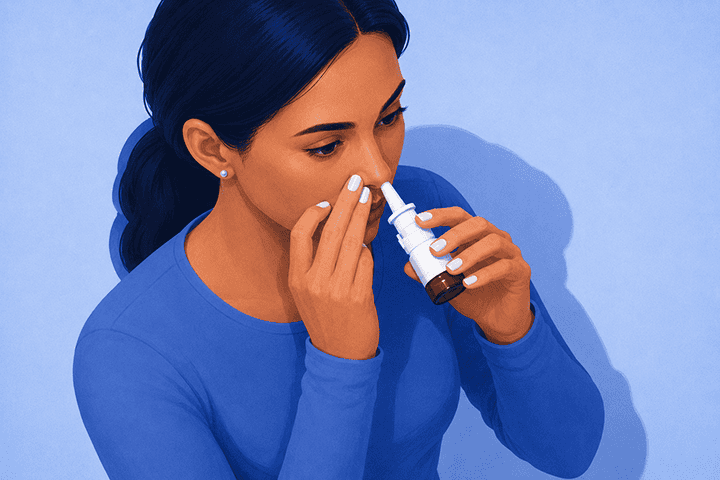
The Food and Drug Administration (FDA) approved Tyrvaya, a new nasal spray designed to treat dry eye disease, in October 2021. A major benefit of the new drug is that it won’t require patients to apply drops directly to their eyes, which is very hard for some to tolerate. Some eye drops on the market irritate eyes and can even cause a rebound effect, making symptoms worse overtime.
Some might wonder about the frequency with which patients are directed to use Tyrvaya. Rather than drops that are used as-needed, the new drug is a nasal spray for dry eyes that you squirt into your nostrils twice daily to increase tear production. Sneezing was the most common side effect, with almost everyone in the trial reporting an achoo or two.
“The data from the FDA trials appear promising, and I am hopeful that it will work even better in combination with existing dry-eye therapies for patients who are looking for greater relief,” Dagny Zhu, an ophthalmologist and cornea, cataract and refractive surgeon, at Hyperspeed LASIK | NVISION Eye Centers in Rowland Heights, Calif., told MedShadow.
However, with new treatments come the possibility for side effects that you need to be aware of.
The side effects reported in the trial were all relatively mild, and the type of reaction you would expect to experience after squirting mist up your nose. Most people (82%), sneezed, 16% coughed, 13% had throat irritation and 8% had irritated noses.
Zhu says that one benefit of the new drug is that “because it is administered nasally rather than [as] an eye drop, there is less toxicity to the surface of the eye from long-term use.” Patients who use eye drops often experience a rebound effect, where redness and itchiness actually worsens with continued use.
Independent reporting on drug recalls, medication safety and integrative health, including supplements. No pharma funding.
Yuna Rapoport, MD, MPH, an ophthalmologist at Manhattan Eye, recommends some nonpharmaceutical interventions including:
When sprayed into your nose, Tyrvaya travels through your trigeminal nerve, a large bundle of neurons that helps you chew, swallow and feel sensations on your face and scalp, to your ophthalmic nerve, where it stimulates acetylcholine receptors thought to provoke the production of tears.
Tyrvaya’s active ingredient is the same one used in Chantix, a drug taken orally that helps people quit smoking. Chantix pills are generally prescribed starting at 0.5mg of varenicline, the active ingredient in both Chantix and Tyrvaya. Chantix is known to produce such side effects as nausea, diarrhea, headache, fatigue, insomnia, pain and even hallucinations. Tyrvaya doses have smaller amounts of varenicline, 0.03mg and the two clinical trials didn’t identify the same side effects as for Chantix. However, doctors and patients should keep a close watch, because a range of side effects are commonly identified only after a drug enters the market and is prescribed to large numbers of people.
The clinical trials showed that about half of patients saw substantial improvements in their Schrimer score, a measurement commonly used to evaluate dry eye in clinical trials.
Rappaport, who says she will recommend Tyrvaya for patients whose dry eye is not controlled with eye drops or nonpharmaceutical strategies, pointed out that the drug did not lead to statistically significant improvements on a different clinical test—the controlled adverse environment (CAE) stress test. In this test, patients enter a climate-controlled chamber, where they’re exposed to conditions that can make it difficult to maintain adequate tear production, such as low humidity and tasks that require them to focus their vision, while scientists evaluate their dry eye symptoms.
Most of the patients in the FDA-reviewed trials used the nasal spray for about one month. The longest any patient in the trial was followed was for 105 days of use.
Lastly, if you’re experiencing dry eyes, it’s possible that it’s a side effect of a drug you’ve already been prescribed for another ailment. Before reaching for over-the-counter or prescription eye drops or nasal sprays to add to your regimen, you can talk to your doctor about whether you can try an alternative treatment or alter your dose to lessen the impact.
Drugs and treatments that can cause dry eyes include:
If you’ve experienced side effects or medication issues related to this topic, we want to hear from you.
Submit Your StoryDISCLAIMER: MedShadow provides information and resources related to medications, their effects, and potential side effects. However, it is important to note that we are not a substitute for professional medical advice, diagnosis, or treatment. The content on our site is intended for educational and informational purposes only. Individuals dealing with medical conditions or symptoms should seek guidance from a licensed healthcare professional, such as a physician or pharmacist, who can provide personalized medical advice tailored to their specific circumstances.
While we strive to ensure the accuracy and reliability of the information presented on MedShadow, we cannot guarantee its completeness or suitability for any particular individual’s medical needs. Therefore, we strongly encourage users to consult with qualified healthcare professionals regarding any health-related concerns or decisions. By accessing and using MedShadow, you acknowledge and agree that the information provided on the site is not a substitute for professional medical advice and that you should always consult with a qualified healthcare provider for any medical concerns.

Help fund our fight for improved medication safety and transparency by supporting our independent journalism.
Give NowWe seek to create a world where there are safer medications for all and where all people are fully informed about their medication benefits and side effects, using our explanatory and investigative journalism to both inform and stimulate public discussion to drive toward solutions.
Stream our library on demand, including insights on generic drugs and pain management, straight from experts.
WATCH NOWMedShadow.org is dedicated to empowering people with our evidence-based journalism about the safest ways to take over-the-counter (OTC) and prescription (Rx) medications.
We also seek to stimulate public discussion about potential improvements to drug research, manufacturing and distribution processes. and also to encourage the improvement of processes to ensure that we are all better protected.
As a result, we encourage other nonprofit newsrooms, mission-aligned outlets, and advocacy organizations to republish our original content under the following conditions:
1. We Are Credited Fully and Clearly
You must include the byline and credit MedShadow.org as the original publisher. Please include a link to the original article at the top or bottom of the piece. Use the following attribution:
This article was originally published by MedShadow, a nonprofit foundation that focuses on the safest ways to take over-the-counter and prescription medications.
2. Our Content Isn’t Edited Without Permission
You may make small changes for clarity, such as adjusting headlines, subheadings, or transitions, but you may not change the core meaning, tone, or intent of the article. For substantive edits, email us at republish@medshadow.org for review and approval.
3. You Do Not Sell Or Use Our Content Commercially
Our work is free to share, but it may not be sold, monetized, or repurposed for commercial gain. You may not republish our articles behind a paywall or in publications whose primary purpose is advertising or product promotion. You may not place drug or supplement advertising adjacent to our story.
4. Photos, Graphics, and Multimedia Are Not Used Without Permission
Only the text of the article is available for republication. Images, graphics, and videos may not be reused without explicit written permission, unless they are clearly marked as Creative Commons licensed. Contact us if you’d like to request reuse of a visual asset.
If you’re unsure whether your intended use falls within these guidelines, or would like to discuss a formal syndication or licensing arrangement, please email: republish@medshadow.org
We want our journalism to reach as many people as possible, especially those making critical decisions about medications and health.
For website editors
Copy the article body, including its formatting and links, then paste it into your publishing system. Add the byline and required credit described in these guidelines.
<!-- wp:heading --> <h2 class="wp-block-heading">Tyrvaya: A Nasal Spray for Dry Eyes</h2> <!-- /wp:heading --> <!-- wp:paragraph --> <p>The Food and Drug Administration (FDA) approved Tyrvaya, a new nasal spray designed to treat dry eye disease, in October 2021. A major benefit of the new drug is that it won’t require patients to apply drops directly to their eyes, which is very hard for some to tolerate. Some eye drops on the market irritate eyes and can even cause a rebound effect, making symptoms worse overtime.</p> <!-- /wp:paragraph --> <!-- wp:paragraph --> <p>Some might wonder about the frequency with which patients are directed to use Tyrvaya. Rather than drops that are used as-needed, the new drug is a nasal spray for dry eyes that you squirt into your nostrils twice daily to increase tear production. Sneezing was the most common side effect, with almost everyone in the trial reporting an achoo or two.</p> <!-- /wp:paragraph --> <!-- wp:paragraph --> <p>“The data from the FDA trials appear promising, and I am hopeful that it will work even better in combination with existing dry-eye therapies for patients who are looking for greater relief,”<a href="https://dzeyemd.com/" target="_blank" rel="noreferrer noopener"> Dagny Zhu,</a> an ophthalmologist and cornea, cataract and refractive surgeon, at Hyperspeed LASIK | NVISION Eye Centers in Rowland Heights, Calif., told <em>MedShadow</em>.</p> <!-- /wp:paragraph --> <!-- wp:paragraph --> <p>However, with new treatments come the possibility for side effects that you need to be aware of.</p> <!-- /wp:paragraph --> <!-- wp:heading --> <h2 class="wp-block-heading"><strong>Tyrvaya’s Side Effects</strong></h2> <!-- /wp:heading --> <!-- wp:paragraph --> <p>The side effects reported in the trial were all relatively mild, and the type of reaction you would expect to experience after squirting mist up your nose. Most people (82%), sneezed, 16% coughed, 13% had throat irritation and 8% had irritated noses.</p> <!-- /wp:paragraph --> <!-- wp:paragraph --> <p>Zhu says that one benefit of the new drug is that “because it is administered nasally rather than [as] an eye drop, there is less toxicity to the surface of the eye from long-term use.” Patients who use eye drops often experience a<a href="https://medshadow.org/side-effects-of-eye-drops/" target="_blank" rel="noreferrer noopener"> rebound effect</a>, where redness and itchiness actually worsens with continued use.</p> <!-- /wp:paragraph --> <!-- wp:heading --> <h2 class="wp-block-heading"><strong>Nonpharmaceutical Dry Eye Treatments </strong></h2> <!-- /wp:heading --> <!-- wp:paragraph --> <p><a href="https://www.manhattaneyenyc.com/lasik/laser-corrective-surgery/" target="_blank" rel="noreferrer noopener">Yuna Rapoport</a>, MD, MPH, an ophthalmologist at Manhattan Eye, recommends some nonpharmaceutical interventions including:</p> <!-- /wp:paragraph --> <!-- wp:list --> <ul class="wp-block-list"><!-- wp:list-item --> <li>Using a humidifier in the rooms you occupy most often</li> <!-- /wp:list-item --> <!-- wp:list-item --> <li>Drinking plenty of water</li> <!-- /wp:list-item --> <!-- wp:list-item --> <li>Employing the 20-20-20 rule: for every 20 minutes you spend staring at a screen, spend 20 seconds looking at something at least 20 feet away</li> <!-- /wp:list-item --></ul> <!-- /wp:list --> <!-- wp:heading --> <h2 class="wp-block-heading"><strong>How—and How Well—Tyrvaya Works</strong> </h2> <!-- /wp:heading --> <!-- wp:paragraph --> <p>When sprayed into your nose, Tyrvaya travels through your<a href="https://my.clevelandclinic.org/health/body/21581-trigeminal-nerve" target="_blank" rel="noreferrer noopener"> trigeminal nerve</a>, a large bundle of neurons that helps you chew, swallow and feel sensations on your face and scalp, to your ophthalmic nerve, where it stimulates acetylcholine receptors thought to provoke the production of tears. </p> <!-- /wp:paragraph --> <!-- wp:paragraph --> <p>Tyrvaya’s active ingredient is the same one used in Chantix, a drug taken orally that helps people quit smoking. <a href="https://medshadow.org/smoking-cessation-medications/" target="_blank" rel="noreferrer noopener">Chantix pills are</a> generally prescribed starting at 0.5mg of varenicline, the active ingredient in both Chantix and Tyrvaya. Chantix is known to produce such side effects as nausea, diarrhea, headache, fatigue, insomnia, pain and even hallucinations. Tyrvaya doses have smaller amounts of varenicline, 0.03mg and the two clinical trials didn’t identify the same side effects as for Chantix. However, doctors and patients should keep a close watch, because a range of side effects are commonly identified only after a drug enters the market and is prescribed to large numbers of people.</p> <!-- /wp:paragraph --> <!-- wp:paragraph --> <p>The<a href="https://www.accessdata.fda.gov/drugsatfda_docs/label/2021/213978s000lbl.pdf" target="_blank" rel="noreferrer noopener"> clinical trials</a> showed that about half of patients saw substantial improvements in their Schrimer score, a measurement commonly used to evaluate dry eye in clinical trials. </p> <!-- /wp:paragraph --> <!-- wp:paragraph --> <p>Rappaport, who says she will recommend Tyrvaya for patients whose dry eye is not controlled with eye drops or nonpharmaceutical strategies, pointed out that the drug did not lead to statistically significant improvements on a different clinical test—the<a href="https://www.ncbi.nlm.nih.gov/pmc/articles/PMC5693827/" target="_blank" rel="noreferrer noopener"> controlled adverse environment</a> (CAE) stress test. In this test, patients enter a climate-controlled chamber, where they’re exposed to conditions that can make it difficult to maintain adequate tear production, such as low humidity and tasks that require them to focus their vision, while scientists evaluate their dry eye symptoms. </p> <!-- /wp:paragraph --> <!-- wp:paragraph --> <p>Most of the patients in the FDA-reviewed trials used the nasal spray for about one month. The longest any patient in the trial was followed was for 105 days of use. </p> <!-- /wp:paragraph --> <!-- wp:heading --> <h2 class="wp-block-heading"><strong>Dry Eyes Are Often a Side Effect of Other Drugs</strong></h2> <!-- /wp:heading --> <!-- wp:paragraph --> <p>Lastly, if you’re experiencing dry eyes, it’s possible that it’s a side effect of a drug you’ve already been prescribed for another ailment. Before reaching for over-the-counter or prescription eye drops or nasal sprays to add to your regimen, you can talk to your doctor about whether you can try an alternative treatment or alter your dose to lessen the impact.</p> <!-- /wp:paragraph --> <!-- wp:paragraph --> <p>Drugs and treatments that can cause dry eyes<a href="https://medshadow.org/5-worst-drugs-that-cause-dry-eye-disease/" target="_blank" rel="noreferrer noopener"> include</a>:</p> <!-- /wp:paragraph --> <!-- wp:list --> <ul class="wp-block-list"><!-- wp:list-item --> <li>Radiation</li> <!-- /wp:list-item --> <!-- wp:list-item --> <li>Antihistamines and decongestants</li> <!-- /wp:list-item --> <!-- wp:list-item --> <li>Antidepressants and antipsychotics</li> <!-- /wp:list-item --> <!-- wp:list-item --> <li>High blood pressure medications</li> <!-- /wp:list-item --> <!-- wp:list-item --> <li>Accutane</li> <!-- /wp:list-item --> <!-- wp:list-item --> <li>Medicines for chronic obstructive pulmonary disease (COPD)</li> <!-- /wp:list-item --> <!-- wp:list-item --> <li>Urinary incontinence treatments</li> <!-- /wp:list-item --> <!-- wp:list-item --> <li>Chemotherapy medicines</li> <!-- /wp:list-item --></ul> <!-- /wp:list -->
We think it’s invaluable — and hope you agree. Our work is made possible by donations from readers like you.
We think it’s invaluable — and hope you agree. Our journalism is made possible by donations from readers like you.
As a nonprofit, we don’t take a dime from pharmaceutical or supplement companies. That means we can report on the benefits, risks, and alternatives to prescription and over-the-counter drugs free from corporate pressure or influence.
No comments yet. Be the first to comment!

We've noticed that you're interested in this topic. Would you read a dedicated newsletter about it?